
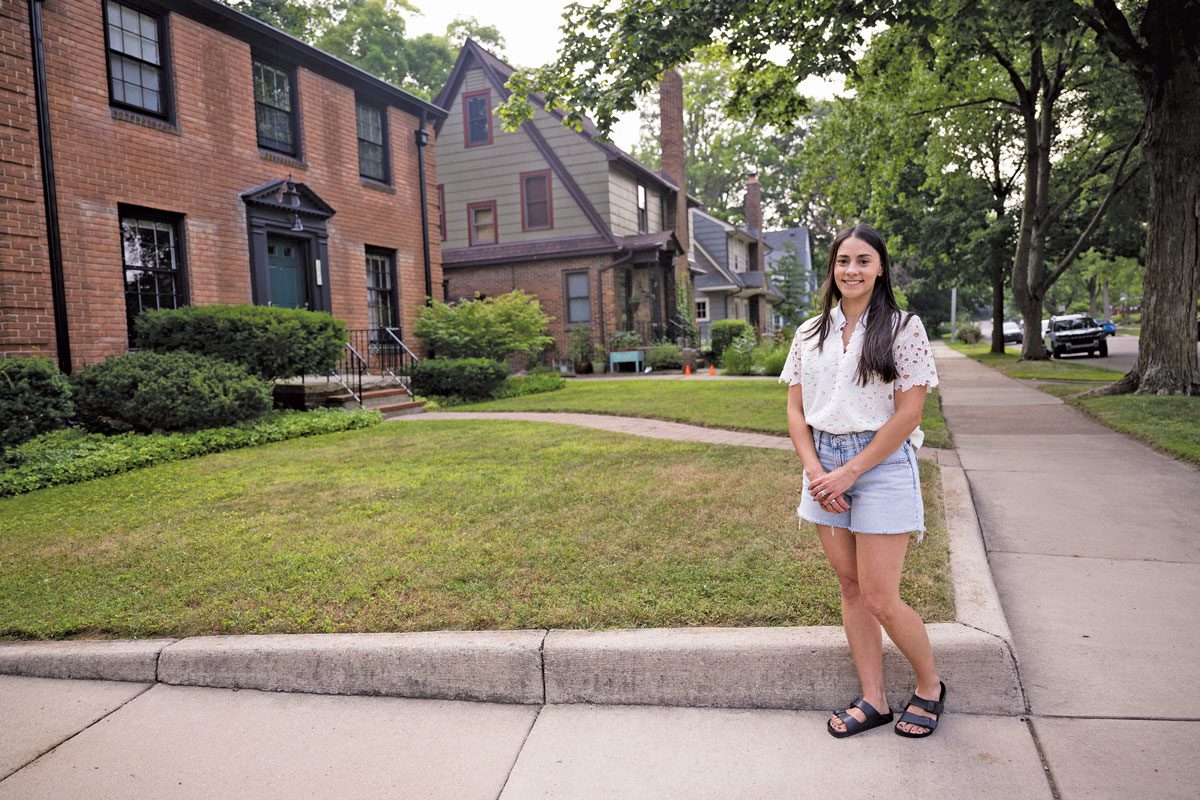
Lindsay Bryan-Podvin lives in a walkable neighborhood of mostly single-family homes. She noticed a common reaction in the Ann Arbor community: “Why are we putting luxury developments in this cute college town?” | Mark Bialek
Clara Bonomi gazes out the window of her tenth-floor apartment in The Legacy on E. Washington, where she’s lived for over a year. The rising U-M senior has a glorious view of sunsets over downtown and the green neighborhoods beyond.
That high perch also affords her a view of how the growing crop of luxury student high-rises like The Legacy are changing the landscape of Ann Arbor, from the skyline to street level.
In the past decade or so, at least eight buildings of seven stories or more have been built in the neighborhoods around Central Campus, some of them replacing whole blocks of retail and other businesses. Another five are planned or under construction. In all, the streets around Central Campus and downtown will have gained around 6,000 beds’ worth of high-density housing between 2016 and 2029.
Many of these high-rises aim to serve the market for a particular type of student housing: apartments catering to luxury tastes and budgets. “The University of Michigan has a high percentage of affluent students, from affluent families,” says Jeffrey Kahan, a past Ann Arbor city planner who is now a lecturer at U-M’s Taubman College of Architecture & Urban Planning. This, he says, is one of the factors causing developers to enter the student housing market with high-end units that offer amenities such as elegant lobbies, cozy study spaces, furnished rooms with electronic locks, on-site or in-room laundry, rooftop decks, fitness centers, and swimming pools.
Bonomi describes her experience in her Legacy apartment as a simplified way of living, with trash, internet, parking, and maintenance all streamlined within the development.
“I get to have my own bedroom and bathroom,” she says. “Our rooms are almost individualized suites, which is a very nice bonus.”
The rise of these towers marks a pronounced shift for a community where undergraduates who moved off campus traditionally lived in modest, low-slung apartment buildings, or former single-family homes shared among roommates or divided into smaller units. It’s also changing the character of streets around campus in ways that some residents and students complain is costing the city its charm. And it’s part of a broader shift toward higher-density housing that could reshape Ann Arbor communities far beyond student neighborhoods.
Related: The Meaning of the $3,100 Campus Studio (Aug. 2025)
According to the U-M Office of the Registrar, between 1964 and 2010, U-M’s enrollment was increasing at a galloping pace, with roughly 1,150 more students added every year. And yet, during that time, the university did not build a single new dorm. The drought ended with the construction of North Quad in 2010, which added 450 beds, but not nearly enough to keep up with a rise in enrollment that’s still continuing. In 2023, as U-M outlined plans to build a new 2,300-bed dorm at the southern end of Central Campus, it said it had enough university-owned housing to accommodate about a quarter of its undergraduates, down from 37 percent in 2004.
Related: New Dorms at Last (Apr. 2023)
The widening gap between supply and demand—the makings of a student housing crisis—opened up a lucrative opportunity for private developers like Landmark Properties, which has developments across the country. They got into Ann Arbor’s off-campus housing market by buying up local commercial and residential properties and, in their place, erecting high-rise, high-density apartment buildings that could command premium rents. Those long years of pent-up demand contributed to the dizzying pace of development and construction in recent years, which is why it now seems like Ann Arbor is building taller and faster than ever.
“Developers will approach businesses and say, ‘Look, I’m willing to pay you crazy amounts for this property, and are you willing to put that under contract?’” Kahan explains. Once the property owner agrees, and the developers interface with the city for final approval, the developers have the green light.
And just like that, an area once filled with small businesses and foot traffic is transformed into a blur of orange construction signs and clouds of dust, awaiting its future as the next luxury high-rise development.
This transformation is evident on South University Ave., which is preparing for the influx of even more luxury student apartments set to open for the 2027–28 school year. One is Landmark’s The Metropolitan, an eighteen-story, 950-plus-bed student housing community, featuring units “equipped with quartz countertops, in-unit washers and dryers, hardwood-style floors, and sleek stainless steel appliances,” as described on the property’s website. The Metropolitan will be the second development on South U for Landmark, which operates several others around town, with monthly rents ranging from $1,340.94 per bed for the 4X2A to $2,560.94 for a studio.
On the opposite side of South U, CRG is working on the Chapter Ann Arbor, a nineteen-story 625-bed student housing project promising an “elevated living experience.”
The two projects will join a few other high-rises that have already changed the face of South U., while displacing several older businesses on the block, such as the Blue Leprechaun bar, Starbucks, and Oasis Mediterranean Grill. They’ve either moved or closed down permanently, causing some grumbling among students.
Related: Make Way for Chapter Ann Arbor (Apr. 2025)
“When you lose these third spaces, you are changing the city’s culture and replacing it with much more of an impersonal, capitalistic feeling,” says Lucy Martin, a recent Taubman College graduate.
Martin feels the loss personally—she worked at that Starbucks before it was shut down. She and other employees were given the option to switch to another Starbucks location near campus, but there weren’t enough positions for everyone out of a job.
“I know lots of people who chose to leave Starbucks altogether because it was easier, but then had to find another job and start over,” she says.
Tess McKiernan, a recent LSA graduate has fond memories of South U as a walkable, comforting hot spot that has since become unrecognizable.
The loss of two places impacted her in particular: Pancheros Mexican Grill (“It was sneaky cheap. And it was open so late, so my friends and I loved going there after a night out.”) and the Blue Leprechaun. (“It was a bar with a different vibe from the other most popular bars. It was its own thing.”)
To be sure, some of the new buildings have ground-level retail space that can accommodate new businesses, even if they lack the college-town feel of the old ones.
But there was another aspect of the neighborhood that McKiernan misses. When she first came to U-M as a freshman, she would walk daily along the street to get to campus. She remembers the front yards and porches of the houses along East University, where students might be tanning, playing spikeball, working on their laptops, blasting music, or simply hanging out. Two years later, some of those sights, sounds, and smells—yacht rock, freshly cut grass—are gone, replaced or overwhelmed by construction noise and dust.
McKiernan’s face brightens when she talks about her off-campus living experience in a bright, quirky single-family home on Greenwood, with a large parking lot in the backyard. For the first football game of the year, she and her neighbors used the space to throw a giant tailgate that stretched down the entire street. Guests bounced from one house to another.
“Everyone was just so welcoming,” she recalls.
After a decade of fostering higher-density development downtown and in the Central Campus area, Ann Arbor is now preparing to spread more density throughout the city with its Comprehensive Land Use Plan, which the City Council passed unanimously in March.
According to the Ann Arbor City Council, the plan is an outline of strategies aiming to address the city’s most pressing priorities, including housing affordability. The rationale is that in a space-crunched city, allowing for greater density—whether it’s downtown student high-rises, or more multi-unit buildings elsewhere in town—helps create more housing supply, which can bring prices down.
A key element of the land-use plan is allowing taller buildings in certain areas of the city, up to 300 feet in zones defined as Hub areas, such as downtown, the Briarwood area, and the western edge of the city. Transition areas, such as the residential neighborhoods south of Central Campus, could see buildings of four to seven stories.
Although the council vote was unanimous, the CLUP has divided the broader community. Many longtime residents worry it will bring drastic changes, impacting the feel of their neighborhoods and Ann Arbor as a whole.
Related: Small Town / Big City (May 2025)
“People are buying up these smaller homes and then just stripping them back to the studs,” says Laura Slider, an Ann Arbor resident since 1992 living in a single-
family home, “… or they’ll tear down three old houses and build a condo with six units without additional parking.”
Although she says she trusts city government, Slider misses a time when things were a bit slower-paced.
“It’s gotten really much more of that kind of urban, fast-paced, real professional interactions,” she says. She laments the loss of some businesses close to campus, such as Borders bookstore downtown, which closed in 2011, and Jack’s Hardware, which moved farther south to make room for another student housing complex.

Jonathan Levine, a U-M professor of urban and regional planning, says upward development can increase a city’s mobility and accessibility. | Mark Bialek
But Ann Arbor’s trend toward higher-density housing has its supporters. Single-family homes have long been seen as the default option, “simply the backdrop,” says Jonathan Levine, a U-M professor of urban and regional planning, but pushing for upward development will increase a city’s mobility and accessibility.
“If we build more compact, more walkable cities and neighborhoods, this would lead people to drive less and walk more, cycle and take the bus more,” he says. “So if you can really get people to drive less, maybe there’s a justification for pro-density policies.”
Levine attended the City Planning Commission meeting on March 17, where residents had a chance to voice their thoughts and concerns about the CLUP. He recalls a citizen commenter asking council members if they were 100 percent sure the reform would achieve the anticipated benefits. “And the answer is no, of course, we’re never 100 percent sure about anything,” Levine says.
Although this uncertainty might come across as a big red warning sign to many residents, Levine says, it’s an expected part of any policy reform.
“People think unless you’re sure, unless you have scientific confidence, then the answer is, well, you shouldn’t do anything,” Levine says. But that “is not an option, because doing nothing means retaining exclusionary zoning,” which favors detached, single-family homes and excludes high-density housing and other more affordable housing.
The motto attached to the CLUP—“A2 for All”—reflects the city’s intention to transform Ann Arbor into a more sustainable, diverse, and equitable place for all to live. “Change is inevitable, right?” Levine says. “So the only question is what form that change takes.”
Related: Comprehensive Plan: What Happens Now? (Apr. 2026)
Accepting change is often the hard part. While residents may understand the need for development in a rapidly growing city like Ann Arbor, they still want to hold on to what they perceive as good about their beloved town. That’s why Lindsay Bryan-Podvin, a longtime resident, noticed a common reaction in the community: “Why are we putting luxury developments in this cute college town?”
Bryan-Podvin, a financial therapist, lives near Q Bakehouse & Market and says that has made her life more enjoyable. She would never want to give up the ability to walk down the street and grab a scone or a cup of coffee, and wants everyone to be able to enjoy walkable experiences like that. But she also accepts that access to such enriching local experiences means building more housing in varying forms.
“There’s been such an emphasis on people pointing their fingers at high-rises and saying, ‘Well, we want more housing, but not housing like that or not housing that might put a duplex or triplex in my neighborhood,’” she says.
She believes that being able to build densely and diversely is the key to unlocking a truly inclusive version of Ann Arbor.
“That’s what’s going to enable us to become the type of city we like to pretend that we are, which is inclusive and welcoming to all,” she says.
Ann Arbor is not just a “cute college town”. It is a city of neighborhoods. Many of them peaceful, pleasant, duplex and single family zoned neighborhoods. Now, a large multifamily building can be built next door anywhere in town. The peak of the roof can be 40-50 feet tall, blocking sunlight much of the year. Trees are being removed, worsening climate change and making the neighborhood less calm, less peaceful. More and more short term rentals that the city dies nothing about, even when notified about illegal STRs. Those of us opposed to these radical changes aren’t trying to save a cute college town, we are trying to save a wonderful way of life in our hometown of decades.