
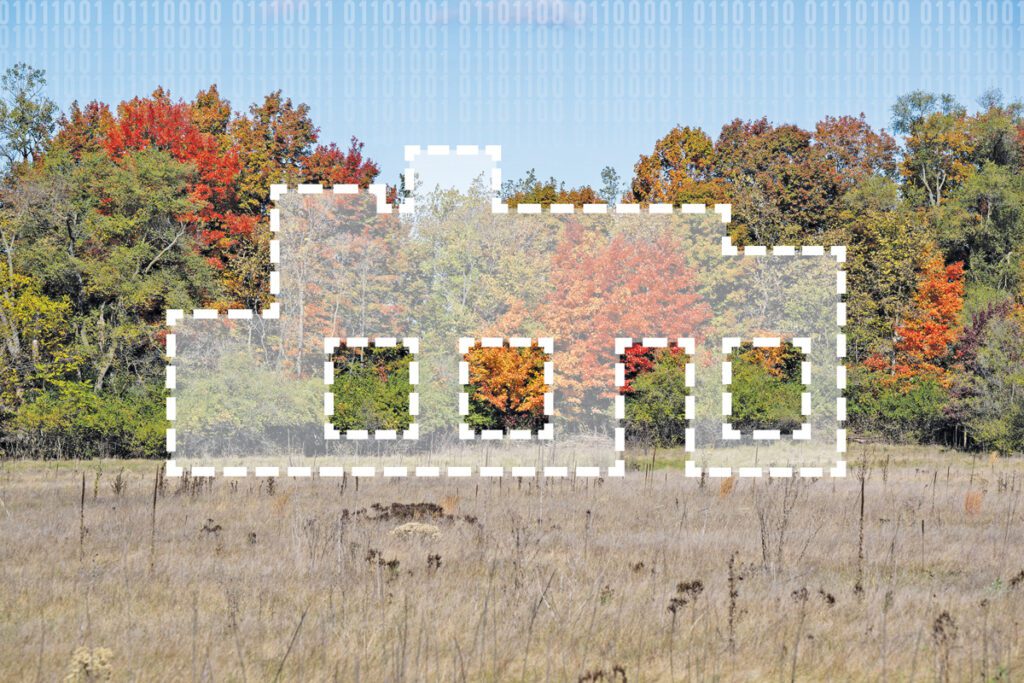
The U-M has approved the purchase of around 150 acres of land in Ypsilanti for a nearly 300,000-square-foot computing facility. | Mark Bialek
In December, U-M announced its plans to partner with the Los Alamos National Laboratory (LANL) to create a $1.25 billion “state-of-the-art” computing and AI research facility. Construction is expected to begin in 2027 and wrap up in 2031. The facility is tentatively sited on nearly 150 acres of land on Textile Rd. in Ypsilanti Twp.
Funding comes from a $100 million Strategic Site Readiness Program (SSRP) grant from the state, plus another $300 million from LANL. U-M itself will pay the remaining $850 million. The SSRP application specified that the facility would be located on twenty acres on Textile Rd., but six months later, the U-M Board of Regents approved the purchase of over 124 acres of adjacent land.
The proposed facility has sparked concern from Ypsilanti residents, township officials, and some U-M employees. Yard signs have popped up across Washtenaw County, and protestors have beaten drums and left computer parts outside of township officials’ homes. The primary opposition group, Stop the Data Center, garnered over 6,000 letters urging state officials to take action, and has led protests calling for a halt to the project, citing environmental and health impacts.
In an August resolution, the Ypsilanti Twp. board of trustees note that because U-M is exempt from township zoning ordinances and property taxes, the proposed facility “will create a financial burden to the taxpayers of the Charter Township especially as it pertains to police and fire services.” Some residents have even expressed fears that the facility might have ties to nuclear weaponry—LANL did, after all, develop the atomic bomb.
“I think that this is the fight of our lives,” says Stop the Data Center’s Sarah Stewart, a Ypsilanti resident. “I don’t want to see increased DTE rates. I don’t want my rivers and land and air to be poisoned.”
At a May 29 AI talk by U-M engineering professor Alex Gorodetsky, three protestors yelled into megaphones. As Stewart tells it, “a plainclothes security guard immediately pops out the crowd and grabs them and drags them and pushes them up against a wall.”
“Grab and drag” may be up for interpretation, but an Instagram video from Stop the Data Center shows a guard making physical contact. The caption claims the protestors were “forcibly pushed against the wall until DPSS arrived, detained, and banned … from campus for a year.”
Related: More Arrests at Protests Against the University’s Plans to Build a $1.2 Billion Data Center
The U-M declined to arrange interviews, instead pointing to a Public Affairs webpage that catalogues the project’s potential benefits, including cutting-edge research on projects like medicine, energy, climate science, and national security. The U-M has also dedicated a page to answering frequently asked questions about the project. It emphasizes that the facility will bring “hundreds of jobs” to Washtenaw County and states that it is “committed to ensuring that the new facility is developed in a way that protects the environment.”
“We have a little jar in my office. If someone calls what we’re doing a data center, they have to put a quarter in,” quipped Steve Ceccio, U-M special advisor for strategic initiatives, in a speech at a September Ann Arbor/Ypsilanti Regional Chamber event. “It’s not just the verbiage … these are two different things. Now, they are big computers doing a lot of big computation, but they’re not the same purpose.”
According to the PowerPoint slide behind him, computing facilities process complex tasks and simulations for scientific research, whereas data centers store and distribute data for purposes like social media and online gaming.
The proposed facility will have two components: a 50,000-square-foot U-M facility for academic research, and a 220,000- to 250,000-square-foot LANL facility for “classified federal research.” U-M estimates it will create 300 construction jobs and thirty to fifty support positions. But according to research from the U-M Ford School, construction jobs are short-lived, and support jobs “are typically low-wage, term-limited, nontechnical positions such as security, maintenance, and janitorial work.”
The facility will, however, create at least 200 research jobs paying around $200,000 per year, plus benefits. In his speech, Ceccio explained that LANL “are now hiring people to live in Ann Arbor to collaborate with our researchers. … Already twenty people that have moved—not moved, they’ve come here to Ann Arbor. … We’re not taking people from New Mexico, we are growing a new workforce.”
Ceccio was asked to elaborate: “They’re not necessarily relocating,” he said. “They’re actually bringing in new jobs.”
A search of LANL’s Jobs site for the keyword “Ann Arbor” returns one result, for an AI integration engineer with a group that “builds AI tools for weapons physics to support the laboratory’s mission of maintaining and modernizing the U.S. nuclear stockpile while exploring future deterrent options. These AI tools accelerate weapons design, engineering, production, certification, and assessment processes. … We are seeking talented software engineers and scientists to join our teams located in Los Alamos, New Mexico and Ann Arbor, Michigan.”
Ceccio also said that proximity to the computing facility wasn’t necessary in order to use it. “The real impact is gonna be this research ecosystem that we hope to create and are creating as part of this collaboration.”
According to the SSRP grant application, U-M anticipates that the facility will “provide a significant attraction opportunity for out-of-state companies that are interested in partnering with LANL or the University,” bringing new jobs and generating additional business and tax revenue. Pat Steffes, a software programmer in the U-M School of Information and Ypsilanti resident, isn’t convinced.
“There’s a huge battle over data centers across the country … it seems nobody really wants these things,” Steffes says. “And the local benefits that [U-M] has claimed, I don’t agree with at all. I don’t think that they’ve been able to back it up.”
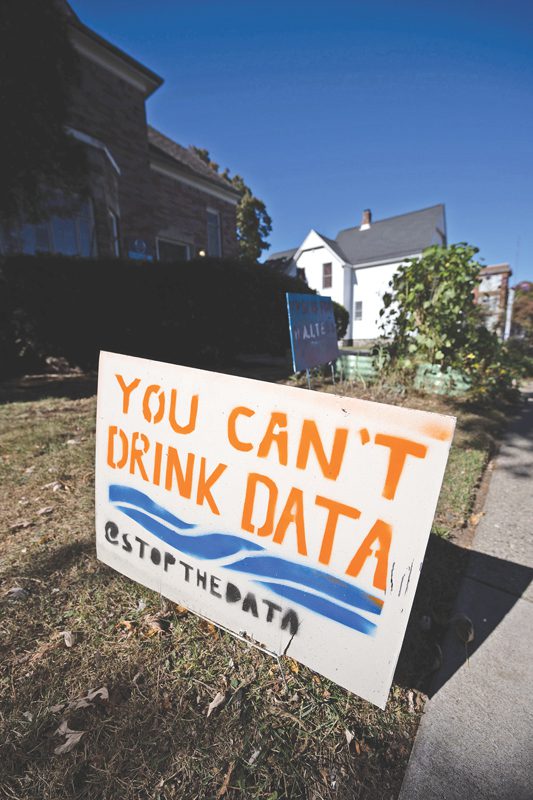
Signs protesting the facility have popped up across Washtenaw County. | Mark Bialek
Tiffany Green lives near the proposed Textile Rd. site. She feels U-M has deliberately avoided explaining why they chose to build in Ypsilanti Twp.
“If [the facility] is going to be so great and fantastic for everyone, why is it not being put in Ann Arbor?” Green says. “There’s plenty of space. The University has made money hand over fist. You can afford the Ann Arbor rent, so why Ypsi? Why that location?”
The U-M FAQ site says the Ypsilanti site is zoned for light industrial and commercial use; it has wide roads, utility infrastructure, and minimal residential density. The plan is to situate the buildings closer to Textile Rd. and further from South and North Hydro Parks “to preserve the site’s natural features.” Potential impacts to regulated wetlands on the property will be subject to review by the Michigan Department of Environment, Great Lakes, and Energy. The U-M also says it will “preserve existing vegetation where it is possible.” And Ceccio explained that the facility would be cooled with water in a closed-loop system, which is 10 to 15 percent more efficient than air cooling.
“I feel like [the center] would not necessarily work well with the current ecosystem,” says Green. “I know they say they’re going to run water from wherever they’re getting it from, but I’m a little suspicious.”
The university plans to contract with the Ypsilanti Community Utility Authority for water and sewer service. In an interview with WEMU, its executive director, Luke Blackburn, estimated that the facility will use about 200,000 gallons of water per day. He added that it would take eight to ten million gallons per day to strain the system.
The SSRP application puts the combined electrical demand of the two facilities at 110MW—by some estimates, one to four times the amount of electricity used by Ypsilanti Twp.’s 23,458 households. To accommodate these energy needs, a substation will be constructed near the site, “with two-thirds of the substation’s capacity supporting the Project and the remaining one-third capacity for community benefit.”
The U-M further says it will minimize the environmental impact of the facility with energy-efficient design and Energy Star equipment. The roof will allow for the installation of solar panels, and if the power goes out, “only 20 percent of the facility’s power will be supplied by back-up generators.”
“We have a very aggressive carbon neutrality plan. This project will not take us off that plan,” said VP of government relations Chris Kolb at the Chamber event. “And so we are pursuing the ability to provide clean energy to power, at least our portion of this.” The U-M portion, however, is just one-tenth of the entire project.
Related: Powering GenAI
At a Sept. 30 U-M lecture on sustainability, former U.S. Energy Secretary (and Michigan governor) Jennifer Granholm suggested that data centers could even serve as allies in the transition to clean energy.
“If these huge data centers allow the local utility to use that data center to turn on the dimmer switch when they need more power, then the data center actually becomes a grid asset,” she said.
Granholm added that clean energy sources like wind and solar are now the cheapest and fastest options for powering large facilities. But last year, renewable resources produced less than 13 percent of DTE Energy’s power in Michigan.
Ann Arbor resident Fred Zimmerman works in the AI field. He believes the proposed computing facility aligns with the future of technology and research and that the concerns surrounding energy and water use are overstated.
“People have to realize that data centers are going to be built no matter what the public thinks, because there have been hundreds of billions, maybe trillions, of dollars invested in the enterprises that are building these data centers,” he says. “People generate a lot of numbers about the impact of these data centers, and on water and energy in particular, but they’re not as enormous in proportion as people like to make them out.”
For example, the International Energy Agency stated in late 2024 that data centers accounted for just under 2 percent of global electricity consumption in 2022, which Zimmerman argues is significant, but has to be compared against other sectors: “For example, what is the cost/benefit relative to internal combustion engines or concrete buildings?”
On the other hand, the IEA also states that: “globally, data centre electricity consumption has grown by around 12 percent per year since 2017, more than four times faster than the rate of total electricity consumption.”
“I feel sympathy for people who are not thrilled about having a big industrial facility come near where they live,” Zimmerman says. “But I just feel like this is kind of the direction things are going.”
Green, who lives near the proposed site, feels differently. “Not in your backyard?” she asks. “Well, also not in my backyard.”
Ypsilanti Twp. officials have urged U-M to re-evaluate the site, proposing instead the American Center for Mobility at the Willow Run manufacturing complex, which already has substantial infrastructure. A Sept. 9 University Record article notes that U-M is investigating both locations.
The township is preparing for a legal battle. When Saline’s township board denied the rezoning of farmland for a data center, the developer and the property owners sued the township. “We are working to have our Planning Commission review zoning where data centers can be located,” writes Ypsilanti Twp. Trustee Karen Lovejoy Roe in an email. “We also authorized our attorney to begin preparing for litigation if the University of Michigan will not move the data center from the fragile lands surrounding the Huron River. We authorized hiring an environmental attorney to help in our fight to protect our community.”
Stop the Data Center, meanwhile, continues to mobilize grassroots opposition.
“People feel really disempowered when going up against the university, because they are this behemoth with so much money, so much power, so many connections,” says Stewart. “But $64 billion in data centers have been stopped by local resistance the last few years. I think that we can add $1.2 billion to that.”
don’t call it a data center, sure got it. it’s actually worse than a data center so, okay – still against the development of the “biggest, baddest” supercomputer that will undoubtedly be sucking resources from our local ecosystems to support the creators of the atom bomb…!