
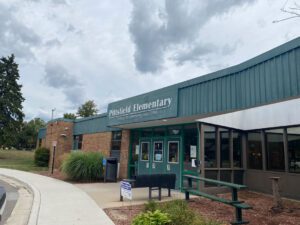
Pittsfield Elementary is among several candidates for potential closure, AAPS insiders told the Observer. Pathways, the district’s alternative high school, is also in the conversation. | Vi DePasquale
Throughout the debate over Ann Arbor Public Schools’ money troubles, there have been rumors about the prospect of shutting down schools. But this summer, board members began treating it as a foregone conclusion.
The real questions seem to be: How many? And which ones?
“This has been something that we knew we’d have to do eventually,” says trustee Susan Baskett. “It’s just finding the right time. We’re up against the wall here.”
Board president Torchio Feaster says this action should have been taken when student enrollment started to decline. But for the 2027–28 school year, he says, “My thought would be that we should close at least two.” He adds that if the teachers’ union wins “larger raises than the norm” in their ongoing contract negotiations, that number could rise to four or six.
Related: “Learning in Limbo” (Jan. 2026) & “Water from a Stone” (Feb. 2026)
A detailed proposal for “right-sizing” the district was anticipated at the August 26 school board meeting, but it was unclear at press time whether specific school-closure candidates would be named. District insiders, however, gave the Observer some schools under consideration: Pittsfield, Abbot, Carpenter, Lakewood, and Haisley elementaries, Forsythe Middle, and the alternative high school Pathways to Success.
“Most people in the neighborhood are likely to be opposed, but I think that would be true of any school,” says Alex Lowe, president of the Pitts Greater Neighborhood Association.
A district publicist wrote in response to an inquiry: “As shared in presenting the budget this spring, to ensure the Ann Arbor Public Schools remains financially stable action is needed on land and building sales; cost control and effective vendor contracts; right sizing staffing; and school and programming consolidation. AAPS staff is reviewing options and considerations in all four areas and will present recommendations to the Board of Education when this work is completed.”
Related: “Over the Cliff” (Apr. 2024)
Whatever happens, it seems likely the course will be set in the next few months, led by Baskett, Feaster, and Susan Schmidt—three board veterans not seeking reelection whose terms expire at the end of 2026. Their departures mean that, should Rima Mohammad win reelection this fall, she’ll be the only trustee not in her first term come 2027, and that a majority of the seven-person board can make decisions this fall without the pressure of facing voters.
It will take time for newer board members to get up to speed on the financial issues, Schmidt says. “We have lived the financial issues, and so it only makes sense that we’re part of the solutions.”
While there’s plenty of debate over who is responsible for AAPS’s financial issues, the mechanics of the problem are indisputable: falling enrollment and rising expenses, following a decade-long hiring binge. Enrollment has declined every year since 2018, dragging state funding down along with it.
In April, district CFO Anté Britten told the board that at the current pace, expenses would exceed revenue by $7.6 million in the 2030–31 school year, leaving the fund balance $5 million in the red.
Opponents of school closures have seized on a line in Britten’s report indicating that consolidating schools would save as much as $5 million. It’s not clear whether this would be annual savings or if that figure was per closed school, but education activists like Lena Kauffman believe it suggests the savings wouldn’t be worth the pain.
“I was surprised by the moderate savings—and then whatever savings you get from that you’re likely going to lose” because of further declines in enrollment, says Kauffman, who ran unsuccessfully for the AAPS board in 2022.
AAPS did not make Britten available for this article.
If AAPS moves ahead with closures, it wouldn’t be the first time. In a massive 1985 reorganization, six schools were closed, including Lakewood. The building was mostly unused and reopened as an elementary school in 2001 for fast-growing Scio Twp. But that revival could be short-lived; in March, AAPS postponed the 2026 groundbreaking of a replacement school, citing rising building costs and the need to ask voters to renew the sinking fund millage. (That renewal passed in the August election.)
“There are two schools of thought about what to do about Lakewood,” an administrator tells the Observer on condition of anonymity. “They could not build it and close the school. Or they could build it and use the new, bigger school to move students from Haisley or Abbot if those schools are closed. But that would take years and we don’t have years.”
That type of maneuver is a key reason Pittsfield Elementary is such an obvious target—the students could be moved to the new, larger Mitchell Elementary a mile away that opens in fall 2027. “We all wondered why they’re building a new Mitchell with the capacity for 600 students when the student population is half that,” says one Mitchell teacher. “It only makes sense if they’re closing Pittsfield—and maybe Carpenter, too.”
Pathways, the alternative high school, is also in the conversation. Moving its programs to the conventional high schools would allow the sale of the Stone School Rd. building that hosted just sixty-one students in spring 2026.
“If Pathways was delivering amazing results in terms of attendance and education outcomes, the community would be like, ‘Yay, that’s awesome, all the money that we spend on it is definitely worth it,’” says Kauffman. “But Pathways has historically not had very good numbers for attendance, for graduation rates, for general education outcomes.”
Baskett acknowledges this possibility but adds: “We are very empathetic, sympathetic regarding the Pathways community. We understand that some of those children have left or never went to the comprehensive schools, so we want to be very mindful if we move the program.”
In early August, A2STEAM teacher Nathan Smead joined members of the Ann Arbor Education Association picketing outside the administration building on Earhart. Until the Observer told him Feaster had linked the number of school closures to the outcome of contract negotiations, it hadn’t occurred to Smead that the two questions were quite so related.
“Oh, so this is another thing they’re going to pin on us,” he groused to another teacher.
Baskett insists that’s not so. “But the reality is, when you look at the budget, it’s 85 percent humans,” she says. “We want to pay our teachers fairly, so we’re trying to put this all together, but you can’t give money you don’t have.”
Smead questions how effective school closures would be, noting that past decisions to do so have “created a lot of disruption in communities.” They also provided opportunities for private or charter schools to buy the buildings and siphon off more AAPS students; the 1985 closures included sales of schools that became the Jewish Community Center’s Hebrew Day School and the Rudolf Steiner School.
Smead offers one alternative idea to raise money: selling the administration building. Purchased for $17 million in 2022, it has long been a target of critics wondering why it’s so out of the way. “If you’re a person who relies on public transit and you want to come and talk to the administration of our district, you can’t get here,” he says. “The fact that no students ever set foot in this building or participate in this building is hugely problematic for me.”
Schmidt frames the challenge this way: “I’ve sat down with a number of community members with our spreadsheets, and they’ll look at me and go, ‘Well, yeah, we’re going to have to close some buildings.’ And I say, ‘And you’re okay with that until I tell you it’s yours.’ That’s where the problem is: we all can see what we need to do.”
Calls & Letters, October 2026: Lakewood School Lived On
“Day of Reckoning Nears for AAPS” states that Lakewood school was closed in 1985 and was largely unused until 2001. That may have meant that it was not a regular Ann Arbor school, but it was a very active and important place. It served as a Day Treatment for emotionally impaired elementary and middle school students from across the county.
I joined the staff as a social worker in 1987 and we were, in fact, working very hard over there. Each classroom had a teacher, a paraprofessional, and a social worker. I ended up marrying the teacher I worked with. Working in a classroom like that gives you a good idea what a person is made of.
Judy Brown
“While there’s plenty of debate over who is responsible for AAPS’s financial issues…”
No, there’s zero debate. Two years ago, during the last financial crisis, Plante Moran conducted an analysis of variance in the 2023-2024 budget and determined: “The obvious red flags should have been identified by management and the Board for which responsibility for the current situation is shared.” An independent auditor determined that the responsibility rests squarely on the Board’s and Administration’s shoulders. The only debate is the Board veterans and Administration trying to deny what was literally their jobs in an effort to avoid accountability to the AAPS community they serve.
“If Pathways was delivering amazing results in terms of attendance and education outcomes, the community would be like, ‘Yay, that’s awesome, all the money that we spend on it is definitely worth it,’” says Kauffman. “But Pathways has historically not had very good numbers for attendance, for graduation rates, for general education outcomes.”
And who is at fault for that? Certainly not the students.
The idea that AAPS should get rid of a program that serves some of the most vulnerable students in the district, instead of fixing it, is reprehensible.
Pathways, special education, and similar programs should not be negatively impacted by poor accounting.
The potential closures would disproportionately affect title 1 schools. 3 of the 6 —half—of the proposed closures, and 2 of the 3 target title 1 schools. This creates an equity problem in the district.