
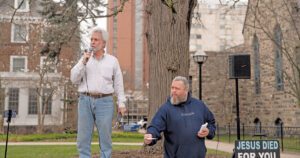
U-M allows preaching on the Diag and other public areas of campus— within limits. Some students see preachers’ presence as a nuisance. | Lillie Eastman. Courtesy of the Michigan Daily
It’s a warm, sunny day on the University of Michigan campus—the kind of day that draws hundreds of students to the Diag in search of sunshine, a study break, or a picnic. Others scurry to class, heads down. Amid the chaos, standing on the steps of Hatcher Graduate Library, a preacher is shouting.
“You mock God now, but one day every knee will bow!” cries the preacher, his voice ringing against nearby buildings. “The wages of sin is death, but the gift of God is eternal life through Jesus Christ!”
U-M student Emily Karamihas reads on a bench to the side of the Diag. Like many students, she values free speech on the Diag but is still irritated by the shouting.
“Because it’s a preacher, it’s extra annoying, because it’s like ‘you came here with the intention to disrupt other people,’” Karamihas says. “Especially with the anti-abortion and anti-gay preachers, I don’t want to think about the state of this country if I’m sitting outside on a beautiful sixty-degree day.”
Paul Young, a twenty-six-year-old recent U-M graduate often found preaching on the Diag, disagrees.
“Open inquiry and debate is the lifeblood of this university,” Young says. “I think the Diag is a really good spot for that. It’s my favorite spot to preach, and I think some students are open to that, but most of the time it’s probably ignorance, or you have to get to class, or you have to do finals or whatever.”
Street preachers have sparked controversy at U-M—and on college campuses nationwide—for decades. In the 80s and 90s, preacher Mike Caulk drew crowds of supporters and protesters with controversial Diag sermons. Years later, in 2003, the Michigan Daily reported on divided student reactions to preacher Dave Sackett, who delivered a sermon during a silent demonstration in support of closeted LGBTQ+ individuals. Today, most people walk past in silence. Others flip off the preacher or shout back.
“It feels more like reaching arms than open arms—like it’s invading my space, my mind, my life,” says recent U-M grad Dylan Ingui, who watched public preaching on campus for years. Once, they were yelled at by a preacher for being gay.
“If you’re trying to spread your religion, attacking someone’s character probably isn’t the right way to go about it,” Ingui says. “So I did stop. I made sure to look at them, and as they were speaking, I walked away because they didn’t provide me with respect.”
Despite mixed reactions, public preachers continue to return, safeguarded by the First Amendment’s protection of free speech.
As specified in the U-M Standard Practice Guide 601.01, public preachers are protected as long as they use public campus spaces, are not using amplification, do not set up permanent structures, and are not harassing individuals—a provision Ingui would likely say the preacher he interacted with violated—or causing undue disruption.
“The minute we start picking and choosing who can speak based on whether they’re left-wing or right-wing, religious or not, that’s when we run into First Amendment problems,” says Don Herzog, a U-M law professor and First Amendment specialist.
Over time, their presence becomes easy to dismiss—just another part of the Diag’s background noise. But the longer you watch, the harder it is to ignore the commitment it requires to stand there, speaking to a crowd that largely isn’t listening. Who chooses to do that, and why?
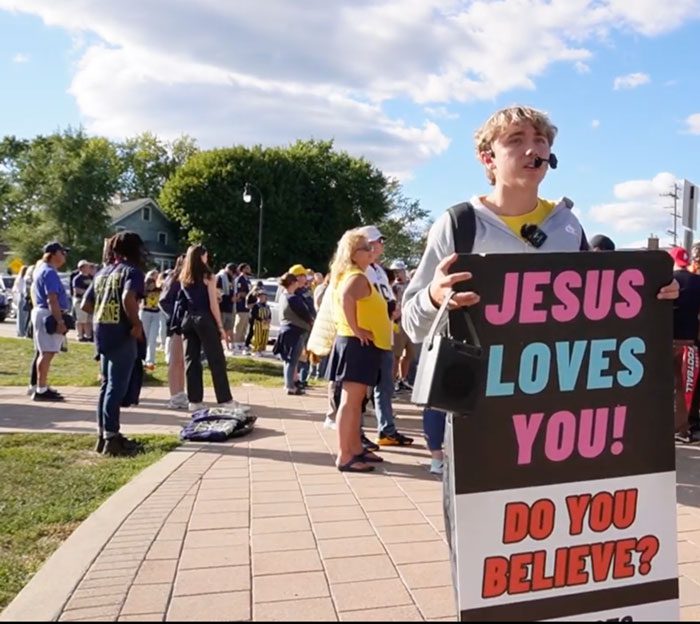
Corey Sparks preaches at the Big House. | YouTube
In late 2024, Corey Sparks, a nineteen-year-old from outside of Toledo, began experiencing episodes of sleep paralysis. “Satan would attack in my dreams,” he says. During one of these episodes, he says he heard the voice of Jesus urging him to abandon his vices and dedicate himself to spreading the Gospel.
Today, as usual, he makes the forty-minute journey to U-M, arriving late in the morning and setting up his camera in front of the School of Kinesiology, facing Mason Hall. He usually wears a sign reading “Prove Jesus is not God, win $1000” over his shoulders and documents the debates it prompts on Instagram and YouTube under the handle Christ Defend.
Several times over the course of the day, he compliments the shoes or bikes of passersby, speaking with a calm, gentle demeanor. He doesn’t personally know any of the other preachers that frequent campus, and doesn’t like what he calls “boombox” preachers who spread an intense message of fiery retribution.
“The boomboxes are just annoying,” Sparks says. “And it’s a hateful message. If I were not Christian and someone was like ‘you’re going to Hell,’ I would be mad. If you are not Christian, all you need to know is that Jesus loves you.”
He says he only speaks to people who are interested in talking with him, and he tries to make genuine connections rather than start arguments.
Sparks never went to college, saying he “didn’t have the grades” in high school, but has been a lifelong U-M football fan—driving his decision to preach on the campus.
As Sparks packs up his camera at the end of the day, he sighs and shakes his head. He says preaching can be demoralizing when he feels like students on campus see him as “some weirdo who is just standing out here, wasting my time.”
“They don’t like my message at all,” Sparks says. “About every single person has that look on their face. I’ve had multiple people come to me and say, ‘What are you doing, man?’ They are just mad at me today. It just is what it is—I mean, they hate Jesus.”
Paul Rowe, a forty-nine-year-old street preacher from Tecumseh, wears a well-worn flannel shirt and rests a large, annotated and dog-eared Bible on the table in front of him. He flips through it compulsively during conversation, sometimes taking several minutes to find the exact passage he has in mind.
“Universities are a big deal to me because it’s a time when people are forming their worldviews,” Rowe says, thumbing through the Old Testament. “It’s important that they hear the other side—not just what the world teaches, but what the Bible said. Because I believe Jesus is the truth, and truth isn’t subjective.”
Around eight years ago, after being involved with his local parish, Rowe began to feel a tug toward street preaching. His first time was at U-M.
“I was so nervous that I stood there for a while and couldn’t really speak,” Rowe says. “Then I heard an ambulance, and that helped me. I just said to myself, ‘That could be you in the ambulance,’ and somehow, that got me talking.”
The university is home to what he calls “the religion of science”—what he views as a carefully crafted narrative about evolution used to distance people from biblical truth. In his view, Christianity should be central to university life and national identity.
One week, he might take a softer approach (“always be kind, you don’t know anybody’s story,” he says), while the next, he may preach fire and brimstone.
“There are some people that are just really hard-headed and stubborn,” Rowe says. “They need a slap in the face, right? They need that, that, ‘Hey, wake up, or you’re gonna get thrown into the lake of fire for your second death.’”
Rowe is working toward a commercial flight license at Eastern Michigan University and makes money as a Lyft driver, but says street preaching is the most fulfilling part of his life.
“If I get kind of lazy and I don’t preach for a week or two, I’ll start to feel like this tug, like, ‘Hey, you gotta get up and go preach,’” Rowe says with a smile.
Rowe is known on campus for preaching with amplification near the intersection of State and North University. He sets up there on a sunny Friday, strapping a camera across his midsection and recording his interactions for his YouTube channel.
He says he often has just one positive interaction during each shift (most people ignore him or worse) which gives him the strength to continue.
“I always pray for everybody after my shift. And so I know that that prayer will help them, even though they weren’t ready that day to hear the message. … And again, I’m just one small part. Maybe I planted the seed. Maybe I watered the seed. A lot of times we don’t see the harvest.”
On a sunny Saturday, George Calvis—a sixty-eight-year-old from Dearborn wearing a collared shirt, jeans, and dad sneakers—stands in front of the First Congregational Church of Ann Arbor, across from U-M campus. The church’s Pride flag–adorned doors stand behind him. A friend preaches while Calvis quietly hands out flyers. Calvis says progressive churches like this one—what he calls “fake religion”—are exactly what he’s protesting.
While Calvis was raised religious, his journey to evangelism began in college, when he says he became a “heathen” who “served the devil” through drugs, alcohol, and promiscuity. One day when he was twenty-two, he lost his keys and flew into a rage, tearing his house apart until he found them.
“My mother was so scared,” says Calvis. “I remember her face, and she just said, ‘Are you okay?’ I just didn’t even answer. I just drove away.”
His mother’s fear stuck with him, and he began to feel guilty about the way he was living. Nine months later, he dedicated his life to God.
Today, Calvis is a grandfather of three and retired from a career in research and digital design at Ford Motor Company, where he worked on microchips and controller systems. He holds a bachelor’s degree in computer science and a master’s in theology. Five years ago, he began street preaching.
“If I didn’t care about people’s souls, I wouldn’t be out here,” Calvis says. “I’d be home playing with my grandchildren. But this morning, I told my grandchildren, ‘Grandpa’s got to go save people’s souls.’”
Calvis’s style of preaching, in comparison to Rowe and Sparks’s, is intense.
“Preaching is not about being liked — it’s about truth,” Calvis says. “And the truth is, people are going to Hell, and I believe that with all my heart.”
Though their methods vary—from Sparks’s conversational approach to Calvis’s blunt denunciations—the underlying logic remains consistent: the message matters more than how it is received. On a campus where students are encouraged to question everything, these preachers arrive with answers they see as non-negotiable.
Karamihas, who was raised Greek Orthodox, says she can understand the impulse.
“If you earnestly believe, like, ‘Oh my God, all of these people on this campus are going to burn for eternity if I don’t help them’—if I earnestly believed that from the bottom of my heart, I would also be out there preaching.”