
Courtesy of Solo Aviation
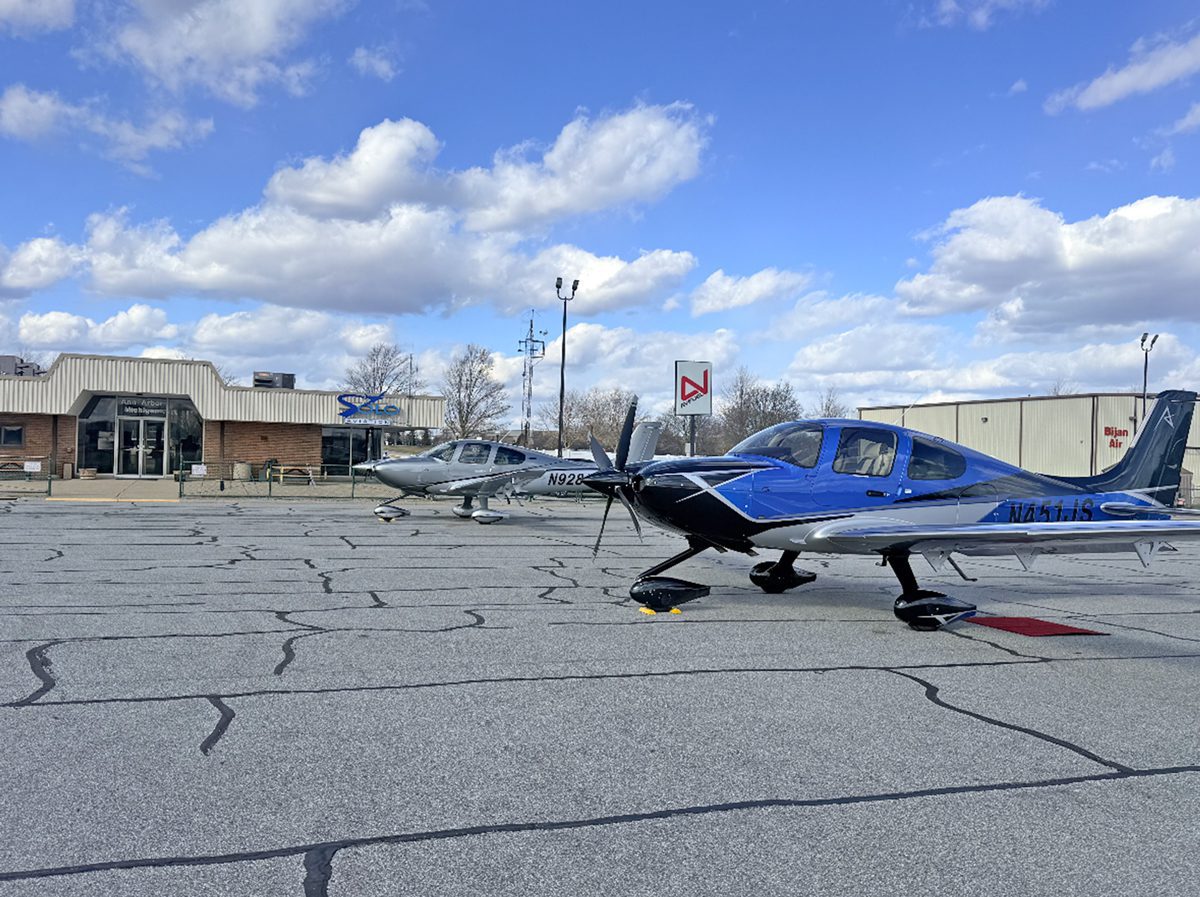
On a recent sunny Friday, I spent a day at the Ann Arbor Airport. As a general aviation pilot, it’s been a familiar hangout since I first moved here in the eighties.
I started my day at Solo Aviation, an FBO housed in a squat brick building east of the control tower known as the “terminal building.” For the uninitiated, FBO stands for fixed-base operator, a combination gas station, maintenance/rental/instructional facility, local concierge, and community gathering place. The Ann Arbor Airport has two FBOs, plus several other businesses and clubs.
From the large picture windows in the back of Solo Aviation, you can see the two runways: one paved and running east to west, and one grass, running north to south. The different orientations give pilots the option to choose the runway with the most favorable winds, and the grass runway gives them a chance to practice on an unpaved surface.
They cross in the middle of the airport, forming a large letter X, which also marks the spot where the terminal building and control tower sit. On the northeast and northwest sides of the airport are the hangars, 157 hangars and thirty paved tie-down spaces in all; to the south and west are 160 acres of leased farmland (Project Grow has an outpost here); and scattered throughout the property are four solar arrays that offset the airport’s energy usage.
When I arrived in the morning, a helicopter had just landed next door. I walked over to inquire why it was there, and was treated to a tour of the facilities that U-M Survival Flight uses to maintain its three choppers. The large, tidy hangar keeps the aircraft out of the ice and snow during the winter, and mechanics here perform the regular maintenance needed to keep two working copters available at any time. The helicopters each fly about forty hours monthly, often coordinating with Huron Valley Ambulance. Last year, there were fifty-eight round-trip transports between HVA and U-M Survival Flight, plus an additional thirty-three transports that arrived in airplanes.
They aren’t the only emergency services aircraft that call the Ann Arbor Airport home. The Civil Air Patrol, founded in 1941, keeps an airplane on-site and has an active group of volunteers that revolve around three core programs: emergency services, aerospace education, and a cadet program that gives teenagers hands-on STEM education. In the past, they’ve helped with search and rescue and disaster aid, and during the Edenville Dam failure in 2020, they led hospital and aerial surveillance missions.
But it’s not all emergencies. Throughout the morning, prospective pilots stopped by asking about renting or instruction. There was also a steady stream of airplanes arriving and departing. At mid-morning, a couple arrived in a small plane from Waterford to meet a friend and go out to breakfast. They took advantage of borrowing a late model Toyota Scion the FBO keeps on hand to lend to visitors in need of local transportation.
I took a look at the visitors’ log for transient pilots and found airplanes flying from airports throughout Michigan, Ohio, Delaware, Tennessee, Indiana, Wisconsin, Missouri, and Nebraska. People come to conduct business, take college tours, go to football games—or grab breakfast with a friend.
The Experimental Aircraft Association has a local chapter housed in a building on the east side of the airport, just off State St. EAA members include pilots who construct a special category of experimental airplane, built by individuals using kits, which provides an option for a more affordable and customized aircraft. Today the building is quiet, but a contingent of pilots gather at least one Saturday a month for coffee, donuts, and conversation.
Locally, they’re perhaps best known for their annual Pancake Breakfast—it’s on June 14 this year. Past Pancake Breakfasts have drawn over 1,000 attendees, a third of whom are kids and the rest of whom are kids at heart. Representatives and airplanes from local flying clubs, Civil Air Patrol, radio control pilots, the Pittsfield Fire Department (with their trucks), and others are usually on hand. In past years the Michigan Flight Museum flew in its vintage Huey helicopter and the Scio Flyers have brought RC planes, drones, and a flight simulator.
The Pancake Breakfast takes place at the hangar of the nationally recognized AvFuel Corporation, headquartered right here in Ann Arbor. The event is a fundraiser for the Ray Aviation Scholarship, which awards an annual scholarship to teenagers to help cover the cost of flight training.
The EAA also sponsors Young Eagles Rallies every summer, offering free rides to children to inspire their aviation and scientific minds. One of the previous Young Eagles pilots went on to become a flight instructor, with the help of the Ray Aviation Scholarship program.
Related
I Spy: Avfuel Logo (Sept. 2025)
Over the lunch hour at Solo Aviation, one student pilot was preparing for his first solo flight, and another was discussing a practice cross-country flight with his instructor. These students are at the beginning of a training pipeline that supplies pilots for airline, cargo, and medical flights. Introductory flight lessons are an easy way for anyone to discover if flying small planes is something they would enjoy. These flights are offered by FBOs and flying clubs, such as the Michigan Flyers Fly with Us program, which for $120 gives prospective pilots the chance to fly in a Cessna for thirty to forty-five minutes with an instructor.
In the early afternoon, a Northwoods AirLifeline flight flew in from Marquette with a mother and her young child, on their way to a doctor’s appointment at University Hospital. Northwoods is one of several nonprofit organizations, founded by pilots, that provide free transport for patients and their families to necessary medical services that can be hundreds of miles away. The Wings of Mercy nonprofit sends about 20 percent of its flights to C.S. Mott Children’s Hospital, with many patients arriving from the UP.
After they left for the hospital, I visited two large hangars on the west side of the airport, where I found half a dozen airplanes in various states of disassembly for routine maintenance, troubleshooting, and avionics repair. The team of mechanics—three certified aviation maintenance professionals and two apprentices—had clearly been hard at work. Most of the planes had the engine housing, or cowling, removed, exposing the engine, cylinders, and tubing. Three of the mechanics were working on one of the airplanes, and a couple were taking a break in the back. We joked about a radio issue I had with my airplane a few weeks ago, and I assured them it was now working flawlessly.
The Ann Arbor Airport was in the news in 2024 when city council voted down a plan to expand the runways for safety, after residents shared concerns of noise, air pollution, and carbon emissions. “If the current condition of the airport did not meet FAA safety criteria, the FAA would not permit its operation,” Mayor Christopher Taylor said at the time.
Related: Runway Reconsideration (Apr. 2025)
Noise complaints have been attributed to three locally based aircraft, a small percentage of the over 80,000 operations annually. Ironically, the very existence of the Ann Arbor airspace prevents noisier flights from much larger planes inbound or outbound from Willow Run and Detroit Metro.
Airport leaders are considering the installation of a large new solar array. DTE had considered a similar project in 2015, but the proposal was tabled due to opposition from Pittsfield Township officials. At the last airport advisory meeting, one committee member commented that such a project might benefit the community and provide a significant source of green energy for the Sustainable Energy Utility.
The day had started with light winds out of the southwest, but had increased to stronger and more challenging gusty winds by late afternoon. The controllers in the tower calmly managed airplanes throughout their arrivals and departures, providing alerts to the location of other air traffic, responding to questions about the current winds, and stewarding Ann Arbor’s share of the sky. The Ann Arbor tower is a designated training facility for new air traffic controllers. In a way, local pilots are shaping the future of the national airspace every time they fly.
Tower directs one departing airplane to “have a safe flight” as they leave the area. I take my leave as well.