
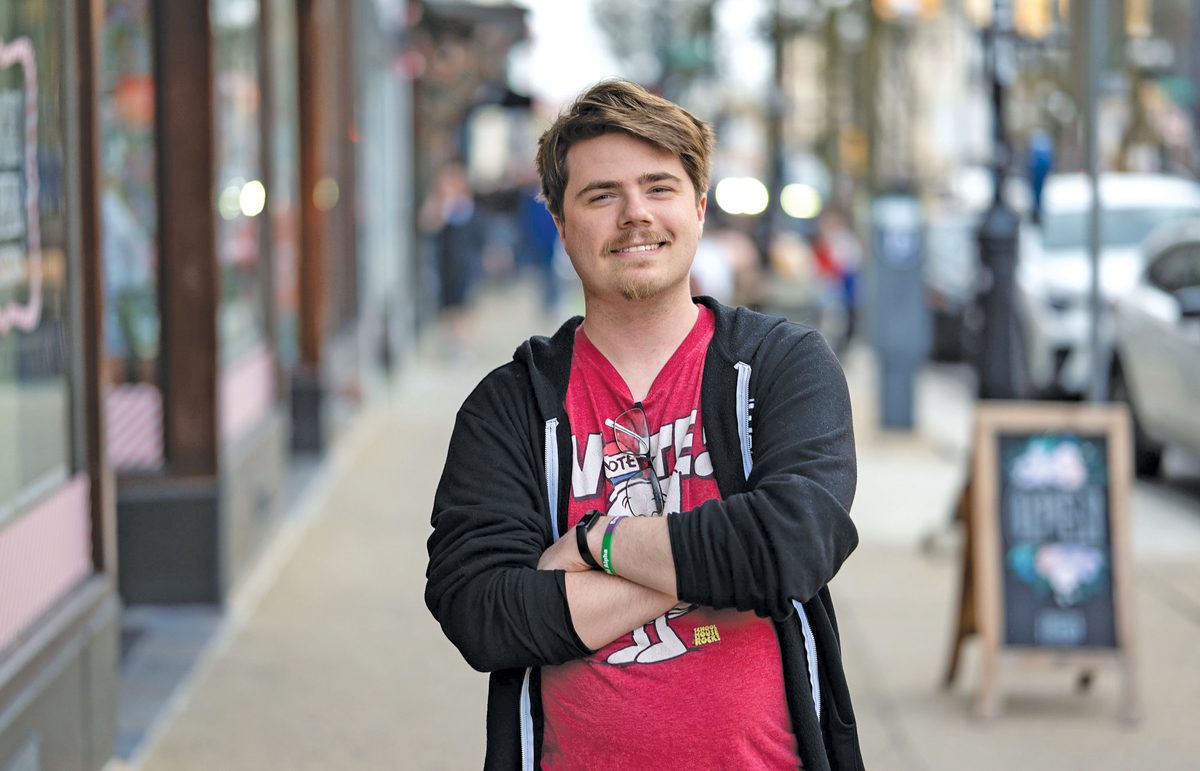
“It’s very easy to just stay home and stay on my computer and watch TV,” says Ethan Ward, but instead he’s being proactive about meeting people and being social. | Photo: Mark Bialek
On a Friday evening in March, Ethan Ward makes his way through the Pretzel Bell’s busy basement bar to find the group “20s & 30s New Friends” in the back room. It’s Ward’s first time at the board-game event, and he settles into a seat near a few other guys his age.
Twenty-three with a ready smile, Ward graduated from college last year and moved back home to live with his family. He says he’s lost touch with his high school friends and struggles with loneliness and social anxiety. “The two kind of amplify each other,” he explains.
Ward found tonight’s group on Meetup, an app and website that connects people with similar interests. Without Meetup, he’d be “up a creek,” he says, because he lacks “a place to go—a place that’s familiar and comfortable.” He wants to hang out with other people his age.
Ward is not alone in his loneliness. According to the 2023 U.S. Surgeon General report “Our Epidemic of Loneliness and Isolation,” about half of all adults say they’ve experienced loneliness. For adolescents and young adults, the rates are even higher.
“It’s very easy to just stay home and stay on my computer and watch TV,” Ward says, but instead he’s pushed himself to be more social. A short time later, Ward is asked to play a word-guessing game called Taboo. He joins the half-dozen men and women at the next table, introduces himself, and soon the group is lost in the game, exchanging smiles and laughter.
Loneliness is “natural and part of the human experience,” says University of Michigan social epidemiologist Lindsay Kobayashi, who studies aging and the life course. For the past decade, she has researched the health implications of loneliness from a global perspective, using longitudinal studies of aging. “Everyone has felt lonely at different parts of their life,” she explains, as they move into and out of a “bundle of social roles … and different social institutions.” However, the Covid pandemic exacerbated loneliness, and “we’re seeing more of it than we should be in Western society and the United States, and it’s going on for a prolonged time.”
Kobayashi says people experience loneliness when “perceptions of their social relationships don’t match what they would ideally like them to be. Not everyone who feels lonely is truly alone and not everyone who is socially isolated feels lonely.”
Recent research demonstrates that the health implications of loneliness are profound: loneliness and social isolation increase the risk for premature death by 26 percent and 29 percent respectively—and they’re also associated with an increased risk for anxiety, depression, and dementia.
Multiple factors contribute to loneliness, Kobayashi says, including that “we live in a very individualistic society and the family is the dominant structure.” In addition, she says, “there often aren’t affordable and easily accessible public spaces for leisure and socializing.” Though online forms of connection are “not inherently good or bad,” Kobayashi explains they’re not a replacement for social connection, and the way they are used “is creating a more polarized society.”
The importance of third places—low-cost or free community spaces like parks, coffee shops, and libraries where people can find connection outside of home (a first place) and work (a second place)—is becoming a more popular topic in public health research, Kobayashi says.
“If we see loneliness as an individual phenomenon, it’s a mistake,” she says, “because the environment we live in can either foster human connection, or shut it out and make people feel physically isolated.”
Flashback: Working Alone, Together (Sept. 2019)
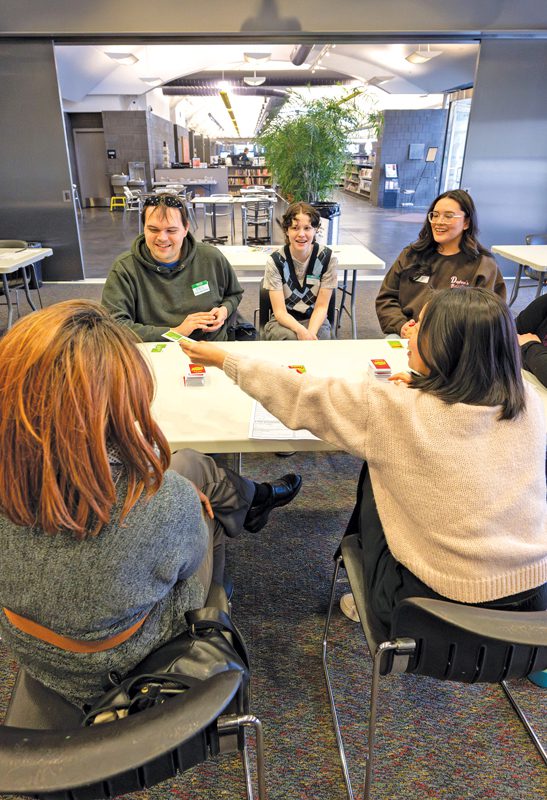
A group of people play a game at a Let’s Be Friends event at the AADL’s Pittsfield branch. The events don’t have a facilitator; it’s up to participants to mingle and, hopefully, make friends. The goal is human connection. | Photo: Mark Bialek
At Ann Arbor District Library’s Pittsfield branch on a recent Thursday evening, human connection is the goal. Tables are set with a variety of board games for Let’s Be Friends, a regular event for adults that offers a space, name tags, and a themed activity—but no facilitator. It’s up to participants to mix, mingle, and (hopefully) make some friends.
Only seven people show up tonight, but it’s a good enough number to play Apples to Apples, a card game where players take turns judging clever—and sometimes funny—adjective and noun combinations.
Gina’s here because she needed to “get out of my house and away from this!” she says, holding up her phone. Liz, who moved to Ann Arbor from California two years ago for her husband’s PhD program and works remotely, is always looking to meet new people. She and Emery, who’s here too, met in December at a Let’s Be Friends “Looking for a Book Club” event and started a book club together. Bethany’s new to library events, and a few others are big fans of the Summer Game and other library programs.
As the group shares some laughs about card combinations like “Hot” and “George W. Bush,” and conversation drifts from kittens to book club picks, one hour turns into two. A library employee gently reminds the group it’s closing time.
“Hope to see you guys around,” Gina says. Bethany smiles, says goodbye, and heads out to her car. A few minutes later, the group decides to exchange phone numbers, and later that evening, the New Friends group chat lights up. One member shares a photo of her two cats cuddling. Another one invites everyone to a “mini downtown exploration” walk she’s organizing with a friend. The group plans another game night at Pittsfield in May. There’s just one thing missing: Bethany. No one has her last name or number. Bethany, if you’re reading this, your new friends are looking for you.
“Deep social ties are important, but it’s [also] important to have that sense of broader togetherness,” says Jessica Finlay, a health geographer and environmental gerontologist at the University of Colorado Boulder who studies where people live as they age and how it affects their health and well-being. She says visiting a coffee shop or park to “soak up the sounds of people around you” can be “immensely important and protective.”
During the Covid pandemic, “places to sit and linger and hang out” vanished, Finlay says, and there were more closures of brick-and-mortar third places. With more self-checkouts and drive-thrus with screens, people are losing “that friendly smile or brief chit-chat.” Fourth places, or “in-between spaces,” like sidewalks, plazas, bus stops, and thresholds outside of stores also play a part in building togetherness, she says.
Ann Arbor Planning Manager Brett Lenart shares in an email that he thinks the planning profession is generally moving in the right direction: “Over more recent history, planning has embraced mixed-use as a hallmark of successful communities. While by no means a magical solution, when Ann Arbor and other communities begin to break down regulatory silos, and enable more flexibility and fluidity, I think it affords the opportunity for more connections.”
One example is Washtenaw Dairy on the Old West Side, where regulars meet for coffee and picnic tables and benches overflow with customers in the warmer months. He shares that Ann Arbor’s recently adopted Comprehensive Plan envisions additional opportunities for “neighborhood-embedded commercial services.”
He also shares that density in city planning “increases the chance that public transit, bicycles, or even walking become more viable options for moving through one’s daily tasks.” These interactions are quite different from driving from home to work in isolation, he explains.
In addition to the built environment and public policy, interventions on loneliness also consider social norms, Kobayashi says. “Being open to difference and multiculturalism is part of it,” she says. “This is very much in the political moment … Wanting immigrants out of the country. Seeing other people as different and other. You’re less likely to help your neighbors. … That’s the type of society where people feel isolated and feel lonely. Where you don’t feel neighborliness for your neighbor.”
Dennis Sparks, seventy-nine, who’s lived on his own in the Eberwhite neighborhood for thirty years, is grateful for his neighbors. At the height of the pandemic, they left desserts and treats on his porch on his birthday, delivered Thanksgiving dinner to his door, and remembered him on their trips to Costco. “It feels good to be known,” he says.
Sparks, who often visits elderly friends and relatives, says even the “briefest encounters in the neighborhood” can build a “powerful connection.”
For Melissa Dominguez, loneliness feels like being trapped in a well. “[You’re] stuck and desperate for someone to pay attention. You’re sometimes afraid and sad, and want to be understood. The resources aren’t always there.”
Dominguez, thirty, who moved from Atlanta to Michigan with her husband and infant son a year ago, says she was the first of her friends to have a baby. “Friendships change. That’s a part of the new motherhood journey. Your priorities change.”
Diagnosed with postpartum depression, Dominguez, a registered nurse who works remotely for an insurance company, says she felt isolated—even with a supportive partner. She found Ann Arbor’s Little Break Cowork, part of the nonprofit Mamas Network, in an online search. For several months she worked out of the space and met other moms at the organization’s events who became friends.
Related: Little Break
“I really think it’s hard to get your head above water when it comes to loneliness,” she says, “but when you do, it’s like baby steps until you kind of make a path toward not feeling so isolated.”
Even public figures aren’t immune to loneliness. “Everyone looks at me and thinks I know everybody,” says U.S. Representative Debbie Dingell, “but since John died, if I get sick, or if something happens, who do you call? Who will be there for me?”
She’s at the Ann Arbor Senior Center on a Friday morning in March as Molina Healthcare of Michigan representatives announce a donation to senior centers in Michigan that will fund programs to combat social isolation. During the Covid pandemic, Dingell says the importance of friends came to the forefront. She and her longtime friends created a text thread, and every morning, they still “check in and say we’re okay.”
Brittany Patton, director of the Ann Arbor Senior Center, says seeing friendships develop at the Burns Park building is a favorite part of her job. She wants seniors to “come for the classes and stay for the feeling of belonging.”
On a Thursday afternoon in March, Natural Area Preservation staff teach a small group how to make homemade bird feeders with cookie cutters, and in the main room seniors play duplicate bridge. After the bridge game, James Walter, eighty-six, sits and chats in the center’s lobby. His wife passed away suddenly fourteen years ago and he doesn’t have children.
He recalls returning to his empty house the evening she died. “I thought, what am I going to do? Then I remembered I used to play bridge.” He now plays six days a week, including at the Ann Arbor City Club. He calls his group of bridge friends “the usual suspects.”
David Pehlke, eighty-nine, is another bridge player and an enthusiastic senior center walking group member who moved to Ann Arbor from Utah a couple of years ago to live near family after his wife of sixty-two years passed away. He has plenty of tips: “If you want a friend you have to be a friend.” “You have to put yourself out there and prepare for rejection.” “Keep your antenna up for friendships.” His bridge partner has become a friend and invited Pehlke to his home for Christmas Eve brunch and drives him to the senior center on bad weather days.
It’s been a month since Ethan Ward’s Pretzel Bell game night, and since then, he joined a group walk at County Farm Park, caught the new Ryan Gosling movie with a few people afterward, and he’s now a regular at a weekly social anxiety Meetup at a coffee shop.
He says he’s feeling “hopeful.”
I couldn’t help think, as I read about third spaces, that the Center of the City could have been that for many people. An opportunity lost. Unfortunately.