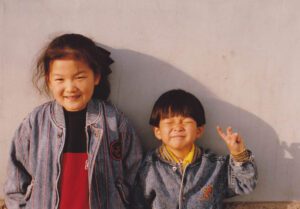
Michelle Yang and her brother in the 1990s. | Courtesy: Michelle Yang
My first time dining at Paris Bánh Mì near the Diag, I noticed a preteen boy in the corner sorting Pokémon cards, completely absorbed. A few months later, my spouse and I spied twin boys being scolded in Mandarin behind the counter at Aloha Hawaiian BBQ.
Seeing other restaurant kids always takes me back to my childhood in Phoenix, where my brother and I grew up in our family’s Chinese take-out restaurant. Restaurant kids share a kinship. We grow up highly visible to the community, with the business doubling as our living room, and our family’s work permeating every corner of our lives.
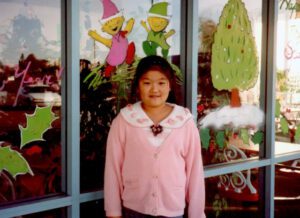
Michelle Yang stands in front of her family’s restaurant in Phoenix, AZ, in the 1990s. Every year, she painted the windows for the holidays. | Courtesy: Michelle Yang
In the 1990s, I began working at my family’s restaurant around age twelve. You could say it made me a better student. Homework was preferable to wiping tables, hauling trash, or running the register, so I lingered over assignments and buried myself in library books. My younger brother, by contrast, passed the time playing Game Boy or getting into trouble for not sitting still.
I remained a steady presence at our restaurant through college, until graduate school took me away. Decades later, in 2021, I moved to Ann Arbor with my husband and child, arriving at a time when the pandemic made it difficult to feel connected. That’s when my then-eight-year-old son got hooked on Kids Baking Championship on the Food Network. Our favorite contestant, Nemo Tsai, turned out to be part of the family behind Tsai Grocery and Godaiko on Oak Valley, places we already frequented. Without even meeting them, we felt a little less like outsiders.
Related: Sixth-Grade Baker Competes in National Baking Show (Dec. 2020).
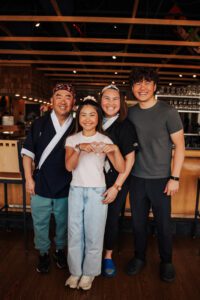
The Tsai family in their restaurant, Godaiko. | Courtesy: Tsai family
When I did eventually meet the Tsais, I realized Nemo and his younger sister Lilo represent a different kind of restaurant kid than my brother and me. Now a high school junior and star golfer, Nemo says, “I’m more involved with the business through social media and marketing. I’m good at making people feel good when they come into Godaiko.”
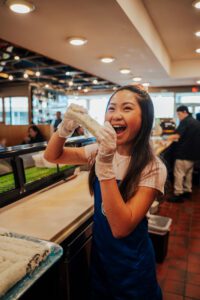
Lilo shows off a roll she made. | Courtesy: Tsai family
Lilo, eleven, competed on season nine of MasterChef Junior, putting her culinary skills to work. Both kids seem genuinely to love contributing to the family business. When I ask if they get paid, they both laugh as if my question is very silly. “No, we don’t need to get paid,” Lilo says. “We like to do it,” adds Nemo.
Their father, Paul, sees a clear generational shift. “When I grew up working for my parents, I had to,” says Paul, whose kids will be third-generation restauranteurs, if they take over. “There was no choice. We were the laborers. We were the ones helping with everything. Their experience has been different. They want to be here. They love it and they bring a special energy to the business.”
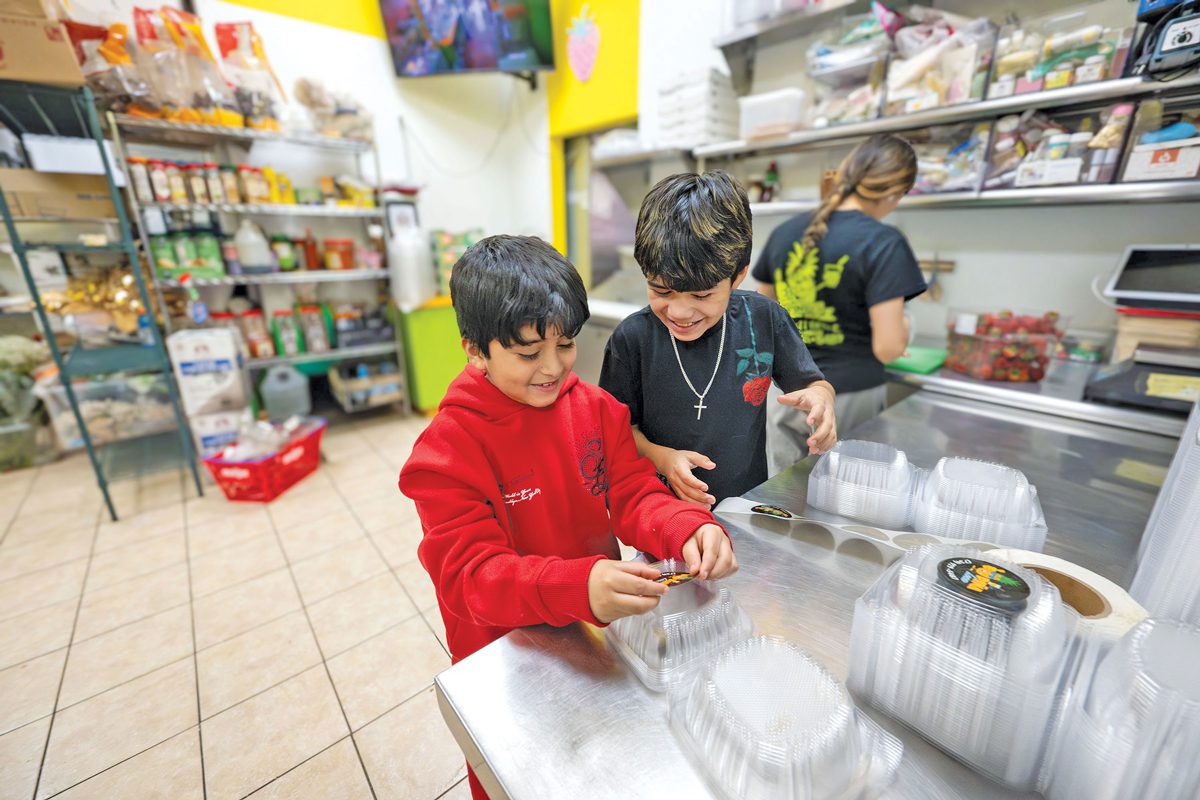
Brothers Oliver and Alex (left to right, ages seven and nine) mix work and play as they place stickers on takeout containers for their parents’ restaurant, La Piña Loca. They’re part of a new generation of restaurant kids. | Photo: Mark Bialek
At the Mexican street food and treats spot La Piña Loca, brothers Alex, nine, and Oliver, seven, help their parents, Benjamin de Jesus Garduno and Gloria Sendejo, by placing stickers on takeout containers. The soccer field at the park behind their restaurant and the claw machine they got in last year are the boys’ favorite parts about being restaurant kids. With piñatas and colorful banners strung about and lively Latin music blasting through the speakers, the space feels playful in a way my childhood restaurant never did.
Related: La Piña Loca: Sweet, tart, and spicy (Oct. 2020)
A Paleteria on Platt Rd. (Mar. 2019)
The boys’ ambitions also reflect their joy. Oliver dreams of becoming a YouTube gamer; Alex, a soccer player. Hearing them, I couldn’t help but think of my own upbringing, where career options were strictly limited to doctor or lawyer, to justify the hard work and sacrifice of my immigrant parents. Though my brother and I refused these paths, we were never nurtured to dream outside the box.
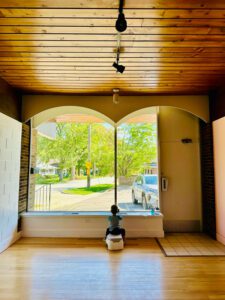
Chef Rachel Liu Martindale’s son sits in the window of Q Bakehouse. | Courtesy: Rachel Liu Martindale
Chef Rachel Liu Martindale understands similar pressures firsthand. Raised in Troy, she fell in love with baking as a child, watching the Food Network with her grandmother. Still, she pursued engineering to meet her parents’ expectations. “And then I got a job in supply chain and manufacturing right after college and absolutely hated it,” says Rachel, who suffered from multiple panic attacks during that time. “I call it my quarter-life crisis. I finally realized my whole life had been doing what my parents wanted for me.”
Fast-forward eight years to February 2024, when Rachel realized her dream of opening her own bakery storefront in Ann Arbor called Q Bakehouse & Market—selling the same milk buns she loved to bake for her grandparents as a teenager, and featuring other flavors of her Taiwanese and Shanghainese upbringing. “This [store] is very much me. What I loved to eat growing up,” she says. “It’s my story, told by food.” The business also donates 10 percent of its profits to the Hope Clinic and Ozone House.
Related: Q Bakehouse Gets a Home Base (Jan. 2024)
Now a mother of two, Rachel is intentional about how her business fits into family life. Her young son, Silas, spent time at the bakery during its early construction, and still visits—sometimes lured by his favorite rice crispy treat from the bakery case. Though Rachel isn’t technically a restaurant kid, she spent time at her relatives’ eatery, Golden Dragon in Bloomington, IL, and remembers the relentless pace. “They immigrated here and had to have this restaurant to survive as a way of making ends meet, working from dawn to dusk every single day,” she says. “They only closed one day a year. They work so, so hard. I don’t know how they do it.”
Like Paul, Rachel talks about the privilege of being second- or third-generation immigrants. “I chose to do this out of desire, not because I have to,” she says. “I choose my work-life balance and choose how I want to run the business and how much I want to be involved. We have pretty short hours. We close. We have a big summer break and a big winter break that we take for everybody to get a reset time. We’re closed every major holiday. I want people to have more ‘corporate benefits’ kind of style of work in the midst of a small business. It’s something that I care a lot about.”
Rachel’s perspective reflects what I see in families like the Tsais and the Sendejo–de Jesus Gardunos. For many first-generation immigrants, restaurants were about survival, demanding long hours and leaving little room for anything else—something I experienced, our family life structured entirely around the business.
But for these second- and third- generation immigrant restaurant kids of Godaiko, La Piña Loca, and Q Bakehouse, the formula has changed. Though the kinship remains, the experience is evolving. These restaurant kids still grow up in these spaces and absorb the rhythms of service and community, yet they have more room to choose, to dream, and to step in or step away on their own terms. For this next generation, the restaurant is more than a place of obligation and survival. It is a place of possibility.
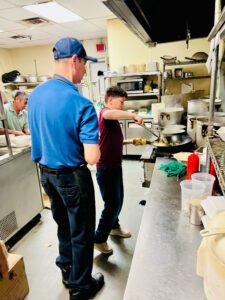
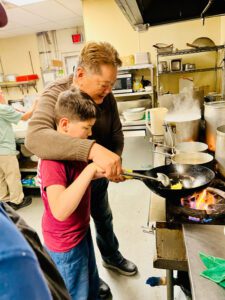
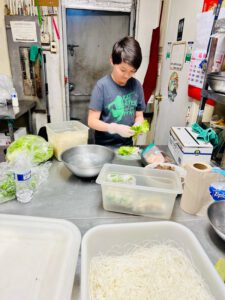
Michelle Yang’s son loves to help out at her brother’s restaurant when they visit Arizona: