
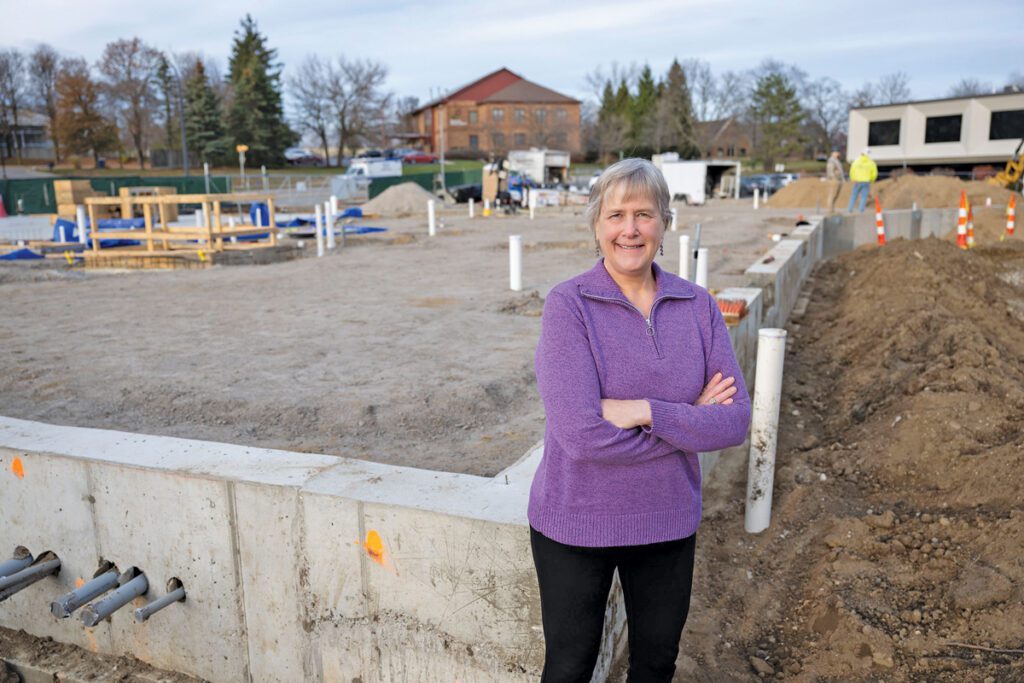
Mindy Kerr stands outside the construction site for the new fire station that will be named in her honor. She joined AAFD in 1980, and remained the only female firefighter for ten years. By the time she retired, the thing that defined her was not her gender, but her twenty-five years of service to the department. | Mark Bialek
Construction is underway on Fire Station 4 at 2415 S. Huron Pkwy. The original building, constructed in 1966, was razed to make way for the city’s first net-zero, carbon neutral facility, complete with solar panels and geothermal heating and cooling. The city broke ground on May 20 and expects to wrap construction by fall of next year.
The name of the new station is a nod to a pioneer: Mindy Kerr, Ann Arbor’s first female firefighter.
In a December 1985 Ann Arborite profile, Observer reporter Annette Churchill described Kerr as a “tall young woman [who] projects physical strength.” Churchill writes that “it wasn’t feminist zeal to break traditional employment barriers that led her to try for the job.” Instead, it was a brief stint working at the Commission on Professional and Hospital Activities.
Reflecting on that experience in 2025, Kerr says, “all I knew in my heart of hearts was, I [didn’t] want a desk job.”
She was naturally strong, and loved being outdoors and helping people, so firefighting sounded like a good fit. The twenty-four-hour-on, forty-eight-hour-off schedule also appealed to her, because it would allow her to keep working at Meadowcroft Farm, where her family bred horses—a duty she performed before, during, and after her career with the AAFD.
So, in 1980, at the age of twenty-four, Kerr applied to the AAFD—unaware that there were no women in the department. She says she was lucky to have leadership that treated her fairly. Her first lieutenant, John Schnur, “just treated me completely as an equal,” she says. “Completely professional, took me under his wing, showed me the ropes, never acted like I was any different than anybody else.” And her battalion chief for her last fourteen years, Russ Taylor, was “tough, tough, tough, but fair.”
It was Taylor who gave Kerr her first tour of the downtown fire station after she finished her training. Toward the end, the gruff chief told Kerr she had to take the pole back down to the trucks.
“We happened to be on the third floor when this discussion took place,” says Kerr. “[And] there I am with my twenty-pound purse slung over my shoulder.”
The first time sliding down a third-floor fire pole has to be intimidating, let alone with extra baggage. Kerr was nervous: Would she get stuck in the hole in the floor? Was she supposed to just drop her purse and then walk back up two flights of stairs to retrieve it?
“So finally I go, ‘Okay, here!’ I handed him my purse and I slid the pole, and then he had to slide the pole behind me with my purse on his shoulder.” She laughs at the memory. “It was hilarious!”
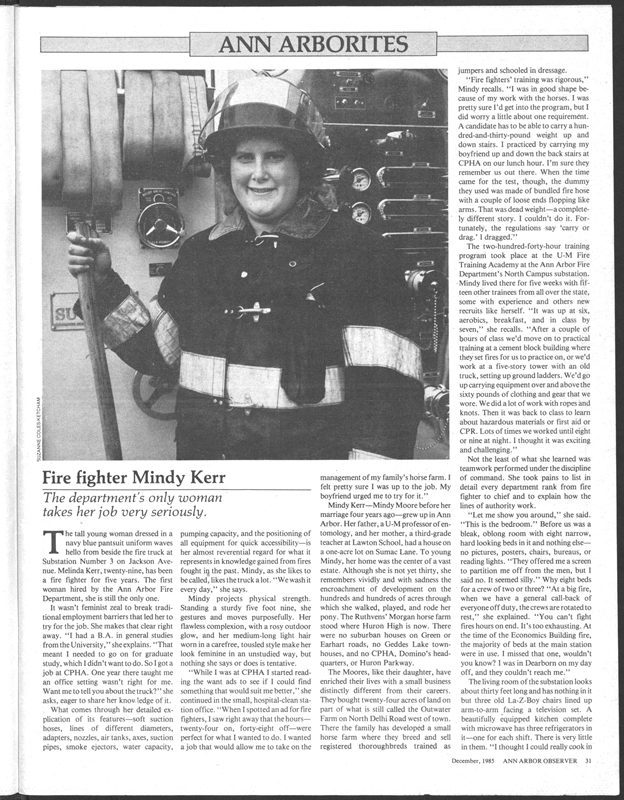
Mindy Kerr’s 1985 Observer profile. | Suzanne Coles-Ketcham
It wasn’t until 1990 that the AAFD hired another woman. Was it hard being the only female firefighter? “Absolutely,” responds Kerr. There was a tension beneath the surface, a sense that all eyes were on her, and most of her colleagues were skeptical at first—some more vocally than others.
“Several of them came up to me on multiple occasions and said, ‘Aren’t your parents ashamed of you?’” she says. “‘They paid for your degree at the University of Michigan, and here you are. You’re just a firefighter.’ And I said, ‘No! They’re so proud of me. They think this is awesome.’”
The heat didn’t just come from within the department. Before her first day as a firefighter, a dispatcher warned Kerr that some of her colleagues’ wives planned to picket the station. “That kind of put me over the top in the nervousness that I might have to cross a picket line … to protest a woman being hired,” Kerr recalls. But the protestors never materialized, and Kerr wondered whether the rumor had ever been true.
She got her answer a few years later, in conversation with the wife of one of her colleagues at Station Number 6.
“She told me, ‘You know, Mindy, I was one of the women that was going to picket the fire station the day you started. … Now that my husband is working with you, I’m honored that he gets to work with you.’ That he gets to work with you,” Kerr repeats, with emphasis. “It was just amazing to hear that.”
Her coworkers eventually got used to the change, treating her as a member of the team, especially once they got to know her and saw that she could do the job. By the time she retired in 2005, the thing that defined her was not her gender, but her twenty-five years of service to the department.
Including Kerr, twenty-two women have served on the AAFD. “The department currently has seven female firefighters … representing approximately 8 percent of our seventy-eight sworn personnel,” says Fire Chief Mike Kennedy. According to the National Fire Protection Association’s 2022 U.S. Fire Department Profile, women represent 5 percent of career firefighters in the U.S.
Tracey McCoy is one such recruit. A native of Aurora, Illinois, McCoy moved to Ann Arbor after college to join her sister, who was attending U-M. She originally planned to be a physician’s assistant, but when that didn’t pan out, she took a friend’s advice and met with the director of the fire academy at Detroit’s Schoolcraft College. That one meeting, McCoy says, “was like watching all of the pieces come into play, everything that I was interested in and wanted to do fell into place. I realized that this career really does embody everything for me—my character, my love of learning, my drive to serve others.”
The AAFD hired McCoy while she was still completing the fire academy program. “Fire departments are hurting for people to apply,” she explains. “Even ten to fifteen years ago, my colleagues were competing with hundreds of people for the job; that is no longer true. Departments will hire people with no training or incomplete training, like me. I got my hourly wage while I was in the program and was guaranteed a job when I finished.”
This allowed McCoy a smooth transition, giving her a chance to get to know the role and the community before stepping into full-time firefighting—a role she has filled since May of 2023.
Gender representation matters to Kennedy. “When I was appointed fire chief in May 2018, the department had not hired a female firefighter since 1998, a twenty-year gap that was completely unacceptable,” he says. “Since then, we have worked diligently to expand opportunities and remove barriers to entry for women in the fire service.”
One such opportunity is the four-year-old Blaze & Blue Career Camp, a joint program with the Ann Arbor Police Department designed to introduce young women to careers in fire and public safety. McCoy co-led Blaze & Blue for three years and will head up the program next year.
“Girls spend four days at the camp, two with us and two with the police department,” she explains. “We run them through stations, go to our training stations at the Wheeler Center. They do some rappelling, ride in the bucket, cut up a car—basically practice doing what a firefighter does.”
Kerr’s advice to young women hoping to become firefighters is simple.
“Just like any other job, you have to want to do it. There has to be something about the profession that’s really appealing to you,” she says. “On the other hand, if it’s something you really want to do, try not to let anybody stop you.”

“This career really does embody everything for me—my character, my love of learning, my drive to serve others,” says firefighter Tracey McCoy. Next year, she will head the Blaze & Blue program, which introduces a new generation of young women to the profession. | Mark Bialek
Back in 1980, Kerr and fifteen other trainees underwent a 240-hour, five-week training program at the U-M Fire Training Academy. In the 1985 Observer article, she recalled 6 a.m. wake-ups and morning aerobics. There was classroom training on hazardous materials, first aid, and CPR, and practical training that included putting out practice fires, setting up ground ladders, and hauling a 130-pound weight up and down stairs (she practiced by carrying her boyfriend).
Kerr might have gotten off easy compared to today’s recruits. The Schoolcraft fire academy program is a nine-week, full-time course where attendees obtain their fire certificates and pass the national fitness exam known as the Candidate Physical Abilities Test.
During the CPAT, would-be firefighters have ten minutes and twenty seconds to complete eight stations. The test begins with a three-minute stair climb while wearing a seventy-pound vest. After fifteen pounds are removed, the candidates complete a hose drag, where they pull and run with the hose around a barrel. Next up, they carry equipment, raise and extend a ladder, simulate a forcible entry, run into a pitch-black maze, do a rescue drag of a 165-pound dummy for seventy-five feet, and finally work their way through a ceiling breach.
“There is no difference between the age or gender for any prospective firefighters,” McCoy explains. “The job doesn’t change for anybody, and that is what I like to point out to people. I passed the same fitness test as everyone else.”
The training may have changed, but some things about firefighting will always endure.
“You never know what’s waiting for you on a run,” Kerr said in 1985. It’s a sentiment that still rings true.
“We are seeing someone on their worst day,” McCoy shares. “Each call is different, each building is different, each fire is different, but seeing each crew know their part to put the fire out and keep everyone safe … it’s like watching a masterpiece unfold. … All of us coming together, showing up at different times from different parts of the city, communicating what we see, knowing our roles, and leaning in and trusting that everyone involved are confidently doing their jobs makes you realize that all of us are working in harmony to make sure that this house is saved or to make sure that no one is injured.”
On a spring day earlier this year, Kerr got a call from an unknown number. Normally she’d send it to voicemail, but her father had just gone into hospice, so she assumed the call was from a hospice worker… named Mike Kennedy.
“He said, ‘Have you heard that there’s a new Fire Station 4 being built?’ And I said, ‘Yes.’ And then my mind starts going, boy, this is a weird thing for a hospice worker to ask me! And then all of a sudden it kicked in,” says Kerr. “When he tells me why he’s calling, it was such a roller coaster of emotions. You could have knocked me over with a feather. I literally had to grab onto the counter in the kitchen.”
Kerr says she was stunned, humbled, and flattered at the news that Fire Station 4 would be named in her honor. There’s only one thing about it that she doesn’t like: at some point, she says, she’s going to have to give a speech.
“You know, people have courage in different forms,” she laughs, “and I literally would rather run into a burning building than speak in public.”
Awesome career Mindy.