
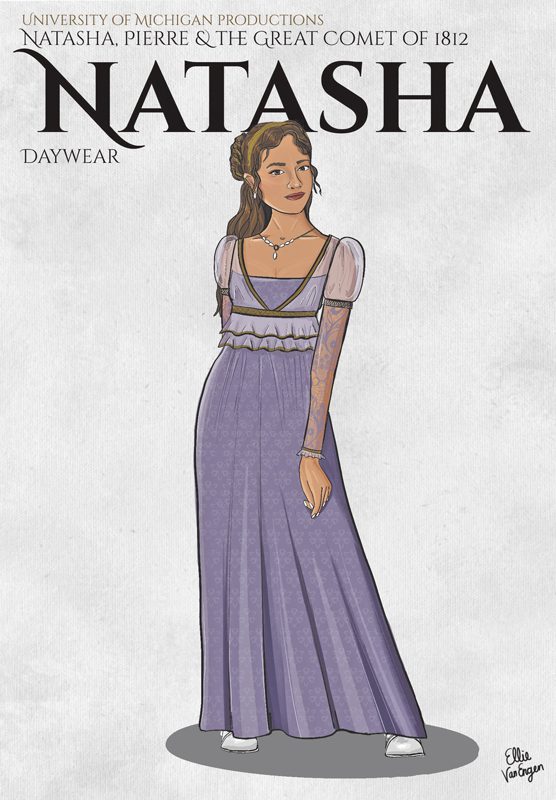
Caption: Costume design for the U-M School of Music production of Dave Malloy’s Natasha, Pierre & the Great Comet of 1812, April 16-19, 2026 at the Power Center. | Costume design by Ellie Van Engen
Set in 1812 Moscow, Natasha, Pierre & the Great Comet of 1812 is a musical adaptation of seventy pages of Tolstoy’s War and Peace. Natasha, a young countess, is torn between her love for two men, neither of them Pierre, who is dealing with his own crisis. Among the events in this saga are scandals, a suicide attempt, a duel, an awakening, and the arrival of a comet.
Student dramaturgs for the U-M production researched the play—which premiered off Broadway in 2012 with not-yet-Hamilton-famous Phillipa Soo; Josh Groban led the Broadway cast in 2016—to help the cast and production team understand the characters and their times. How did the Napoleonic Wars affect them? How did they view marriage and infidelity? And then there’s the comet. “It was visible through most of 1811,” assistant dramaturg Joe Guzon discovered, noting that while some characters feared it heralded the end of the world, others longed for a closer look.
The story is told in song, without spoken dialogue. Composed and with lyrics by Dave Malloy, the score merges Russian folk, classic music, and indie rock. Although it may not evoke Mozart or Puccini, music director Jason DeBord says the score, which calls for woodwinds, accordions, and synthesizers, “takes its cues from opera. … Malloy uses patterns that repeat themselves over and over. Sometimes they sound very classical. Sometimes they sound like electronica dance music. The music takes you into the past and brings you into the present.”
“I’m still inside the piece, figuring it out,” DeBord said early in the rehearsal period. His initial response to the story and the “dense and difficult score” is that the show is about the repetitive patterns of war and the relationships between people. When we can’t control events on the world stage, “we can make a difference in the relationships we have with people right in front of us,” he noted.
The production, like the score, integrates the historic and the modern. Costume designer Ellie Van Engen, for instance, created silhouettes suggesting 1812 Russia, filling these in with modern fabrics, colors, and accessories for a modern feel as well. She shopped in New York City for sequined sheers and other lightweight fabrics, eschewing the heavier materials of the period. The thick breeches of the time would have constricted the dancers, so she adapted stretch pants to reflect the period and allow for free movement. She dressed the ensemble in grays and blues to mirror the snowy world of the show. “The music has lots of moments that feel Russian and others that feel punk,” she says, noting that different costumes reflect one more than the other.
“Great Comet gives us an opportunity to witness the patterns we repeat as humans over the course of history and lifetimes,” DeBord reflects. “There will always be profound forces beyond our control shaking us to our core, pitting us against each other while we search for larger meaning and redemption. How do we find meaning in this chaos? I think this piece invites us to ask this question and meditate on it.”
Natasha, Pierre & and the Great Comet of 1812 runs April 16–19 at the Power Center.
The show was one of the best I’ve seen at U-M. The voices are breathtaking, the costumes beautiful, the dancing/ choreography amazing, the sets mind blowing. DO NOT MISS THIS