
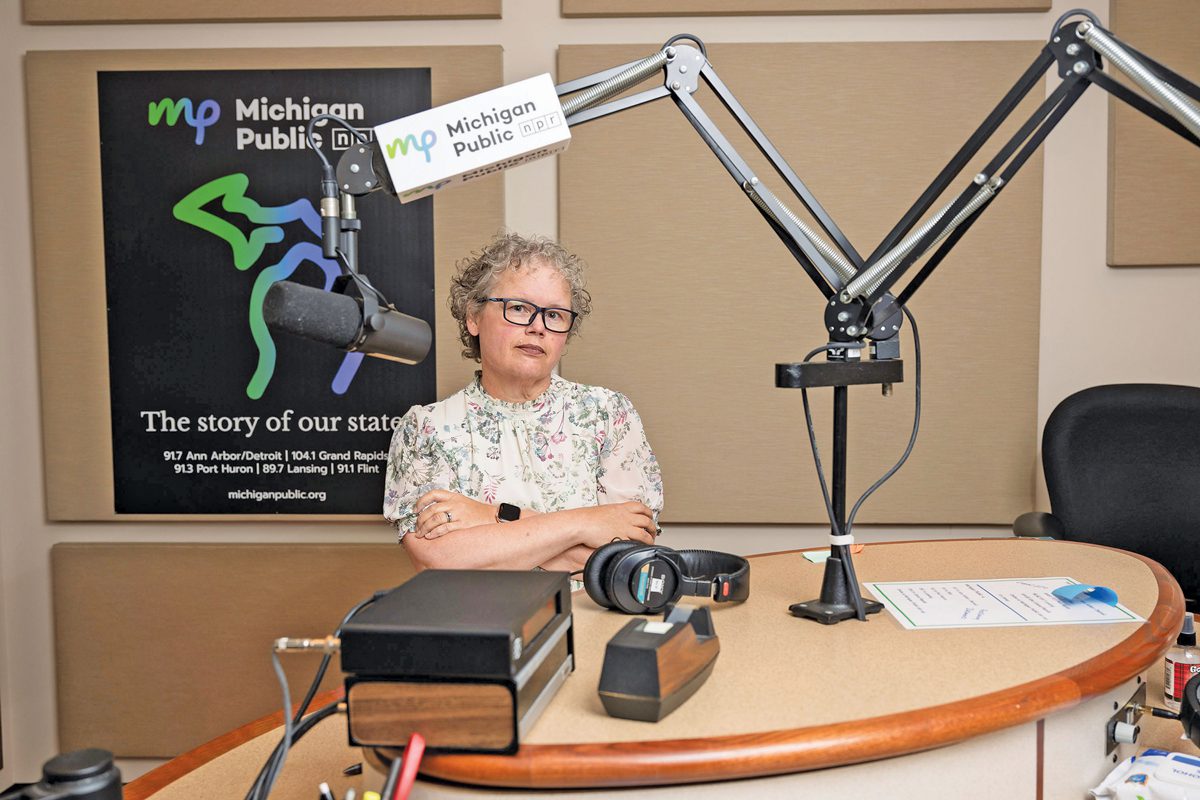
Michigan Public executive director and general manager Wendy Turner says they lost $560,000 when the administration clawed back funding Congress had approved. Donations flooded in—but then the Corporation for Public Broadcasting announced it would shut down. | Mark Bialek
At first, Wendy Turner, executive director and general manager of Michigan Public (broadcasting on WUOM and four other stations in Lower Michigan), was reasonably optimistic. So was Molly Motherwell, general manager of WEMU and president of the Michigan Association of Public Broadcasters. After all, the Corporation for Public Broadcasting (CPB) was still intact.
On August 1, the second ax fell: CPB, which distributes federal funds to member stations and provides vital technical services, announced it would shut down by year’s end.
Related: Target: The Arts
The 1967 bipartisan Public Broadcasting Act created the CPB, which upholds “the standards that define us,” says Turner. “Eligibility for CPB support requires a documented and certified commitment to the highest levels of public service, community accountability, and fiduciary responsibility.”
Michigan Public lost $560,000 in the clawback, about 6 percent of this year’s budget. Hundreds of donations came in as soon as the first news was reported, and Turner says that the station has reserves it can draw on for now. Long-term, she hopes to replace the lost funds through “more effective use of sponsorship and community support.”
The hole left by closing the Corporation for Public Broadcasting will be tougher to fill. “CPB negotiates and pays for the blanket music rights/royalties for all stations, and as of this moment, we have not heard how that might get resolved,” Turner says. “And while we are not a music format, we use music in our programs, and we air programs that use commercial music.”
The future of the Public Radio Satellite System is also at risk. “This is the infrastructure and funding for stations and networks to receive and deliver live programming reliably,” she says. “These are issues Michigan Public can’t address on our own; they require urgent system-wide solutions.”
Turner says all the stations in Michigan communicate with each other and support one another. “The biggest unknown for me and my colleagues is what happens to our entire system when you take a billion dollars out of it.” Some stations may no longer be able to afford NPR programs, and while Turner does “not have front-burner worries about Morning Edition or All Things Considered going away,” NPR might have to drop some less popular programs and stop experimenting with new shows.
Michigan Public news manager Vincent Duffy doesn’t anticipate a reduction in local news coverage. But if smaller NPR stations fold or can’t afford to pay for NPR’s programs, he says, the survivors may have to pay more. “Our partners at NPR are going to be as careful as they can and if prices were going to go up, they’d let us know, and we’d have to work hard to raise that money.”
Related: Michigan Radio: Crushing the competition, politely
The clawback cost WEMU eight percent of its $1.5 million budget. Motherwell says they saw it coming back in March, “started talking about it in our April fundraiser, and had a fantastic response. For the short run, we’re okay. [But] it’s not an ongoing business plan. We’ll have to be more strategic.”
WEMU’s commitment to preserving American music includes helping local jazz venues thrive by promoting their events. Drummer Sean Dobbins, a professor of jazz at Indiana University, remembers hearing his mentor, the late trumpeter and Pioneer High teacher Louis Smith, perform live for the first time at one of these gigs.
When he was growing up, Dobbins didn’t often have money to buy records. “WEMU was like free Spotify,” he says. “I was able to have access to a variety of music to listen to and learn from. It was huge.”
NPR stations even save lives. Motherwell reports that the Public Radio Satellite System creates the emergency alerts distributed by TV and radio stations. Some rural and tribal stations may receive their entire budgets from federal funds, and it’s these stations that rely heavily on NPR alerts because they don’t have access to broadband or digital servers. Some of these stations will close.
The off-air staff at WEMU has always been lean, but there are unknowns as they approach the next year. Motherwell reports that stations throughout the state have seen a groundswell of support in response to emergency fundraisers. But “can we count on that kind of support going forward?” she wonders. “It’s very very hard to plan a budget around volunteer support.”
The Michigan stations are coming together to try to find ways to weather the storm, and she believes one day the skies will clear. “The polling continues to show that most Americans want federal funding for public media. Sixty-six percent of Americans support it, and 58 percent of Republicans.”
Congress received more than 2 million emails and 25,000 phone calls in support when the news broke. Michigan senator Elissa Slotkin phoned every general manager in the state to confirm her support. “The subject will come up in the House again,” Motherwell says. “Advocacy matters.
“There’s optimism within the system that at some point, federal funding for public media will be added back into the mix,” adds Motherwell. “This fight is far from over.”
CPB and NPR don’t generally cover stories of interest to me, and both have clear left-wing bias. I say begone with them.