
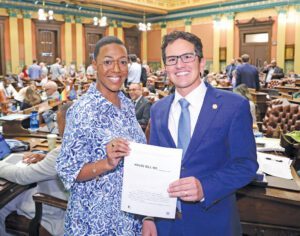
State reps Morgan Foreman (left) and Jason Morgan of Ann Arbor on the House floor. Their legislation would force U-M to follow local zoning rules. | Photo: Jeremy Herliczek
In 1901, U-M faced rapid overcrowding and needed to expand the College of Literature, Science, and the Arts. Its solution: buy a building from the city.
According to the Bentley Historical Library, the university spent $16,000 to purchase the 1st Ward School, which was renamed West Hall and used for classes in English, modern languages, and forestry.
For decades, U-M continued scooping up Washtenaw County properties and expanding its footprint without much resistance—until some recent moves incurred the wrath of Michigan politicians.
In late June, three Democratic state reps—Jason Morgan and Morgan Foreman of Ann Arbor and Jimmie Wilson of Ypsilanti—introduced legislation that would require university officials to follow local zoning requirements and ordinances. This followed U-M’s announcement in May that it would purchase the 140-acre Concordia University campus for $60 million. Because the university has legal autonomy on land purchases, the move did not require local input. (U-M has since approved plans for a new $175 million library facility on the property.)
Also in late June, Democratic congresswoman Debbie Dingell wrote a letter demanding answers over U-M’s plan, with Los Alamos National Laboratories, to build a $1.25 billion high performance computing center in Ypsilanti Twp. Her letter, directed to U-M president Domenico Grasso and Los Alamos laboratory director Thom Mason, followed a June 16 Ypsilanti Twp. board of trustees meeting in which they voted to formally oppose construction on either of the proposed sites: 124 acres on Textile Rd. along the Huron River, which U-M purchased in March, or the Willow Run Complex near the West Willow neighborhood.
Morgan, who is leading the legislative effort in Lansing, says he’s alarmed that U-M has purchased more than 300 acres in Washtenaw County in the past two years, at a time when Ann Arbor has struggled to address a significant housing shortage.
“I love U-M, I’m a proud graduate, and I certainly see the incredible value it brings to the state and community every day,” Morgan tells the Observer. “That doesn’t give it blank permission to ignore the community we call home.”
The first measure, House Joint Resolution X, would amend the state constitution to require U-M to comply with local restrictions for all land purchases beginning in 2027. If passed by the legislature, it would go before voters. Morgan and Foreman also introduced two bills, HB 6120 and 6121, that would extend local zoning authority over U-M property purchased in 2027 and beyond.
Morgan says he and his colleagues acted because “there is strong opposition from both communities” to U-M’s actions. “The volume of land being purchased is extreme,” he says, noting that the Concordia purchase happened without public notice or discussion. He adds that he hopes U-M will invite the city to work in partnership as the Concordia site is developed.
Meanwhile, Dingell wrote in her letter that she was frustrated by U-M’s lack of transparency and community engagement with the Ypsilanti computing facility. She went on to share twenty-one questions reflecting concerns from her constituents, giving Grasso and Mason a deadline of July 10 to respond. Among them: What specific benefits would the facility bring to Ypsilanti Twp.?
In their response, Grasso and Mason wrote that U-M “looks forward to working with the township to identify investments that can help deliver concrete benefits across the community” and that it “will work with local leaders and residents to identify opportunities to provide meaningful long-term value to the Ypsilanti Township area community.”
Dingell tells the Observer that the response raised more questions than answers. “They owe a town hall and direct conversation with this community,” she says.