
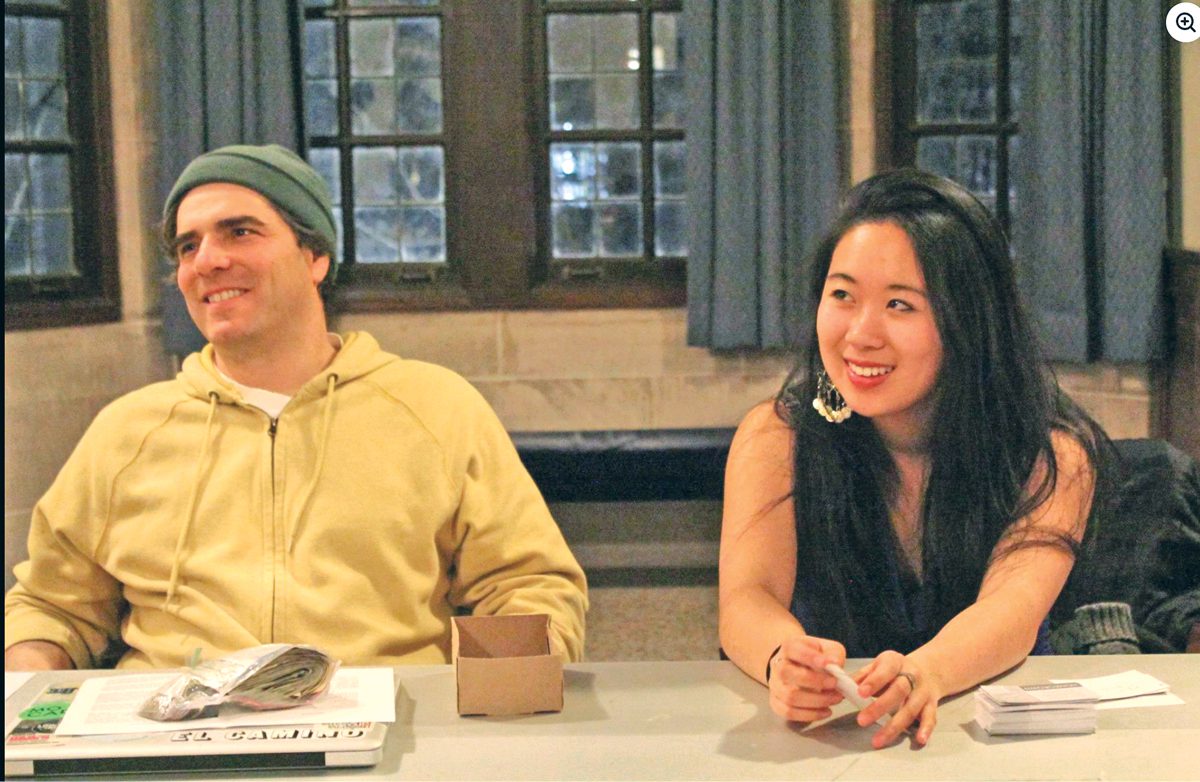
“I’m a writer who believes in multiple beginnings,” writes Carlina Duan, pictured above with Jeff Kass in 2013 at a book release for her poetry collection Electric Bite Women, cowritten with Haley Patail. “And at the root of one of my origin stories is Jeff Kass’s classroom at Pioneer High School, where I sat nearly two decades ago, age thirteen, and began to love poetry for the first time.” | Adam Hagopian-Zirkel
Poems for the People, an event to celebrate thirty years of Ann Arbor youth poetry and the retirement of longtime AAPS creative writing teacher Jeff Kass, will be held at Pioneer High’s Schreiber Auditorium on Friday, May 22 from 7–9 p.m. The event features 2025 National Book Award winner Patricia Smith, Ross Gay, Hanif Abdurraqib, Shira Erlichman, Sarah Kay, and Ann Arbor poetry alums. $15 general public, $5 students of any kind. For tickets, visit bit.ly/poemsforthepeople.
Picture this: A girl, thirteen years old, on the first day of high school. Around her, the squeak of sneakers on linoleum; hall monitors with whistles around their necks; lockers with chunky dials to spin and spin. In the cafeteria, the scent of marinara sauce and stringent lemon cleanser hangs through the air. It is 2007, and in the era of braces and popped collars and burning CDs for your crushes, that girl is now hovering behind a door on the third floor of Pioneer High School, where, through the tiny glass window, she can see a row of desks, and everywhere across the walls: Paint, posters, art. The words “POETRY NIGHT IN ANN ARBOR,” in vivid block letters. Bookshelves teeming. In the room, students lean back on hard, red chairs.
On one desk, the teacher sits in Crocs, and he opens up class with a poem. His voice reverberates against the walls: “Underneath my skin is my shirt, underneath my shirt is my heart, and underneath my heart is …”
I’m a writer who believes in multiple beginnings. And at the root of one of my origin stories is Jeff Kass’s classroom at Pioneer High School, where I sat nearly two decades ago, age thirteen, and began to love poetry for the first time.
Related: Jeff Kass (Sept. 2019)
Through the doors of our classroom floated contemporary American poetry legends: Patrick Rosal, Patricia Smith, Ross Gay, Angel Nafis, poets who spun magic out of language and made it bend. Prior to Kass’s classes, I had always loved writing, but poetry seemed out of reach for someone like me: a shy child of immigrants, who had desperate dreams to get out of Michigan and do something “useful” with my life. Encountering contemporary poets early on in my youth changed something for me. These were living poets! These were writers who looked like me, who spoke like me, and who, across proximity and difference, made me feel something electric and real and bright. Reading and writing poetry in Kass’s class began to show me how poems were not puzzles to pry open, nor dry objects to dissect, but portals that could do the critical work of organizing, questioning, community-building, rigorous and joyful innovating.
What I got from Kass’s classroom was not only a lesson in trusting my own language, but also a spark for poetry that would light up the rest of my life. As Kass’s student, I learned how to reimagine my own language, and in doing so, I learned how to reimagine what was possible for me in the world. It was this spark that would eventually lead me to read, teach, and write poetry through new cities and libraries, porches and bookstores, waterfronts and museums, community gardens and train stations, and, always, back into the doors of the classroom, where I now teach poetry at the University of North Carolina.
Jeff Kass was unlike any educator I’d ever had before. He loved poetry—and he not only taught the craft, but he practiced it. He published books; he attended readings; he organized events. Kass directed the VOLUME Youth Poetry Project at the Ann Arbor Neutral Zone, a weekly workshop for high school students. He coached the citywide poetry slam team, made up of local youth poets. He started a youth-driven publishing press, Red Beard Press, devoted to giving young people the chance to edit and publish books by contemporary authors.
I remember my first time going to a VOLUME workshop, facilitated by Kass. Around me: youth poets lay on beanbag chairs, their legs and arms kicked out like starfish. We passed around packets of poems: Martín Espada’s “angels of bread”; Aracelis Girmay’s “Ode to the Little ‘r.’” We read the work out loud. The poems’ sonic life hummed through the air. We talked. What specific lines jolted us awake? How did Girmay conjure flight and longing through her imagery? When Espada described those “hands pulling tomatoes from the vine,” could we, too, sense a tremble in our finger pads, those dark and sun-split tomatoes? Then, we wrote. Those workshops were formative education for me. They taught me that poetry could offer a method of close attention, not just to the poem, but to ourselves, to the worlds around us.
One day, freshly fifteen, as I walked out of the doors of our high school to the parking lot, I heard a voice call, “Hey, Poet! What’s up, Poet?” It was Kass. I turned around. Was he talking to me? Nobody had ever called me a poet before. At fifteen, I’d been called many things: kid, daughter, student. To be considered a poet by a real poet was mind-blowing. I started taking my own writing more seriously then, and began imagining a future for myself beyond the imposed borders of expectation: what could a life of writing look like for me, if I dared to imagine it?
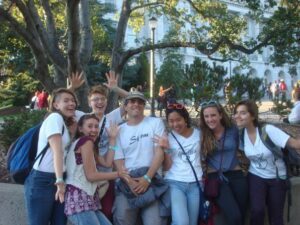
The 2011 Ann Arbor Poetry Slam Team. The team wears “Slam Chowder” shirts that feature a photo of Kass in a bowl of poetry ‘slam’ chowder. | Courtesy Carlina Duan
My senior year of high school, I made the citywide youth slam team. That summer, a group of us performed our poems on a national stage at Brave New Voices in the Bay Area of California. I remember walking with a crew of youth poets through Berkeley, the tall oaks around us glimmering. Kass was one of our poetry coaches that year, and never failed to open a reading with, “This is not your local golf tournament, but a poetry reading. If you like something you hear tonight, show some appreciation, make some noise!” And so, it was through poetry that I first learned how to listen to my own voice, rather than shy away from it. How to cheer and whoop and holler for poems, and how to stay accountable to my language.
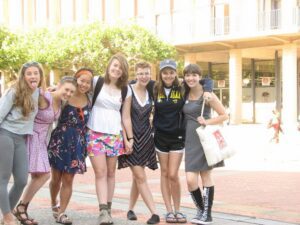
The 2011 slam team.
Kass was in the audience when I won my first writing award as an undergraduate at the University of Michigan. When I returned to Ann Arbor for graduate school in 2019, Kass made sure to come by whenever I had a reading at a local bookstore. At my book release in 2021, he read a poignant, moving poem he’d written after one of my own poems.
Kass models the kind of writer-teacher that I aspire to be with my students: generous, compassionate, humble, open to meeting students where they’re at, always looking for an opportunity to help his students get to where they need to go. His objective has always been to make sure others share the space of poetic language with him. In this way, he is not just an educator, but a community arts organizer who has stewarded generations of creative writing lovers in Ann Arbor.
Now, I work with young writers every day, work that I find deeply meaningful. And I also understand how exhausting this work is: Up against the speed of AI, a burning world, violence after violence, I often encounter questions from my students: Why poetry? Why continue to write? In these moments, it’s the experiences I had as a young poet that call out to me. I don’t know who I’d be if not for poetry, and if not for having a teacher who made sure I understood there is real power in the capacity of a poem—not in “saving the world,” per se, but in offering a chance to reflect a little bit deeper, to slow down, to gather in community, to listen to each other.

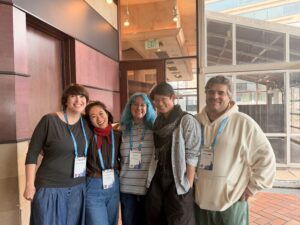
A recent photo from a gathering of Ann Arbor poets, including Duan and Kass, at the Association of Writers & Writing Programs (AWP) conference in Baltimore, March 2026.
The impact that Jeff has had on young writers is extraordinary: Many of us have gone on to continue our writing in some shape or form, and, more importantly, we continue to support one another. Many of my deepest, lifelong friendships were formed by what my friend Sonny playfully calls attending “Kass Academy”: a pedagogical ‘school’ that teaches the ways a writing life is never made in solitude. As writers taught by Jeff Kass, we look out for our friends and our neighbors, we expand writing as acts of possibility, we don’t stop pursuing what we believe in.
There’s an old idiom in Chinese: Teachers open the door, but you must enter by yourself.
While this saying puts an onus on the student to take initiative, I think the first part of this idiom is just as important. Some of us never find that door. Some of us don’t even know such a door exists.
I was one of many students of Jeff Kass’s, standing in front of that classroom on the third floor of Pioneer High School, unknowingly about to cross a threshold that would change the rest of my life.
I remember being in front of that door. I remember pushing it. I remember walking in.