
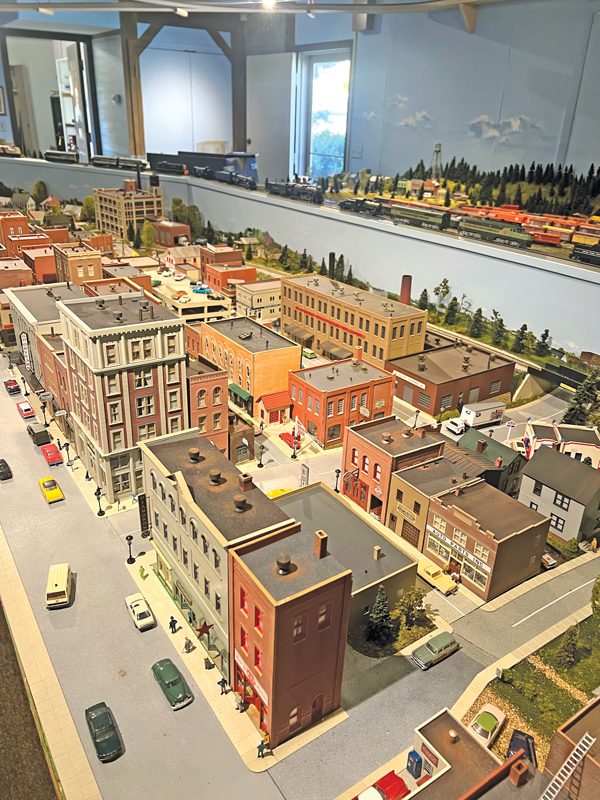
Don Butcher took sixteen years to craft a 720-square-foot model railroad featuring a replica of 1950s Ann Arbor. He donated it to the Kiwanis Thrift Sale. | Ally Choi
On March 1, the Kiwanis Thrift Sale received a stunning donation from Don Butcher: a handmade replica of the 1950s-era Ann Arbor railroad he crafted himself over sixteen years. At 720 square feet, the model is big enough to fill a three-car garage.
“It’s the largest, most complete display of a private collection I have ever seen,” remarks Realtor and Kiwanis member Doug Ziesemer.
They could break it up and sell the parts, but instead, Kiwanis is partnering with the Treeline Conservancy, Ann Arbor Model Railroad Club, and the Rotary to try to find a permanent home downtown where the display can be open to the public.
The challenges? Fundraising and space. “We’ve gotta find our home,” says Norman Herbert, director of the Treeline Conservancy Board.
Butcher spent his career working in the local construction industry; when he started building the model around 1994, he was in his seventies. Through postcards, people, and stacks on stacks of books about our town, Butcher researched and replicated the tracks and trappings of authentic 1950s Ann Arbor.
“Anytime I saw the train, I always watched it. I was always excited to see a train run; I still am,” he says. What is it about trains? “I don’t have any idea. There’s something in your blood, I guess. They’re huge, powerful big machines, and it’s amazing what they can do.”
The project was a collaborative labor of love between many people over many years. “I never was an artist,” Butcher believes. His friends from Florida and the UP helped him work on the model for weeks at a time; each house took around eight hours. An art teacher painted the skies on the walls, and a student painted a ticket office on the door.
Butcher built most of the buildings (some that light up; all built to scale) and all the switching from scratch. His workshop includes an impressive setup of supplies, including a sander, a fine jigsaw, and a maze of wires. He modified other models, dialing them up with paint, a thorough endeavor that he found “a lot of fun.” Butcher points out details I would have otherwise missed: landscapes of small sticks from real trees and bushes, windows from broken bottles. “You could stare at the thing for hours and never, ever catch everything,” he says. His work holds an intricacy much like the Thorne Miniature Rooms at the Art Institute of Chicago, sparking childlike wonder. Ziesemer says that Joe O’Neal, the owner of Kerrytown and cochair of the Treeline Conservancy, stood and stared at one block of the model for twenty minutes, naming every store downtown.
Butcher joined Kiwanis in 1959 and remained an active member for years. “The club opened a lot of doors up for me. I’d like to give it back to them.” Since 1921, Kiwanis has given over $14 million raised through the Thrift Sale in financial support to community services, including co-supporting Breakfast at St. Andrew’s. Last year, they distributed $1,346,794 in grants and gifted goods to fifty nonprofits, more than 100 community projects, and more than 700 people and families in need. Ziesemer, a Rotarian and past president of Kiwanis, works at the sale every Saturday morning, which sees around 700 customers in a six-hour period. Both the Rotary and Kiwanis share a strong commitment to helping kids succeed.
“Just imagine the joy that would be brought to many young children just to see that train set and see it operate,” says Herbert. They hope that the exhibit can serve as an outreach tool for these service clubs. Now they just need a location.
“Whether we can do this or not is still an open question,” says Herbert. “There’s work yet to be done before we feel assured it’s something that can become a reality.”