
It was a bright autumn morning for the more than 100,000 people driving to the Big House for the University of Michigan’s October 4 homecoming game against Wisconsin. Some sixteen miles west, about 250 others gathered at Chelsea Community Fairgrounds for a very different athletic contest: the annual Rode To Hell gravel bike race. Organized by Tris4Health, it featured three routes (twenty-four, forty-one, and seventy-one miles), primarily on gravel roads, with most of the mileage stretching across five townships in western Washtenaw County.
The weather was perfect, but trouble awaited at mile forty-three.
Among the participants was Marvin Boluyt, who’d encouraged his longtime friend Tomoko Murakami to join him. She had returned home to Scio Township just five days earlier after completing a two-week bike trip and mini-triathlon in Europe. Since retiring in October 2023 after nearly thirty years as an anesthesiologist, mostly at the Veterans Affairs Medical Center in Ann Arbor, she upped her fitness with pursuits such as cross-country skiing across Finland and a 100-mile, six-day ultramarathon in Colorado.
After cycling a mile and a half to Chelsea city limits, participants had no law-enforcement support for traffic enforcement. They had to navigate through a number of gravel road intersections at major thoroughfares with posted speeds of forty to fifty-five miles per hour, and without stop lights, four-way stops, or, according to Boluyt, any monitors or law-enforcement officers.
The two friends approached North Territorial Rd. in Dexter Township about three hours into the race. The route called for a quarter-mile stretch along the heavily traveled road with a posted speed of fifty miles per hour and little shoulder. Murakami led the way, searching for the route sign marking the spot for a left-hand turn across two busy lanes of traffic onto Toma Rd.
“I was a few minutes behind her, so I didn’t see what happened,” Boluyt says. “When I came upon the accident, she was lying on the side of the road in a fetal position. Her face was really quiet. I thought she might be dead. Her left leg was bent like a zigzag and there was a pool of blood.”
Murakami had been hit by a pickup truck. A route sign, signaling the turn, lay on the ground next to the accident scene. It may or may not have been upright when Murakami and the pickup truck approached.
Boluyt watched as his friend was loaded into an ambulance and rushed to University of Michigan Hospital’s Emergency Critical Care Center.
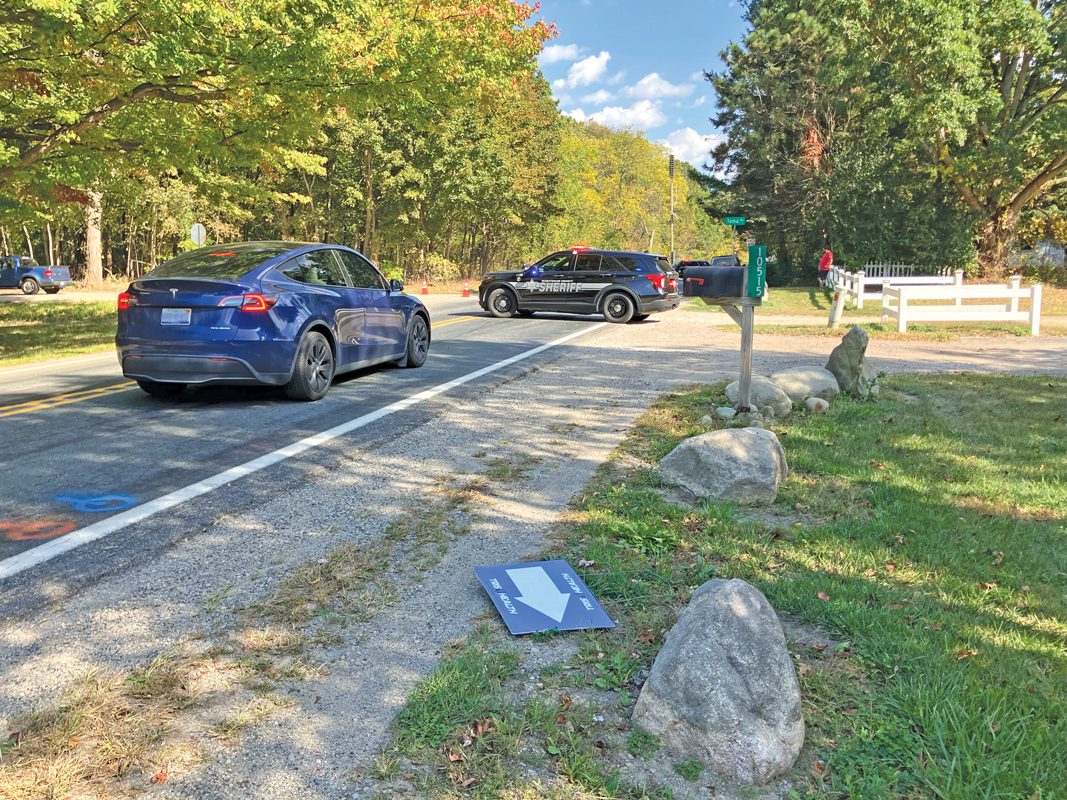
Murakami had been hit by a pickup truck. A route sign, signaling the turn, lay on the ground next to the accident scene. It may or may not have been upright when Murakami and the pickup truck approached. | Courtesy of Marvin Boluyt
There are hundreds of events held in Washtenaw County each year, and many are required to get a permit from the city, township, or village where participants gather. These special event permits give officials a chance to review the logistics of the event to ensure public health and safety. But when the activity extends across jurisdictional boundaries—as many athletic events do—the event permit doesn’t.
There is also no government mandate for race organizers to inform other jurisdictions that the race passes through. In the case of Rode To Hell, not only was Dexter Township left in the dark, so were the other four Washtenaw County townships on the bike routes, according to the supervisors of Freedom, Lima, Lodi, and Lyndon townships.
Even if they had been notified, these townships could not have required the race organizer to apply for a special event permit. They could have approached the Washtenaw County Road Commission for a permit, but WCRC only offers permits for temporary road closures. If an event only uses the road, no permit is available.
Even without a permit, officials say advance notification could make events safer. “If notified,” says Lodi Township Supervisor Jan Godek, “we would want to know the route, and contact our sergeant to advise how to assure safe passage through Lodi Township.”
The resources each township devotes to traffic enforcement have varied widely since 2000, when the county commission discontinued countywide patrols. For example, Lima, Lyndon, and Freedom rely on the limited resources of Michigan State Police (MSP) Brighton Post—which, according to MSP special lieutenant Rene Gonzalez, “was not involved in any way in this event.”
Lodi and Dexter townships, meanwhile, have contracts with the sheriff’s office for road patrols. However, according to sheriff’s office commander H. Eugene Rush, Tris4Health race organizers requested sheriff support only for two intersections in Lima Township, and none in Lodi or Dexter townships. Why only those two intersections is unclear.
As the Observer went to press, Washtenaw County Sheriff Alyshia Dyer was limited in what she could say about the collision and the driver of the pickup truck because the Traffic Division’s accident investigation remained open. But she was able to confirm that the sheriff’s department reviewed the routes in advance.
“We [typically] recommend coverage at most major intersections and areas of concern,” she says. “This type of race is quite extensive, hard to cover it all … and incredibly dangerous.”
One way to provide that coverage is to pay the cost for sheriff’s deputies willing to take overtime shifts. But Dyer explains that the office cannot mandate overtime, and no deputies signed up for the Lima Township traffic duty.
“The challenge,” she says, “is that there were so many resources taken up on Game Day.”
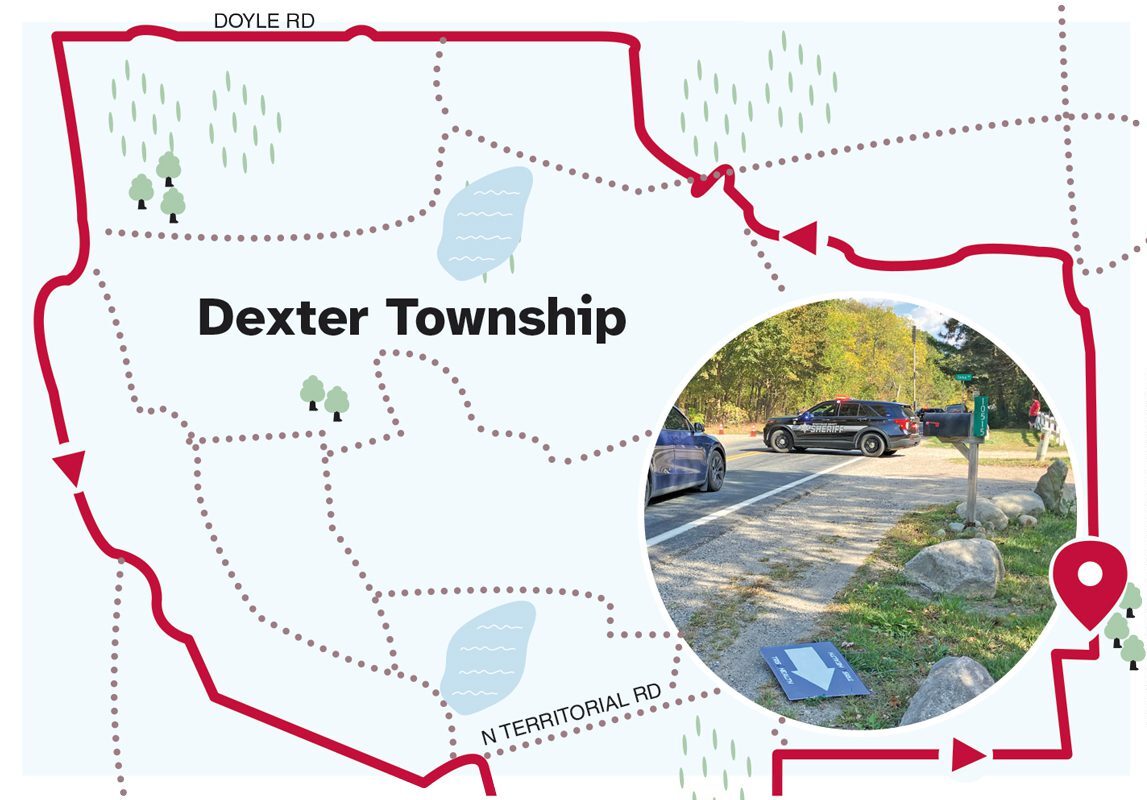
Forty-three miles into the race, Murakami was struck by a pickup truck while traveling eastbound on North Territorial. The road has a fifty-mile-per-hour posted speed limit and a narrow shoulder. | Photo courtesy of Marvin Boluyt
“Any distance along North Territorial is unsafe,” asserts long-time bike safety advocate Steven Kronenberg. “I wouldn’t walk by that road.”
After the collision, Kronenberg spoke during public comment at a meeting of the Dexter Township Board of Trustees. “I do feel there are some measures we can take to try and prevent this sort of horrific accident in the future,” he told them. Dexter Township Supervisor Lonnie Scott later sent Tris4Health a letter to “implore you to contact the appropriate authorities … to coordinate general and specific safety awareness for any future events that involve roads in Dexter Township.”
Chelsea Police Chief Kevin Kazyak also sent a post-race email to Tris4Health race director John Mosey, which the Observer obtained via a FOIA request. He cited several incidents in which cyclists ignored the prescribed route, traffic laws, and officers’ directions, which he said he believed was because the race was timed. (According to Boluyt, he and Murakami were not focused on winning the race—in fact, they were the last two riders on the seventy-one-mile route.)
“This poses a safety risk for not only your participants, but for the drivers on the road and for my officers,” Kazyak wrote. “We have held other running and bike events in the city over the years and have not experienced these types of problems in the past.” The chief added that “if you plan to hold this event within the city of Chelsea next year, the current race route will need to be changed.”
The 2026 routes posted on the Rode To Hell website have indeed been changed, and now skirt the city of Chelsea altogether. (The new starting location is Revel Run, which has a Chelsea mailing address but is located in Lima Township.) The forty-three-, seventy-, and hundred-mile routes have cyclists traveling the same stretch of North Territorial, but heading the opposite direction. They will still have to cross two lanes of busy traffic a quarter-mile west of the collision location, onto Brand Rd.
As for the logistical issues stemming from Game Day, the U-M 2026 regular football season was still pending when the Rode To Hell website announced Sunday, October 4 as the date for its 2026 race.
“We wait for the Big 10 schedule to come out before we schedule the Ann Arbor Marathon,” says Eva Solomon, the founder and owner of Ann Arbor–based Epic Races, which organized eleven running races and triathlons in 2025. She notes that off-duty law enforcement personnel are not generally available for other events during weekends when U-M has a home game.
Solomon adds that Epic’s safety protocols include informing all jurisdictions involved in an event. “We also contact the police and fire. We check with the road commission and let residents know in advance with flyers and notification to homeowner associations, and we place signs on the route.”
Officials from the sheriff’s office note that there are things that motorists and cyclists can do in these situations to keep themselves and each other safe.
Rush reminds drivers that, “vehicles must provide three feet when passing a bicycle driving straight on the roadway and always be mindful of bicycle traffic.”
“I always recommend bicyclists wear protective gear, and ensure to watch vehicle traffic, and follow all traffic safety laws,” adds Dyer. “Some bicyclists have started getting orange flags secured on their equipment for travels which can help.”
Related
Bad Connection: A death on Dexter-Chelsea Road
Staying Alive: Cycling in Washtenaw County
Tris4Health is a brand of Michigan Endurance Holdings, LLC, based in Grand Rapids. Billing itself as “a leader in endurance events,” Tris4Health’s logo includes the trademarked phrase “Athletes first,” and its website boasts “risk-free racing.” Upon inspection, risk-free refers to its refund policy, not safety. The company sponsored twenty biking, running, triathlon, and youth events in 2025. On November 10, its Instagram site announced the rebranding of its cycling events under the name Boundless Race & Ride Company.
During a brief call, John Mosey, Tris4Health co-owner and race director, declined to comment on specific questions about the Rode To Hell race and his company’s operations. In a follow-up statement, he writes, “Participant safety is our top priority. We are cooperating with the authorities as they review the circumstances of the incident. Out of respect for the athlete’s privacy and because the review is ongoing, we are not able to share further details at this time. We remain committed to supporting the athlete involved, and to continuing our work to provide safe, well-organized events for all participants, spectators, and community members.”
Murakami’s younger daughter Kai Cortright says Tris4Health’s support has been two texts from Mosey asking about her mother’s condition.
Mosey declined to comment when asked by the Observer about the frequency of incidents at Tris4Health races.
“It would be useful to publish race incidents for specific events and make it available with the general liability waivers that participants have to sign,”says Boluyt. “It would make signing that waiver more thoughtful.”
At Epic Races, the number of serious accidents totals three in its seventeen years, with none involving vehicles, reports Solomon.
“As a team, we review what happened after an incident,” she explains. “It always results in more participant education. I do something no one else does: hold a [safety-focused] Zoom call for athletes before each event, record it and put it on our website. We also have a mandatory safety meeting for the athletes fifteen minutes before the event. … We do what we need to do to keep the race safe.”

Tomoko Murakami on a bicycle tour in Europe. After retiring, she traversed Finland on cross- country skis and completed an ultramarathon in Colorado. | Courtesy of Kai Cortright
At the time of publication, Murakami was making progress in her recovery. After nearly three weeks in the intensive care unit, she moved into intensive rehabilitation.
“There is hope, she gets better every day,” said Cortright. “Mom loves a challenge and she’s got a big challenge.”
She was able to eat solid food, walk short distances with a walker under supervision, and engage in short- to medium-length conversations. She says she doesn’t remember anything about the collision.
“It’s disappointing that more wasn’t done to make that intersection safe for the participants,” reflects Cortright. “Incidents like this should never occur in an organized event. Cyclists should be able to trust that race conditions are secure and that their safety is a top priority.”
This article has been edited since it was published in the January 2026 Ann Arbor Observer. The caption for the second photo has been amended for clarity.
I appreciate The Observer giving this story attention. However, the article significantly downplays the race organizer’s responsibility. Making a left onto Toma Rd from North Territorial comes immediately after a substantial dip in the road; drivers behind a cyclist may not even see them until it’s too late. No one—on foot or on a bicycle—should be crossing there, much less being directed to do so.
Being struck by a truck at 40–50 mph—it’s a miracle she has recovered as much as she has. This article should also be more explicit about the implications and extent of her initial injuries—trouble with conversation months after the injury indicate a TBI, which could have had a much worse outcome; the speed of the impact on a 60-70 year old (nearly thirty years as an anesthesiologist) those protruding breaks and likely internal bleeding are common, and fatalities are not unusual. And that is the ugly point: the consequences for the racing company would likely be very different if she had died. No matter how much quality of life she’s lost, how close she came to death, or the toll this has taken on her daughters, this will be recorded as an “injury,” when in reality it was very likely a preventable near-fatality (if the crossing described in the article is accurate). That’s not fair to Tomoko and it’s not fair for future riders.
Many thanks to The Observer for covering the story. Love and support to the family—and shame on the race organizer.