
Less than ten minutes into her biweekly Panera coffee klatch with seven other moms of Huron High juniors, the school district calls Melanie. She sends it to voicemail and then the group watches as her iPhone transcribes in real time the familiar automated message alerting Melanie that her daughter is not in school.
It almost seems to amuse her; her daughter, who plays on a nonschool travel sports team, often misses class. Melanie, who asked for anonymity, doesn’t mind because the teen still gets excellent grades by keeping up with her work through the school’s online portal and leaning on friends for class notes.
“Being there in person just isn’t as important as it used to be,” she says, the other moms nodding along. “It’s not like it used to be when we were kids. It’s not like teachers can penalize a kid’s grade for excused absences. They just work around it.”
Huron has one of Michigan’s highest chronic absenteeism rates: 68.6 percent of its students in the 2024–25 school year—more than two-thirds—missed at least 10 percent, or eighteen days, of class. Ann Arbor Public Schools’ other two traditional high schools aren’t much better: Pioneer’s rate was 63.7 percent, and Skyline’s was 61.6 percent. (Chronic absenteeism rates include excused and unexcused absences, but neither AAPS nor the state collects data on how many of each are occurring.)
“That is an extraordinarily high level of chronic absence,” says Hedy Chang, CEO and president of Attendance Works, a nonprofit focused on reducing school absenteeism. Jeremy Singer, a U-M Flint education professor who studies the impact of absenteeism, agrees: “These numbers are definitely a bit starker than I would have expected just based on my impressions of Ann Arbor.”
For context, of Michigan’s 138 high schools with more than 1,000 students, AAPS’s three are among just eleven with chronic absenteeism rates over 60 percent in 2024–25, according to state data. Only seventeen statewide had rates over 50 percent. Meanwhile, Saline and Dexter, the other Washtenaw County high schools with more than 1,000 students, had chronic absenteeism rates of 14.7 percent and 10 percent respectively.
There’s little consensus on why Ann Arbor’s numbers are so bleak—or if it’s a big deal. Students at all three schools, after all, still score significantly above the state average in several student-achievement measures, including the M-STEP exams and the SAT.
And absenteeism evidently hasn’t depressed graduation rates, either. For the 2024–25 year, Skyline’s rate was 90.2 percent, Pioneer’s was a lofty 95.2 percent, and Huron’s was 83.9 percent. Huron’s is a tick lower than the state’s 84 percent average, but not as proportionately out of whack as its absenteeism numbers.
Chang says overall school achievement data can mask the broader impact; neither the state nor the district collects specific data on test scores or graduation rates among chronically absent students. And, while the threshold for chronic absenteeism is eighteen days missed, the average number of days missed in Washtenaw County is thirty-eight, says Naomi Norman, superintendent of the Washtenaw Intermediate School District (WISD).
“Over a thirteen-year school career, that’s 494 days of school or the equivalent of 2.7 years of education,” she says. “So when you ask if it has an impact on educational outcomes, I would say yeah, they’re gonna be about three years behind at least.”
Having such inconsistent attendance also “makes it harder for teachers to teach and to set classroom norms,” Singer says. “If you’re doing a group project and the other kids didn’t show up, how do you finish the group project? It really slows down the pace of instruction. It impacts everyone in the class.”
Roberta Heyward, AAPS’s executive director for K–8, middle, and high school education, calls the problem “a crisis and it’s something that we are focused on and we are going to continue to work on because we want all of our students in school engaging with their peers, with our dedicated staff.”
But AAPS board president Torchio Feaster says Heyward’s boss, superintendent Jazz Parks, has yet to strike such an urgent tone. “When I’ve had conversations with the superintendent about it, they’ve expressed that since people went to online for Zoom learning during Covid, absenteeism has gone up across the board, across the state and the country, and that they don’t particularly think that it’s going to go down. They think that people have decided they’re going to change the way they do education, the way they live life, and that people are going to take the time off and the days off that they want to take off, and that there’s not a whole lot that, from a district standpoint, they think we can do to make them come to school.”
Parks, through a spokesperson, sends a written response: “While it is true that post-Covid we have seen a rise in student absenteeism for a host of reasons, including more students staying home when they are ill now, students have access to remote learning more so now than in the past and with the increase in remote work, more families have a parent at home when students are ill or need support. We still feel like we need to work with families and community agencies to increase the rate at which students are attending school each day. This includes ensuring safe and engaging school communities, that there are consistent processes for attendance monitoring across the district and collaboration with not just families but also community agencies to remove barriers to student attendance. We’re going to try everything we can, our absolute best, to get students to come to school every day.”
Still, Feaster says, “This is the first time I’m hearing about the 60 percent. That’s a huge number. … It’s something that the board should probably be looking into more.”
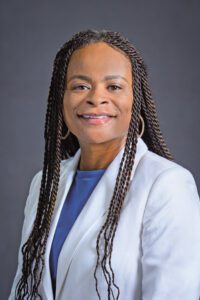
Roberta Heyward, AAPS’s executive director for K–8, middle, and high school education, calls the issue of chronic absenteeism “a crisis.” | Courtesy of AAPS
It’s true that chronic absenteeism rates soared across the state and nation after the Covid pandemic. Statewide, the rate for all K–12 students sat at 19.7 percent in 2018–19, the last academic year unimpacted by Covid. By 2021–22, when virtually all schools had resumed in-person learning and halted hybrid options, it hit 38.5 percent. The state’s average fell to 27.9 percent in 2024–25. AAPS’s rate, 35.8 percent, is well above the state average and WISD’s of 30 percent.
It wasn’t always this way, though. AAPS’s K–12 chronic absenteeism rate was 13.3 percent in 2018–19, far below the state average. That year, Huron High’s rate was 19.7 percent, Pioneer’s was 17.2 percent, and Skyline’s was 21 percent.
Jeremy Singer, the U-M Flint researcher, found that rates went significantly higher the longer a school district remained in online-only mode during the pandemic—and AAPS stayed virtual for almost a full year. Most Michigan schools started the 2020–21 year with a hybrid or in-person model, but AAPS did not even offer a hybrid option until March 2021.
“I have seen some evidence that districts that were in remote learning for like five, six, seven, eight, nine months in that 2020–21 school year definitely have seen a bigger hit to their attendance,” Singer says. “It impacted family-school relationships. It affects habits or mindsets about the importance of being there in person.”
Related: Anxious Parents Weigh Back-to-School Options (Sept. 2020)
Home. School. (Nov. 2020)
Schools in Washtenaw County largely focus their anti-absenteeism efforts on kids whose parents are uncommunicative and whose grades are suffering. “It’s not like they’re saying, ‘I wanna skip school, I’m not gonna go,’” Norman says. “Often, it’s not the kids’ fault. Imagine a family who’s had to move three times to three different apartments in the last six months and maybe there’s a health issue with the single parent who’s raising the kids.”
Students may miss school if transportation issues arise. Some districts set aside funds to help—nearby Lincoln High had two students taking Uber to school one week in February, principal Wendy Bridges says—but AAPS does not. The best AAPS principals can do, Heyward says, is ask parent-teacher-student organizations to intervene with gift cards or bus tokens.
Whether absences are excused or unexcused, families receive letters and calls as missed days pile up. If parents don’t alert schools prior to an absence, they get a call like Melanie did. Parents can also opt in to text alerts when their child misses even a single period of instruction.
When the student has missed the equivalent of five full days, the school sends the parents a letter alerting them and inviting them to get in touch. At ten absences, there are more letters and calls by school administrators to the family and, if necessary, attempts to arrange a meeting. At fifteen absences, WISD is notified and may conduct home visits. In some cases where abuse or neglect is suspected, law enforcement may be asked to do a wellness check.
Requests to speak directly to the administrators at the three high schools were routed back to AAPS public relations, which did not arrange interviews. Heyward, the only secondary education administrator provided by AAPS for comment, offers a range of reasons for the district’s struggles while admitting they are still “gathering information.”
Yet none of Heyward’s reasons are unique to AAPS. She notes that post-Covid, students who are even slightly ill or struggling with mental health issues stay home more, and that kids can pick up assignments online to stay up-to-date, making attendance seem less necessary.
“We see challenging realities of homelessness or food insecurity, and that obviously has a significant impact on attendance,” she adds. “We know that families may have to work, older siblings may have to care for their younger siblings. And the presence or perceived presence of immigration officials in our community, some families may elect to keep their student at home. So there’s a myriad of reasons.”
Bridges was dismissive. Lincoln High has a greater rate of economic disadvantage than Huron but a 25.6 percent chronic absenteeism rate. “Every school has these problems, it doesn’t matter how small you are, how big you are,” she says. “I would say, our students like being here, so they come willingly. Our families are supportive. They’re engaged in their education, and they value education.”
Heyward says AAPS is “engaging in research, looking at other districts, and seeing what we can do to ensure that our students have minimum barriers and they’re able to get to school every day.”
The county is working on filling some of the gaps. In 2023, with funding from a county millage, WISD formed the Bridge team of social workers and “wraparound” specialists skilled in helping young people facing mental health challenges access a community resources with the goal of increasing attendance. Chelsea Parker, one of those specialists, says most of the clients “miss a lot of school for many reasons. They’re in juvenile detention or they have depression and don’t want to go to school [or] they’re staying away because of something that happened at school.”
This fall, WISD will add direct referrals from schools regarding specific chronically absent kids, but there are already three Bridge team members taking on cases. That means meeting with families, getting a sense of what they need, and pulling in community partners like Community Mental Health or a food bank for support.
Improving AAPS’s numbers could take a while, says Jason Wesley, WISD’s attendance coordinator. Wesley was hired in September to focus on this problem. “Right now, we’re in the development stage, meaning we’re going out talking to the school leaders, asking them the same questions that you’re asking: What do you think the barriers are? How do you think that we can do better?” says the former principal of Parcells Middle School in Grosse Pointe Woods. “Typically, it takes from one to three years for reductions to really start to sink in.”
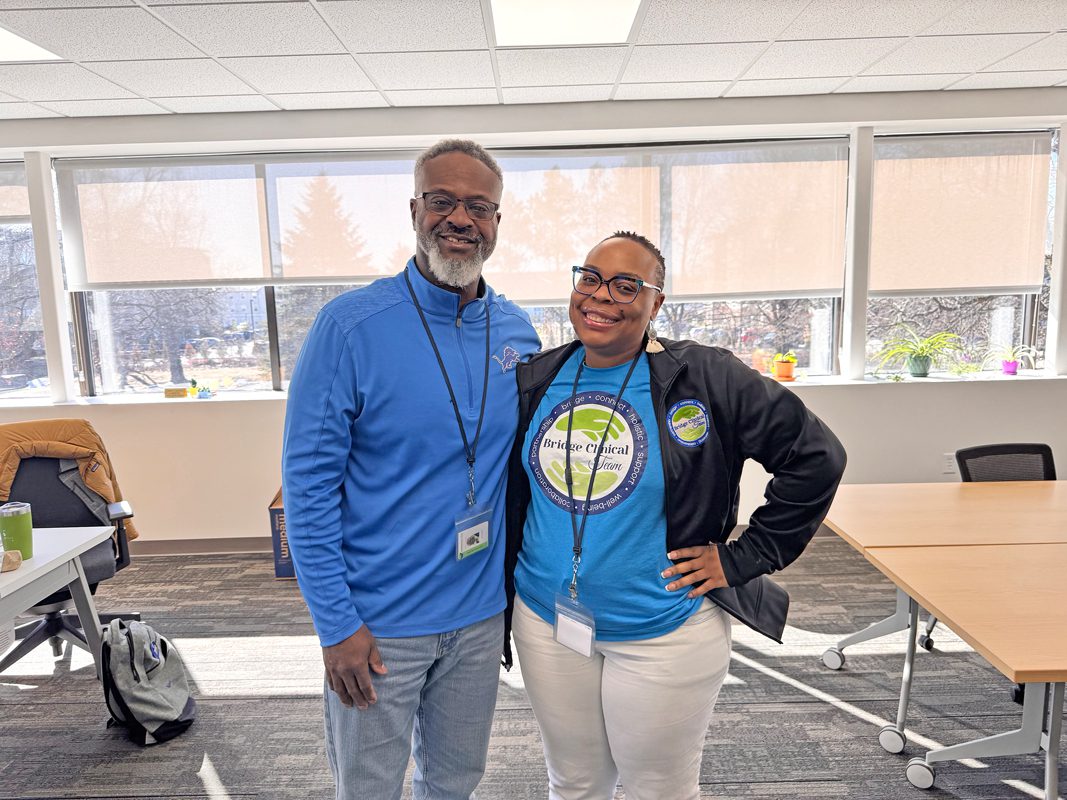
WISD attendance coordinator Jason Wesley works on reducing absenteeism. Bridge team wraparound specialist Chelsea Parker connects students experiencing mental health challenges to community resources, with the goal of increasing attendance. | Steve Friess
If you wonder how so many parents get away with not making their kids go to class, the answer is there’s no will in Washtenaw County to prosecute families over this. Even as Huron High’s website, for instance, twice cites state law requiring students under eighteen to attend, nobody interviewed for this report could recall a single instance in the recent past when anyone was held legally accountable.
“The general consensus of our staff is that we just feel like we don’t have any teeth because in our county, we don’t have penalties or fines or anything like that through the truancy lens,” Saline High dean of students Jen Barnard says. “In other counties, they may be penalized, they may have a fine for not having their student go to school. For Washtenaw County, that does not exist right now.”
Bridges, the Lincoln principal, echoes this. “I have called truancy, I have called the courts,” she says. “Basically, what is supposed to happen is we inform WISD. They’re supposed to contact the court systems about truancy. They’re supposed to help us, and nothing happens. I had one kid where I called probably six, seven times, I just kept doing it. I just kept calling. I didn’t care. I was just gonna hound them, and they still didn’t.”
Norman says even when the prosecutor’s office enters the picture, it often is more trouble than it’s worth. “Several years ago, we took several cases to the prosecutor’s office,” she says. “It was a very heavy lift—we had to ensure many earlier steps were taken and documented—and it didn’t end with the student attending school.” She says she’s “sorry someone had the experience where they didn’t feel like the ISD team supported them” but that she wants “to be realistic about our capacity. Historically we have had one person who has to help navigate the 13,000 kids who are chronically absent.”
Washtenaw County prosecutor Eli Savit says truancy is not his bailiwick. “Our office does not generally receive truancy cases (and this has been true for quite some time),” he writes. “Truancy matters are filed directly with the court without prosecutorial review. It is our understanding that the court generally handles those cases informally and seeks to provide support to families.”
Views differ on how much the legal system should be involved. Bridges believes there could be value in “bringing that kid or those parents in front of a judge to say you need to be in school, to emphasize the importance of that, and then here’s what’s going to happen if you don’t show up to school. The consequence has to be severe enough that the behavior will change. When they know there’s no consequence, nothing’s going to change.”
The lack of muscle in attendance enforcement helps explain why that group of moms at Panera are so relaxed. Melanie, whose daughter is missing school to play on a travel sports team, isn’t close to the chronically absent threshold yet, but two other moms in the group have children who are.
In one case, the child had two bouts with the flu. In the other, the student skipped school for three weeks to join the family overseas on their father’s work trip. “Our kids got to see the world, which I think is at least as valuable as sitting in a class learning geometry or reading Macbeth.”
Mostly, though, Melanie thinks the district brought this problem on itself. During Covid, it proved to parents that kids can make good grades from home—and once the pandemic was over, there was really no significant push to emphasize attendance.
“I get that they have a lot of other problems and a lot of other things to do,” she says, “but so do we. If my daughter needs a mental health day or is even a little bit sick, I’m okay with that. She’s a good, active kid. It’s not like colleges are going to know or care.”