
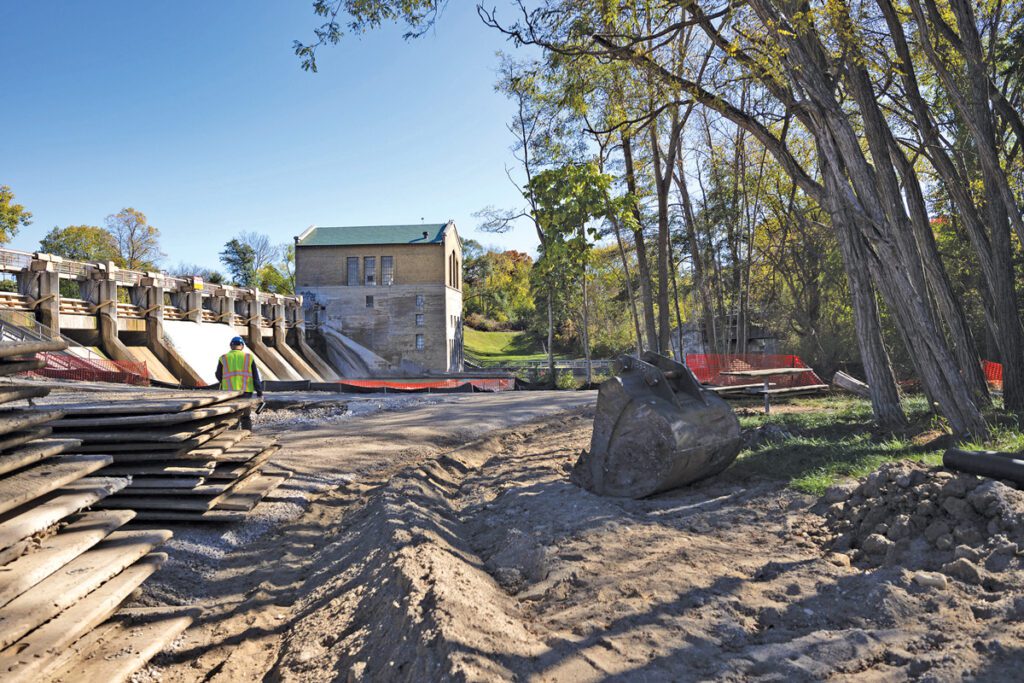
Barton Dam’s new “mineral drain” will prevent erosion while giving a safe path downriver to any water that may sneak through. Building it is a slow process; weather permitting, this year’s work will continue into December. | Mark Bialek
When I lived in Ann Arbor back in the 1980s, Barton Dam was barely on my radar. The Huron River was scenic enough from the road: a heron or hawk here and there, maybe a deer ambling just off the shoulder. The dam itself, tucked out of sight from Huron River Dr., might as well have been invisible.
But last fall, cruising west to soak up the colors, my wife and I noticed a small parking turnout just past Bird Rd. and spotted a trailhead. “Good enough,” we thought, and off we went down the quarter-mile gravel path.
The Huron and other southeast Michigan rivers were first harnessed by the East Coast adventurers and fortune seekers—including Ann Arbor’s founders—who settled here in the 1820s. The federal government pushed Michigan’s Native Americans west, then sent out the call as far as Europe, offering eighty-acre plots for as little as $1.25 an acre.
The settlers dammed the Huron to power sawmills and grist mills that ground corn and wheat. The first electrical generator was installed around 1884 near Dixboro Rd., and twenty years later, the Detroit Edison Company began buying up water rights to build new dams and generating stations. Barton was the first locally, in 1912, followed by Argo, Geddes, and Superior.
Related: Tragedy at Barton Dam: A fatal outing in 1913
Electricity was the modern miracle, and the dams were part of that promise. The power they generated lit shop windows downtown and gave Ann Arbor a taste of what progress looked like. The dams weren’t just another piece of infrastructure—they were the future, humming right there on the Huron River.
In the 1920s, Edison built massive, coal-fired generating plants along the St. Clair and Detroit rivers. The dams’ output paled in comparison, and they eventually cost more to maintain than the electricity they produced was worth. Edison sold all four local dams to the city in 1963.
The sale secured the city’s primary source of drinking water: Barton Pond supplies about 85 percent of Ann Arbor’s needs, with wells providing the rest. It also opened up the riverfront at Barton, Argo, Furstenberg, and Gallup parks.
Related: Return to the River
But with the dams came the responsibility for their safety. In the 2000s, a leaky embankment at the Argo Pond headrace led to a state ultimatum and its replacement: the Argo Cascades.
Scrutiny grew tighter after two dams near Midland failed in 2020. An inspection found seepage through Barton’s earthen embankment—invisible to anyone walking a trail, but worrisome. Left alone, it could cause erosion, even collapse. Barton may look solid, but Mother Nature always tests what we build.
When regulators at the Federal Energy Regulatory Commission (FERC) flagged the leakage, the city had to act. This summer, the area below the dam bristled with payloaders and dump trucks placing carefully specified layers of sand and gravel on the downstream side of the embankment.
“Seepage itself is not the primary safety risk,” explains City of Ann Arbor Senior Utilities Director and on-site program manager Glen Wiczorek. “It is the loss of material that leads to voids and stability issues.” The new “mineral drain” will prevent erosion while giving a safe path downriver to the water that sneaks through. Wiczorek writes that this “proactive and carefully monitored approach lowers the risk of catastrophic failure and protects downstream communities and critical water infrastructure.”
But because the river, the road, and the railroad all limit access, it’s a slow-motion process: tens of thousands of cubic yards of aggregate must be hauled in and placed five cubic yards at a time. Wiczorek says that, weather permitting, this year’s work will continue into December.
Across Michigan, other towns are making other choices. Dexter took down the Mill Creek Dam in 2008, and last year, Ypsilanti won a grant to remove the Peninsular Paper Dam. But Barton’s “critical water infrastructure” ruled out the option of removal.
There’s also an environmental tradeoff. “Less than an acre of wetland was lost in the process,” Wiczorek writes, which was “traded back through the purchase of mitigation credits elsewhere in the watershed. … As required by the state department of Energy, Great Lakes, and Environment (EGLE), 1.5 times the lost acreage will be added in a newly created wetland” elsewhere in the watershed.
From the pond itself, all this is invisible. Geese, ducks, and swans still swim in the deeper water, while herons hunt in the shallows upstream. Paddlers launch canoes and kayaks, fishing lines are cast, and Barton’s hydroelectric turbine hums along, generating up to 900 kilowatts—an insignificant share of the grid, but enough to offset some of the city’s demand.
Related: Barton Dam: Picturesque, historic, and green
Since Barton is regulated by FERC, doing the work was not open to discussion. Still, since January the city has posted regular updates via press releases, newsletters, and a dedicated project page. If you wanted to follow along, you could.
But few seemed interested. Wiczorek emails that fewer than half a dozen questions came in over the course of the last eight months, and all were answered. Ann Arbor residents may argue about development downtown, bike lanes, and roundabouts, but when it comes to the dam that keeps their taps flowing, they seem content to let it stay in the background.
There’s still more work to be done. Next spring will bring restoration of local vegetation and a connection to a new pedestrian and bike underpass, connecting Barton Nature Area’s stretch of the Border to Border Trail with Bandemer Park and the rest of the B2B network to the east. The $12 million project is scheduled for completion in June 2027.
Walking the trails near Barton now, my wife and I breathe in the smell of damp fall leaves, sweet and earthy. We expect the familiar crack of ice on the banks of the pond in winter, when the freeze begins to loosen and shift. The chorus of frogs will follow in late spring, answering each other from opposite banks. Barton Dam is stitched into all of this, a hidden seam holding the landscape together.
I’ve loved the dam, especially crossing over it in winter. The ice structures that form below are extraordinary, especially when the sun is out. Like little I’ve seen.
Viait the damn in winter, when the water coming over it is frozen. Extraordinary site.
FERC wants to limit access to the dam and pond once repairs are complete. Ann Arbor needs to prevent this.