
“The system is the problem,” says Missy Stults, director of the Office of Sustainability and Innovations (OSI), which is why A2Zero focuses on institutionalizing change. Unwinding entrenched policies that have shaped development patterns and limited community choices for decades takes time—so why did A2Zero set a ten-year timeline? Stults insists that the plan’s ambitious pacing was necessary to maintain a sense of urgency about climate impacts.
Related
A2Zero: City council approved an ambitious $1 billion plan to achieve “carbon neutrality” by 2030.
A National Oceanic and Atmospheric Administration state climate summary for Michigan reports that statewide average temperatures have risen almost 3 degrees Fahrenheit since the beginning of the twentieth century, and are expected to rise an additional 3 to 7 degrees by 2050. Precipitation has increased 44 percent since the 1950s, and total rainfall during extreme events increased 37 percent since 1981.
“I think that, for my purposes, the real goal was to turbocharge the transition to the clean energy economy and that the carbon neutrality by 2030 goal is aspirational and inspirational,” says Michael Garfield, executive director of the Ecology Center, one of the key collaborators on the plan. “I don’t think we’re going to come close to it. I think that’s okay too.”
The A2Zero Dashboard tracks progress across the plan’s seven impact areas: renewable energy, electrification of cars and appliances, energy efficiency, transportation, circular economy, community resilience, and “other,” which includes carbon offsets. Heating and providing electricity for buildings accounts for 68 percent of total greenhouse gas (GHG) emissions, and transportation within the city limits accounts for 30 percent.
Here’s the good news: total emissions have declined 15 percent between 2019 and 2024.
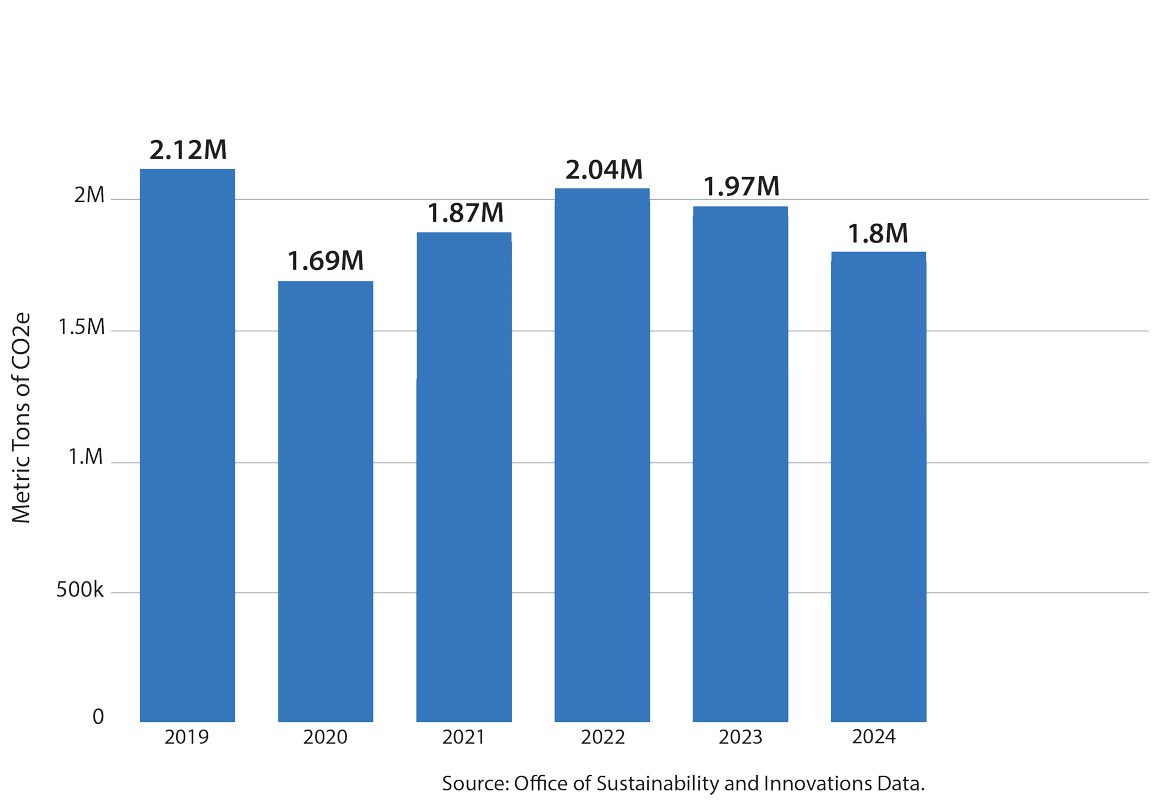
One area of notable progress is renewable energy consumption, which has more than doubled to 32 percent of total energy (though still a ways from the city’s goal of 100 percent). The number of registered electric and hybrid cars increased from 8.1 percent in 2021 to 13.6 percent in 2025—boosted in part by the conversion of nearly all of the city’s fleet to electric. A2Zero’s goal is for 50 percent of vehicle miles traveled in Ann Arbor to be in EVs.
Another area of strong progress is a reduction in residential natural gas consumption, which dropped 28 percent between 2019 and 2024—exceeding the A2Zero goal of a 12 percent reduction. Residential electricity consumption also fell, albeit at a more modest rate of 3 percent; the goal is a 16 percent reduction.
There are other wins. A2Zero set a goal of 78MW of new, local, renewable energy generation, and so far 16.44MW of solar have been installed—21 percent of the way there. And as of 2026, 93 percent of streetlights are LED, up from 37 percent in 2019.
Progress on transportation, which aims to reduce vehicle miles traveled by 50 percent through expanding public transportation and building more park-and-rides, has been limited so far. The A2Zero plan targets 25 percent of in-city trips by walking or biking by 2030—a goal that appeared to have already been surpassed in 2019, when 49.9 percent of trips used those modes—but that share dropped to 38.8 percent by 2023. Likewise, the goal of 40 percent of remaining in-city trips using public transit remains distant, with bus trips edging up only slightly from 2.9 percent in 2019 to 3.2 percent in 2023.
Raising awareness does not itself reduce emissions, but it is nevertheless crucial to generating support for A2Zero. The city held 110 events in 2021 and 255 in 2024, ranging from the Green Fair and A2Zero Ambassador Program to clothing swaps and repair days. And while there are no emissions reduction data available on the circular economy, the City has launched year-round residential composting pickup and is working on expanding commercial recycling with the goal of properly sorting waste streams and reducing the amount of waste generated overall.
Progress has been made, albeit slowly, but it now faces limiting factors outside the city’s control. The 2026 state budget phases out renewable energy tax credits and halts funding for grid modernization, solar expansion, EV chargers, and home weatherization. Further, the Trump Administration has systematically dismantled nearly all federal programs and legislation designed to reduce climate change, most notably the Environmental Protection Agency’s 2009 Endangerment Finding, which allows the agency to regulate GHG emissions.
Related
Target: Environment
“The A2Zero plan as originally contemplated recognized that we needed state and federal action in order to make the goal,” says Ann Arbor Mayor Christopher Taylor. “For a time, the federal government was a great partner, but that time has passed. We are doing what we can as we can within the power of community and local government, and that’s all we can do.”
But even as shifting priorities at the state and federal level have closed some doors, others have opened. The OSI won a $10.8 million grant in 2025 from the U.S. Department of Energy to implement a district-scale geothermal heating and cooling system in the Bryant neighborhood. “Obviously we lost all solar and wind tax incentives, but we maintain geothermal. So we’re going to do a geothermal push,” says Stults. “I don’t know that I would have told you that in 2020.”
The OSI has also found a surprising ally in DTE. In April 2025, the city renewed its heating franchise agreement with the utility—a controversial decision given DTE’s reputation for costly, unreliable energy. But the new agreement is the first in the U.S. to integrate explicit climate commitments to support carbon neutrality goals. DTE’s bid includes workforce training to build the labor force necessary to install networked geothermal systems. Separately, the utility has also bid on the Bryant Park project. The climate impacts of long-term projects such as these will only be felt after A2Zero ends in 2030.
While the seven strategies are advancing unevenly—some requiring more time and investment than others—all are vital to reaching carbon neutrality. The A2Zero plan estimates that transportation strategies will cost $901 million and deliver an emissions reduction of 8.5 percent. So far, transportation emissions have not budged, and on paper that can make these efforts look like a poor investment. Taylor insists, however, that the investment is worthwhile because of both the carbon neutrality benefits and the improvements to quality of life. “With the promotion of efficient mass transit and mode shift, we improve people’s lives. We improve safety. We improve transit time,” he says.
By contrast, buildings account for 68 percent of city emissions, and the plan budgets $14.5 million for energy‑efficiency investments that would reduce emissions by 13.4 percent. The potential return on investment compared with transportation makes energy efficiency an obvious candidate for increased program funding, but the city has no direct say over the choices residents make.
“People are making decisions about whether they’re going to install solar, whether they’re going to buy a heat pump, whether they’re going to get an electric car, whether they’re going to walk places. The city only has so much control over that,” says Garfield. “But there are policies that they’ve been trying to put in place to change behavior.” This includes programs like Property Assessed Clean Energy (PACE) and the Home Energy Rating Disclosure (HERD), which aim to incentivize developers and homeowners to make energy efficiency upgrades. In the courts, Ann Arbor is pressing for more efficient building and energy codes. Together, these initiatives shape markets but may not show strong progress until after 2030.
Stults regards A2Zero as a guidebook rather than a blueprint. The plan contains forty-four actions, but in practice her team is working on more than eighty. “So we do not hold fidelity to the actions,” she says. “We hold fidelity to the seven strategies in A2Zero because the world keeps changing.”
A2Zero has altered markets and created new regulatory and financial tools to accelerate the clean energy transition—even without the authority to mandate many of the changes required.
For Stults, progress is measured not only in metric tons but in momentum. “If you want to be carbon neutral, you have to do it all right,” she says. “We have to figure out land use and transit. We have to figure out how to decarbonize homes. … If we get partway there, that’s good, but that’s not the goal. The goal is all the way there.”
This article has been edited since it appeared in the March 2026 Ann Arbor Obserer. The name of the Bryant neighborhood was corrected.
It’s almost insane that we are spending 1.1 billion dollars on some magic idea that our climate is getting worse and that being net neutral will make our climate better. In general, a warmer CO2 rich atmosphere is better than a colder CO2 poor atmosphere. This article quotes NOAA which chooses arbitrary dates to make it seem like things are going downhill. Why was 1981 chosen as the year to compare total rainfall during extreme rain events? Why does the article neglect to present an alternative view or data that runs counter to the climate alarmism narrative? For instance, the hottest temperature recording in Ann Arbor was on July 24th, 1934 when the high was 105 F. The month with the most precipitation on record was July 1902. The year with the most days above 100 F was 1936 with 7 days. The latest day in the year above 100 F was August 23rd, 1898! These records can be found at http://www.extremeweatherwatch.com. Now just imagine Ann Arbor spent 1.1 billions dollars on purchasing farm land to grow and provide free food to our residents. Or chose to spend 1.1 billion dollars turning the public easements into mini vegetable gardens. In summation, the Ann Arbor Observer should stive to give their readers a fair, unbiased, and impartial view of climate and climate action.
Hi Drew,
Thanks for taking the time to engage so thoughtfully with the piece—I wish more people did!
You’re right that some of the most extreme weather Ann Arbor has experienced happened a long time ago. But climate science looks at long-term global trends, not just individual extremes. All the temperature data I’ve seen show how average temperatures have increased significantly and we broke record temperatures every year from 2014-2024, with 2025 being very slightly cooler than the previous year.
There number and intensity of storms in the North Atlantic has also gone up, and the cost of storm‑related disasters has risen sharply, driven by a mix of more intense events and more exposure of people and infrastructure in coastal and flood‑prone areas. Home owner’s insurance has risen sharply as a result–and don’t I know it!
When it comes to precipitation, baselines like 1981–2010 aren’t arbitrary—they’re standard 30-year “climate normals” used to track change over time. When we compare recent decades to those baselines, we see clear increases in heavy rainfall events across the Midwest, including Southeast Michigan. It would be interesting to know if rainfall was already changing in the previous 30 years.
I’m part of the farmland preservation movement and am glad to be able to say Washtenaw County is one of the very few counties that isn’t losing farmland. Moreover, through our various publicly funded conservation groups we’ve permanently conserved over 8,000 acres of farmland–at or near the top for the state.
Reasonable people can absolutely debate how much to invest and where. My goal with the article is to help readers understand how local decisions connect to climate trends, and what our city is doing to reduce emissions.
I appreciate you raising these questions—it’s a valuable conversation to have.
Trilby
Please note that the neighborhood is not “Bryant Park,” it’s just Bryant. Bryant Park is in New York.
Drat, so sorry about that! It’s been corrected.