
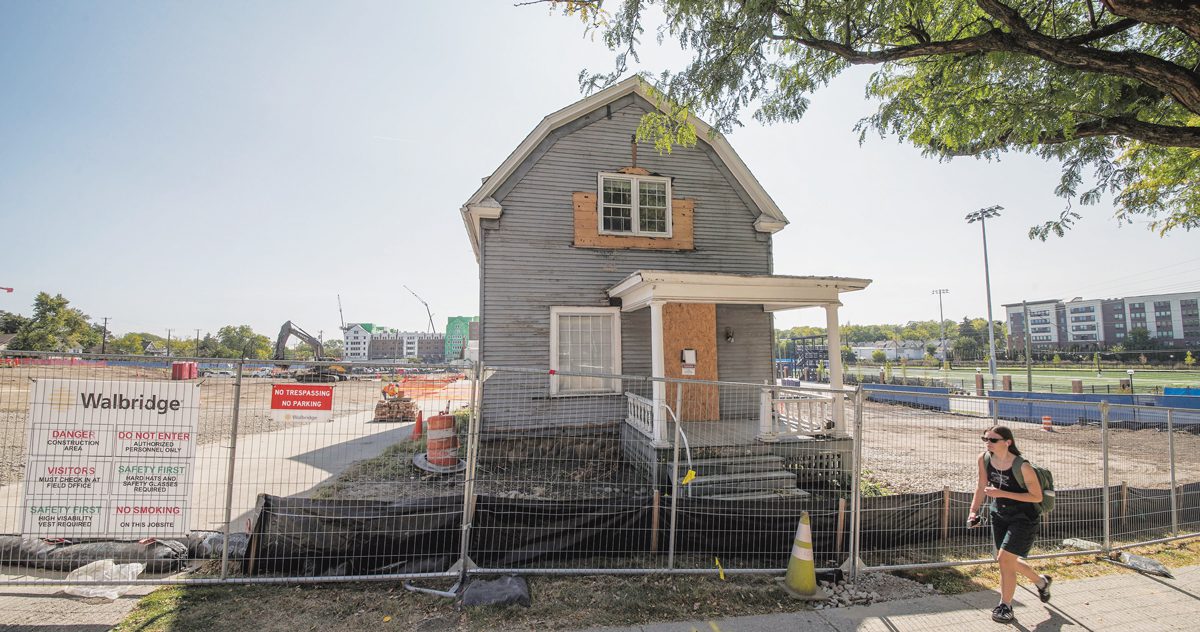
The Wallenberg house on E. Madison stands alone on the site cleared for the next phase of the Central Campus dorm project. | J. Adrian Wylie
Over the summer, a neighborhood vanished. In the hilly rectangle bounded by S. Division, Hill, Fifth Ave., and E. Madison, backhoes methodically crushed scores of wood-frame houses, a handful of small apartment buildings, and the old Fingerle Lumber sales room.
By early September, all that remained were the U-M Coliseum on Hill and a lone house at 308 E. Madison. It will soon be gone as well, but not as rubble in an eighteen-wheeler—it will be carefully lifted off its foundation, mounted on wheels, and hauled uphill to Division, then two blocks north to a U-M-owned lot at the corner of Jefferson and Division.
Related: The New Dorms
Like the demolished buildings, 308 is in the way of a new U-M dorm, the second of a pair advocated by former president Santa Ono. (The first is on the old Elbel Field south of Hill.) It was spared because ninety-four years ago, a Swedish architecture student named Raoul Wallenberg moved into what was then a rooming house.
“All Ann Arbor consists of one-family houses, and I live in one of them,” he wrote home to his grandfather, Gustaf, in 1931. “The streets are very wide and lined by trees. My room is bright and has one small and one large window in two directions. The sun is shining in on Sundays because on other days I am not at home.”
He graduated at the top of his class, but found his U-M degree didn’t qualify him as an architect in his home country. After working briefly in South Africa and Palestine, he found a job with the Swedish branch of a trading firm owned by a Hungarian Jew. He learned Hungarian, making him an obvious candidate when the U.S. War Refugee Board needed someone to send to Budapest on a mission to rescue as many Hungarian Jews as possible from deportation and death. He saved thousands from the Holocaust, only to vanish into captivity and die in the Soviet Gulag.

A Canadian postage stamp honors Wallenberg’s heroism during the Holocaust. His invented “Schutz Pass” saved thousands of Hungarian Jews from the death camps, but he outwitted the Nazis only to vanish into the Soviet Gulag. There’s a question mark on his year of death because even that may never be known.
The Madison house will be placed next to another former rooming house at 439 S. Division. That building is linked to another illustrious 1930s alum: playwright Arthur Miller.
Born in New York City in 1915, Miller enjoyed a comfortable childhood until his father lost his business in the Great Depression.
In the introduction to the 2005 collection Arthur Miller’s America, U-M theater professor Enoch Brater describes how Miller enrolled at City College, but was so tired from working in a warehouse that he couldn’t stay awake in class. Instead, after working and saving for two years, he talked his way into U-M in 1931, persuading a dean to give him a chance, despite his bad grades.
He took buses and hitchhiked to Ann Arbor, later recalling that, when he got here, “I felt at home. It was a little world, and it was man-sized. My friends were the sons of diemakers, farmers, ranchers, bankers, lawyers, doctors, clothing workers and unemployed relief recipients. They came from every part of the country and brought all their prejudices and special wisdoms. It was always so wonderful to get up in the morning.”
Miller enrolled in journalism and wrote for the Michigan Daily, but for him, Michigan’s greatest attraction was the chance to win one of the newly created Hopwood Awards. Along with prestige, the writing honors carried a cash prize.
Brater relates how Miller wrote his first play in a different rooming house, on N. State St., and won not one but two Hopwoods on his way to an illustrious career in the theater. His play Death of a Salesman won a Pulitzer Prize in 1949 and has since been revived on Broadway five times.
By the time Miller died in 2005, the university had its eye on the S. Division house—not because he’d lived there, but because it was planning to expand the Institute for Social Research (ISR) next door.
The university bought the house in 2010 and planned to demolish it until Marilyn Bigelow showed up at a meeting. The self-described “informal historian” laid out the Miller connection and “let U-M officials know she’ll be fighting to preserve the house,” MLive’s Ryan Stanton wrote in 2012.
Bigelow died last December, but her husband, Gordon, recalls how “we showed up at the meeting and we pointed [Miller’s connection] out. And there were other people at the meeting who were sympathetic to us, but no one was going to fund it. And that was the big problem.”
The university offered to donate the house to anyone who would move it. There were no takers—moving a house is complicated and expensive—but it wasn’t demolished, either. And so it was still there as a potential companion when the Wallenberg house was threatened.
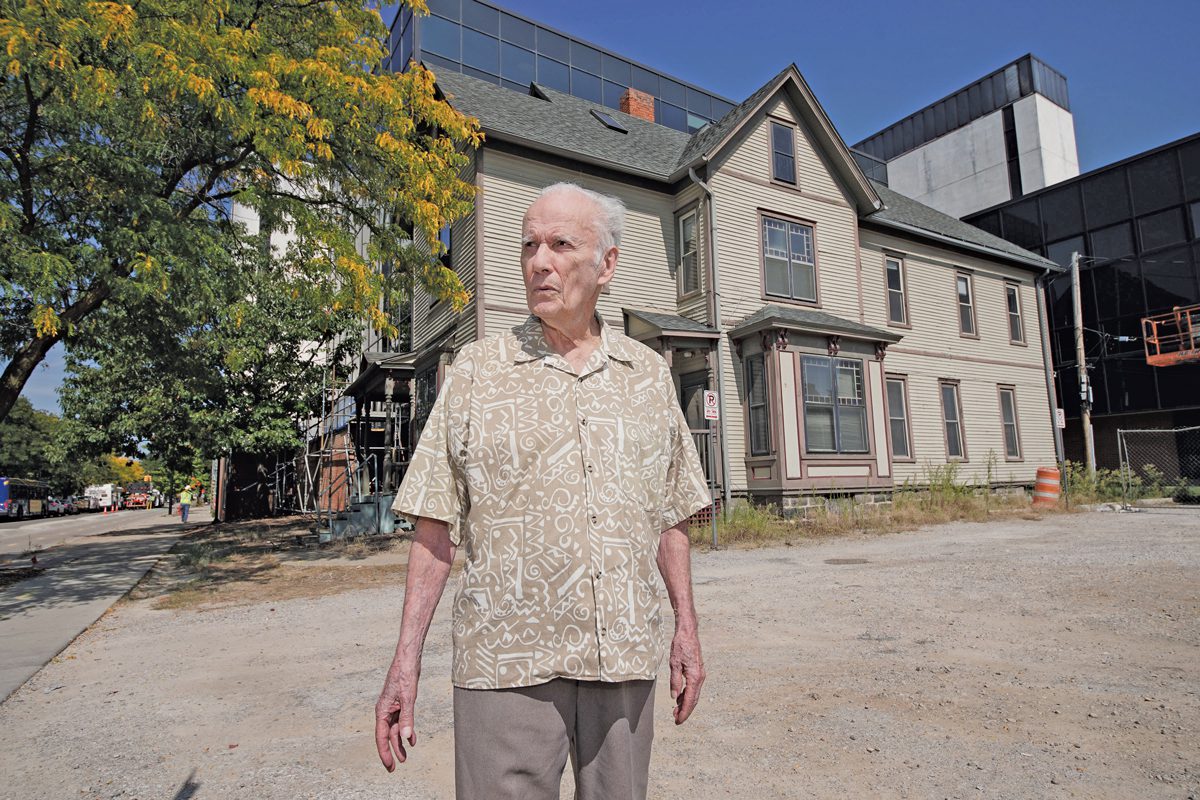
Gordon Bigelow was happy to hear that it will soon stand alongside the Miller house on S. Division: his late wife, Marilyn, was instrumental in saving it. | J. Adrian Wylie
John Godfrey thinks he was the first to call for saving the Wallenberg house. “Back in 2013 … the university hosted an exhibit sponsored by the Swedish government about Wallenberg and his life,” the former assistant dean of Rackham recalls.
“As part of that, I started digging more deeply into his experience here at the university. I had known by that time that Wallenberg had lived at that house. When I read somewhere … that [McKinley owner and U-M regent] Ron Weiser was buying up houses in that neighborhood for a new dorm, I sent an email to leadership of the university, including several regents, saying that this is perhaps a place that the university should consider rescuing because of its history.
“There was a good, strong response. And then things sort of went dormant. I retired, and I didn’t know where things were going to stand with that. Then I got a call from Ken [Fischer, past president of the University Musical Society]. ‘We’ve got to get moving on this,’ he said.”
They did—only to learn that the university was ahead of them. At a meeting, university planner Sue Gott and CFO Geoff Chatas shared a request to the regents seeking approval to spend more than $8 million to move the Wallenberg house, connect it to the Miller house, and refurbish both.
“It’s always meaningful to find ways for our university spaces to reflect both our values and our history,” Gott emails.
“The university strives to ensure that spaces on campus continue to serve our evolving needs. Through careful planning and renovation, we can connect our physical environment to the history and legacy of our community.”
That seems right to Holocaust survivor Irene Butter.
“He is the greatest hero of World War II,” she says. “Almost single-handedly, he saved all these people from being sent to death camps. … He needs to be recognized here on campus and in our community.”
Related: Never a Bystander
From a wealthy family, “Wallenberg could have lived in a castle,” says Jeff Veidlinger, director of U-M’s Raoul Wallenberg Institute. “But he lived in a boarding house. He hitchhiked around the country and biked around town.”
“Hitchhiking gives you training in diplomacy and tact,” Wallenberg wrote to his grandfather from Los Angeles in 1932. Even being held up at gunpoint “will not make me give up hitchhiking,” he wrote to his mother after returning to Ann Arbor. “I’ll just carry less money on me and try to become more devious.”
The regents approved Chatas’s action request in May. It calls for connecting the houses “by a new 845-gross-square-feet addition that will include a shared elevator for accessibility. … In order to relocate the Wallenberg House, a basement and foundation need to be constructed in early Summer 2025 for placement of the relocated house.”
That tight timeline has already expired: as the Observer went to press, the gravel lot next to the Miller house was still a way station for U-M trucks, with workers constantly coming and going between jobs elsewhere on campus. Kay Jarvis, U-M Director of Public Affairs, says the move is still expected to happen this year, but no date has been set.
While no decision has been announced about how the buildings will be used, the obvious candidate for Wallenberg’s house is the university’s new Wallenberg Institute. Veidlinger—the son of a Hungarian Holocaust survivor—says it was created last year “to study and combat ethnic and religious hatred and promote tolerance, courage, leadership, and empathy.”
Veidlinger thinks he first heard of the plans for the house in August of last year. “We then worked with this architectural firm for about four or five months to devise plans and to do a feasibility study, and the feasibility study determined what the cost would be.”
He’s reluctant to say that the plan is a done deal, because “I’ve been around the university long enough to know that not everything goes the way they intend.” But “the space that we’re in now, in the LSA building, is imagined as temporary space. I think it’s safe to say that the intention is that the Raoul Wallenberg Institute will be moving into the building.”
A professor of history and Judaic studies, Veidlinger points out that Wallenberg and Miller were “both humanitarians in some ways, who went to the university at exactly the same time—they were contemporaries here—and I liked the idea of making it a kind of village, a small-scale village that opens up into the community.”
The Miller house is already dwarfed by the ISR, which looms over the site on two sides. But Veidlinger sees a useful lesson there. “Wallenberg, in particular, who stood up both to Nazi Germany and to the Soviet Union—huge entities. The symbolism of the little man, on a human scale, standing up to those great entities, I really liked. We were designing it with that in mind.”
“I think right now the challenge is to use these places in a meaningful way,” Godfrey says. “I think the university is very much concerned about the extent to which it has to, as part of its core sense of self and purpose, be a platform for people like Arthur Miller or Raoul Wallenberg, to come to this place with no expectations, with no connections, and to make themselves afresh, against all odds, and to overcome the limitations that society and family impose on them.”
Before her death, Marilyn Bigelow learned about the planned demolition of Wallenberg’s neighborhood and asked her husband to photograph his house. But Gordon hadn’t heard that it would be spared until a visitor asked how it felt to see their efforts finally rewarded.
“This sounds good, that these things are happening,” he said. “I wish Marilyn were here. She would love this.”