
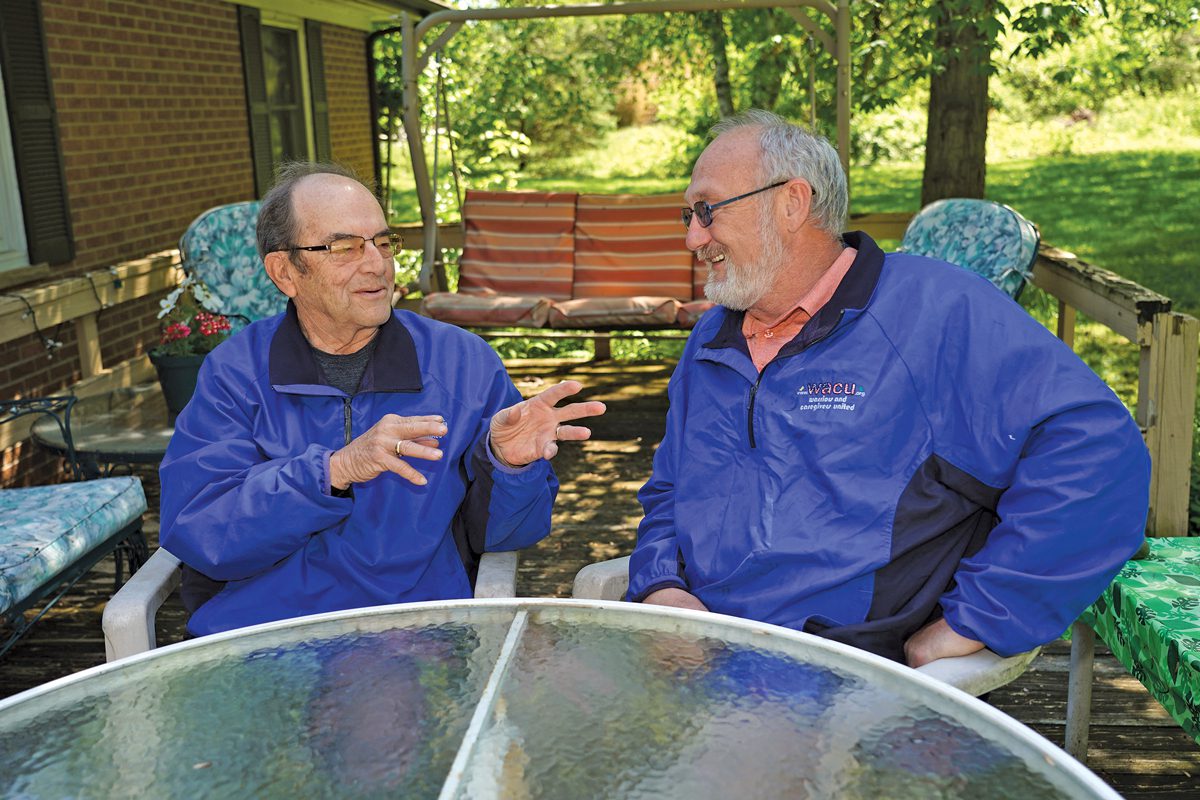
John Kinzinger (left) founded Warriors and Caregivers United after learning about post-traumatic stress disorder and suicide rates among returning veterans. Combat vet Terry Hall (right) says he’s one of those Kinzinger saved. | Photo by J. Adrian Wylie
A Vietnam veteran and Ford Motor Company retiree, Kinzinger has been helping other veterans for around thirty-five years, including raising money for the Washtenaw County Vietnam Veterans Memorial and the Ann Arbor VA Medical Center. Now his focus is on Warriors and Caregivers United (WACU), a nonprofit that prioritizes supporting returning veterans, their caregivers, and their families.
He founded WACU after learning about post-traumatic stress disorder and suicide rates among returning soldiers during the 2010s.
“I attended symposiums and talked to doctors, trying to figure out what I could do personally to try to reduce the suicide of returning warriors from combat,” says Kinzinger. “I had a friend in mental care at the Veterans Administration hospital.
“I asked her what the VA did for post-traumatic-stress caregivers, and she informed me that last summer they had a couples event on Saturday. That’s when God said, ‘There’s where you need to work.’”
In 2015, Kinzinger partnered with the VA hospital’s behavioral health department and Operation Never Forgotten, a volunteer nonprofit supporting soldiers and families of veterans, to offer “workshops on everything from sleep deprivation, eating habits, to counseling.” Those connected him to future members of WACU, including Terrance Hall Jr., who served in Iraq, Afghanistan, and Guantanamo.
WACU supports soldiers and their families dealing with the trauma and aftereffects of war. They offer one-on-one mentorship, community engagement, and events, including recovery retreats for men and women veterans and their caregivers.
They also raise money to send care packages to service members on active duty—“everything from Harley Davidson T-shirts, candy, snacks, to letters from local school kids,” says Kinzinger. “We’ve got some great, rewarding notes back from those serving in the theaters of war.”
And when they’re discharged, “WACU allows them to come home, and nobody asks questions,” he adds. “You come in, know you are in safe territory, and be yourself.”
Related: Buddy System
Hall, who took over as board president in February, calls his involvement with the group a life-changing experience.
“I’m a completely different person than I was ten years ago,” he says. “From my perspective as a combat vet, I was the ‘one more’” that Kinzinger set out to save: “Had I not gotten involved with John, I would not still be here.”
WACU, he says, “helped me see something I had not seen: hope. I was getting to the point where I was not looking for it anymore.”
WACU currently hosts ten events a year, and Hall aims to increase the number.
“We divided the state into six regions, and the goal is to do multiple events in each region,” Hall says. “We are not there yet. We do not have the manpower because we are all volunteers.” Events are announced through their Facebook group, which shares its name with their website: wacu.org.
Hall says the organization currently supports more than sixty combat veterans’ families, and more than thirty attended Month of the Military Child events in April.
Related: The Fisher House
“Our focus works through the family,” Kinzinger says. “It’s not just the returning warrior. The warrior flops himself in a family that he left, and he’s different, and [the spouse] has to handle this person who’s not the same.
“He’s trying to find his way, and she’s trying to hold the family together, pay the bills, and take care of the kids. So you can understand where there’s a lot of pressure on the caregiver.”
Kinzinger says the extent of that pressure came home to him a few years ago, when “we had twelve to fifteen caregivers spending a weekend together.” As the caregivers talked among themselves, he says, they realized that “half of them had themselves thought about suicide in the last few months.”
“With love comes hope,” Hall says. “And by creating venues where we can bring people together, we can create relationships that provide hope.”