
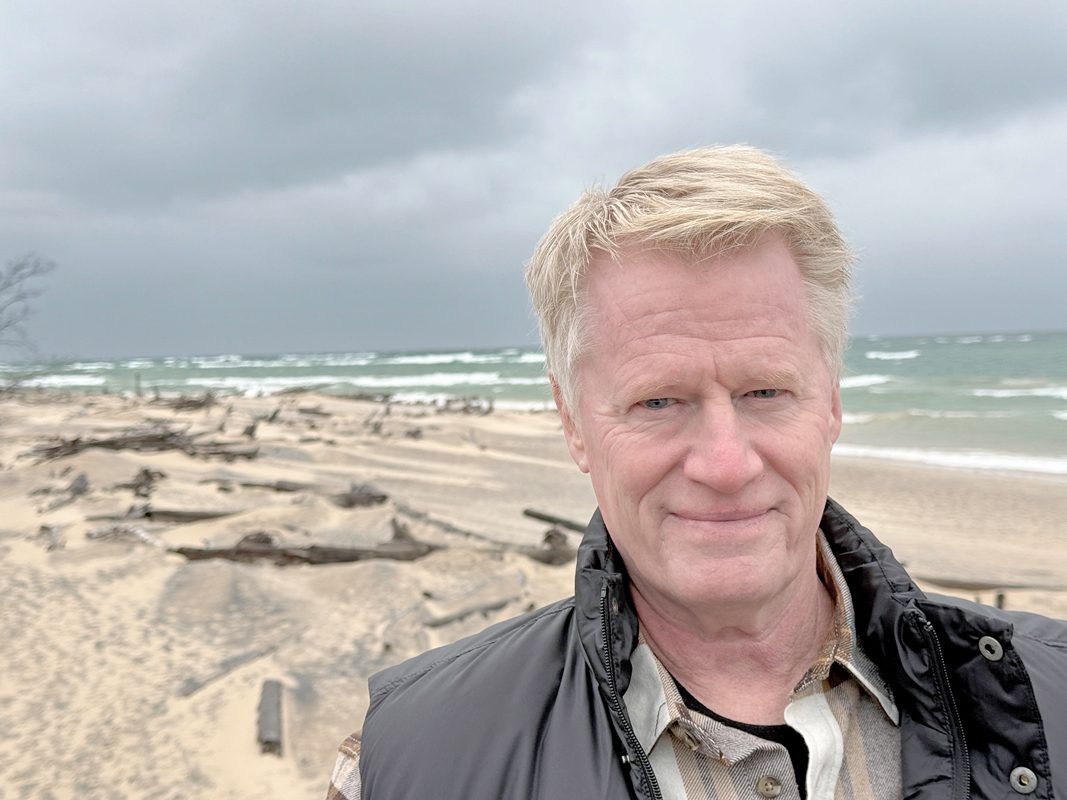
Bacon at Whitefish Point, where the Fitzgerald was seeking refuge. Another ship made it to safety, then went back out to search for survivors. He admires “these guys risking their own lives” for their fellow sailors. “They did it out of honor which is, I thought, quite noble.” | Roger LeLievre
The “Mighty Fitz,” the biggest ship on the Great Lakes when it was launched in 1958, went down with all hands in a storm on Lake Superior in November 1975. Canadian folksinger Gordon Lightfoot immortalized it in “The Wreck of the Edmund Fitzgerald,” and now it’s the subject of Bacon’s latest book: The Gales of November: The Untold Story of the Edmund Fitzgerald.
The local writer and commentator says he first pitched the idea of a book on the disaster twenty years ago. He started visiting the annual memorial at the Great Lakes Shipwreck Museum on Whitefish Point even before he had a contract.
When he started researching, he knew he needed to learn more about the Great Lakes and Great Lakes shipping to tell the full story. In hindsight, he says, “I didn’t know how little I knew. But that’s one thing I love about writing nonfiction—exploring the geography, the history, and, in this case, the economics also.
“But the real thing that drove me,” he says, “is that the twenty-nine men were a number.” Lightfoot sang about how Detroit’s Mariners Church “rang the bell twenty-nine times [in their memory], but nobody can name any of them. No one knows anything about them. Basically, that was the biggest thing I wanted to do—to humanize the twenty-nine men.”
That’s the heart of The Gales of November, which comes out this month. Historian and best-selling narrative nonfiction writer Hampton Sides calls it a “work of spectral beauty destined to be a classic.” Bacon’s talk and reading at Rackham on October 7 (see Events) is part of a book tour that will take him to more than twenty cities in the coming months.
Bacon conducted hundreds of interviews with the families of the crew and many others. But one source fell into his hand: he was surprised to discover that Harry Atkins, an old friend from the press box at Michigan Stadium, had written the first account of the sinking for the Associated Press’s Detroit bureau.
At 729 feet, the Fitzgerald was longer than Detroit’s Renaissance Center is tall. (Bacon explains that all “lakers” are long and narrow, to fit through the Soo Locks.) It was owned by the Northwestern Mutual Life Insurance Company and named for the company’s president.
The Fitz set sail for the last time on November 9, 1975. “Captain Ernest M. McSorley had loaded her with 26,116 long tons of taconite pellets, made of processed iron ore, heated and rolled into marble-size balls,” according to the Great Lakes Shipwreck Museum’s website. “Departing Superior [Wisconsin] about 2:30 pm, she was soon joined by the Arthur M. Anderson, which had departed Two Harbors, Minnesota under Captain Bernie Cooper. The two ships were in radio contact. The Fitzgerald, being the faster, took the lead, with the distance between the vessels ranging from 10 to 15 miles. … Weather conditions continued to deteriorate.”
The ships stayed close to the Canadian shore before heading across the open lake to the shelter of Whitefish Bay. But then the Fitzgerald vanished from the Anderson’s radar. After repeated attempts to reach the lead ship, Cooper radioed the Coast Guard—and then radioed again and again, because a “rookie watchman,” in Bacon’s words, didn’t grasp the gravity of the situation.
The Anderson made it to shelter in Whitefish Bay, only to set out into the full fury of the storm again when the Coast Guard told Cooper that his ship was the best hope of finding survivors. He risked it, found only debris, and made it back to safety.
Bacon admires “these guys risking their own lives” to try to rescue their fellow sailors. “They did it out of honor which is, I thought, quite noble.”
The AP reporter, Atkins, and a photographer drove through the night, crossing the Mackinac Bridge just before high winds shut it down. He worked the phones from the office of the Sault Ste. Marie Evening News, and a reporter there put him in touch with a pilot willing to fly them out to see and photograph the fruitless search. Reading the article decades later, Bacon writes, he was impressed at “how many difficult facts Atkins reported accurately in a few hours using only a notebook and an office phone.”
According to the museum website, while “Captain Cooper maintained that he watched the Edmund Fitzgerald pass far too close to Six Fathom Shoal to the north of Caribou Island … There is absolutely no conclusive evidence to determine the cause of the sinking.”
Unlike others who’ve written about the disaster, Bacon doesn’t claim to know why the ship went down. “I’m not a scientist,” he stresses, “but some theories gain weight and some theories lose it. … I think the odds of the ship having gone over Six Fathoms [reef] and hitting [it] have increased in my research.”
It’s a sad story. “It gets sadder when you get to know the guys and how many ways it might have been different,” he says. If the storm hadn’t been so violent and the waves so high; if the Coast Guard hadn’t approved repeated reductions in the “freeboard” between the Fitz’s deck and the lake; if captains hadn’t been incentivized to “cheat the Plimsoll Line” by overloading their boats; if the boat had a fathometer to warn McSorley that he was too close to the reef …
For Bacon, the hardest and most rewarding part of the project was talking with the families. “It was always in person first,” he says. “That was usually at Whitefish Point,” where the Fitzgerald’s bell, recovered from the wreck in 1995, is rung every year on the anniversary of the sinking.
He even got permission to sail on the two boats that were closest to the Fitzgerald that night, the Wilfred Sykes and the Anderson herself.
“I was on the Anderson for one week,” he recalls. By the time it reached Toledo, “I’d not seen my wife and son in a week, which is nothing for [Great Lakes crews]. They often went nine months without seeing their families.”
His wife Christie and son Teddy, then eight years old, drove down to welcome him back. “Teddy comes running from the car, like one hundred feet nonstop,” Bacon recalls. “I get on my knees. He gives me a hug—I mean, he slams into me and clutches me for like a minute, and that’s when I had a sense of, ‘Okay, this is what these guys did and this is what matters.’
“The real sacrifices were before the accident. They sacrificed their families for nine months out of the year. So the obvious lessons are, guess what matters? Family matters. Friends matter. Don’t skip those moments.”