
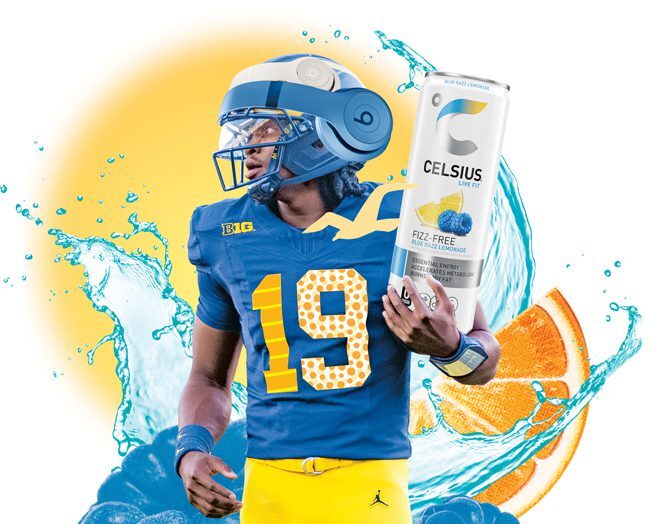
Quarterback Bryce Underwood has snagged sponsorships from Hollister, Beats by Dre, KiwiClo, and Celsius. His estimated NIL valuation is $3 million a year—and he’s passed for 1,440 yards this season. | Patrick Barron; illustration by Tabi Walters
In 2017, Michigan Athletics published a set of rules governing its financial supporters, fans, and alumni.
They could talk up the school, provide an occasional part-time job or meal for enrolled students, buy season tickets, and make financial contributions to the university. But boosters were banned from playing an active role in recruiting, paying athletes for game-used gear, or using them in ads for their businesses.
In 2025, those rules almost seem quaint.
After a landmark July court decision, the NCAA enabled schools to pay their athletes and removed limits on scholarships. Michigan Athletic Director Warde Manuel decided that every competing athlete would receive a full scholarship, and revenue sharing too, although the bulk of that money goes to men’s football, basketball and hockey.
Michigan Athletics is also connecting them with commercial sponsors so they can make money on their own—all in an effort to attract and retain top players. In return, the university aims to sell tickets, attract donations, and raise its global marketing profile.
Manuel estimates this will cost the department $60.5 million—and the quest to cover that expense has been aggressive.
Related: Warde Manuel in the NIL Era
On the Oct. 11 radio broadcast of the ill-fated USC game, listeners heard a frequent commercial tag: “proud sponsor of Michigan Athletics.” That included Old Dominion Freight Lines (the official freight partner of Michigan Athletics); Founders Brewing Company (the department’s official craft beer), and the sparkling alcoholic beverage Long Drink.
Charles Woodson—Michigan football great, Heisman Trophy winner, sports commentator, and whiskey entrepreneur—is selling two special edition bottles; a portion of their proceeds will go toward NIL opportunities for U-M athletes.
On the VICTORS Exchange, potential sponsors can browse a database of 811 athletes available for sponsorship. Men’s soccer player Duilio Herrera charges $10 per social media post; baseball infielder Joe Longo asks $50. Softball player Alexis Dellamonica charges an hourly rate of between $20 for autographs to $75 for private lessons or helping at camps. Volleyball outside hitter Molly Simmons asks $100 for an Instagram post.
On a bigger picture level, the Champions Circle is officially sanctioned by U-M to attract marketing deals for athletes and the school from businesses and nonprofits, adding to those that players drum up themselves.
The biggest beneficiary thus far is freshman quarterback Bryce Underwood, whose decision last year to flip from Louisiana State to Michigan made headlines around college athletics. He is receiving a recruitment package worth an estimated $12 million over four years, funded by a collection of wealthy alumni led by billionaire Larry Ellison, whose wife Jolin Zhu attended Michigan.
Related: The $12 Million Quarterback
Even before the season began, Underwood was sharing his largesse. On his birthday in August, Underwood presented his teammates with custom-made Beats by Dre headphones, part of his deal with the Beats Elite promotional series. Each pair came in maize and blue, decorated with a Block M.
He has a partnership with Hollister, a clothing brand for teens and twentysomethings, which dressed him for his signing day. He also has an apparel deal with Detroit’s KiwiClo; a portion of the proceeds will benefit C.S. Mott Children’s Hospital. When he’s thirsty, he can sip a Celsius energy drink, a sponsorship gig he landed along with Clemson quarterback Cade Klubnik, Notre Dame running back Jeremiyah Love, and Ohio State safety Caleb Downs. On3 estimates his annual NIL valuation at $3 million.
Michigan Basketball forward Yaxel Lendeborg, who initially entered the NBA Draft but withdrew in May to transfer to Michigan from the University of Alabama-Birmingham, has an estimated valuation of $2.3 million. Lendeborg, who thanked the Champions Circle for its role in his Michigan decision, sells customized jerseys through Athlete’s Thread, which is still stocked with shirts from his previous school.
NIL raised the question: Would sponsors advocate for athletes? The answer came during Michigan’s Sept. 6 game against Oklahoma, which Michigan lost 24–13. Midway through the game, Dave Portnoy, founder of Barstool Sports, who spearheaded Underwood’s NIL package, fired off an angry tweet.
“I’m about two seconds away from texting Jolin and telling her to call Sherrone right now and tell him he’s gone if we don’t let the kid throw the football,” Portnoy posted. (As the Observer went to press, Underwood had passed for 1,440 yards.)
Meanwhile, the Champions Circle’s grip on NIL sponsorships faces competition. In October, PeakNIL, cofounded by former Michigan football star and current Los Angeles Rams running back Blake Corum, visited campus in a recruiting bid. Afterward, a number of U-M athletes, including women’s gymnasts, tagged their posts #PeakNIL.
Social media aside, it’s too soon to tell just how much revenue U-M athletes are collecting and what the NIL push is doing for the school, but it’s leading to new relationships within the Ann Arbor community. HopCat, Joe’s Pizza, and Graduate Ann Arbor have all featured U-M athletes, while the M Den sells a variety of athlete-signed gear.
But other local merchants are shying away from NIL deals. Jordan Balduf, owner of Side Biscuit, a popular spot for wings-loving athletes, is one of them.
“I have companies reaching out daily with contracts asking for crazy amounts of money,” such as $5,000 for a video or $10,000 for posts by top players, he says. Instead, he gives the wrestling team a food discount and is rewarded with Instagram posts.