
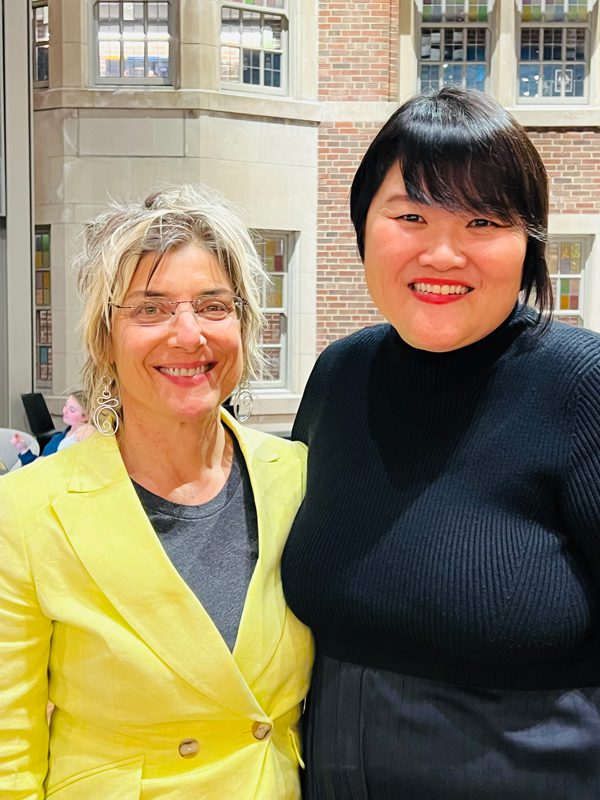
Cartoonist, coach, and therapist-in-training Ellen Forney (left) was the keynote speaker at the 19th Annual Prechter Lecture. She’s also served as a mentor to author Michelle Yang (right) during Yang’s journey from internal stigma to mental health advocacy. | Michelle Yang
On a windy evening in late October, I sat in the impressive Michigan Union Rogel Ballroom, with its vaulted ceilings, arched doorways, and dark, wood-paneled walls. The event? The 19th Annual Prechter Lecture, hosted by the Heinz C. Prechter Bipolar Research Program, featuring keynote speaker Ellen Forney and moderated by program director Dr. Melvin McInnis.
The Prechter Program was founded and funded in 2001 by Waltraud “Wally” Prechter in memory of her husband Heinz, a pioneer in the auto industry who died by suicide at age fifty-nine after hiding his bipolar disorder all of his life. In 2004, the program shifted to the U-M Health System, and today it includes over 1,500 research participants. I’m one of them.
Before the lecture began, I took a moment to marvel at the fact that I was there, surrounded largely by strangers, and yet with a surprising feeling of belonging.
Related: Mental Health Matters
Iwas diagnosed with bipolar at age twenty and kept it secret for nearly two decades. Living in hiding meant constantly fearing what might happen if people found out.
Fighting both internal and external stigma became a means to survive, until I realized I couldn’t advocate for myself or others without embracing this part of my identity. My diagnosis had brought relief—it proved my condition wasn’t my fault and that treatment was possible—but I still hadn’t known many others with bipolar disorder or any experts who specialized in it. I found my way to a National Alliance on Mental Health (NAMI) support group in Seattle, where I was living at the time. Through that support group, I discovered my voice as a mental health advocate.
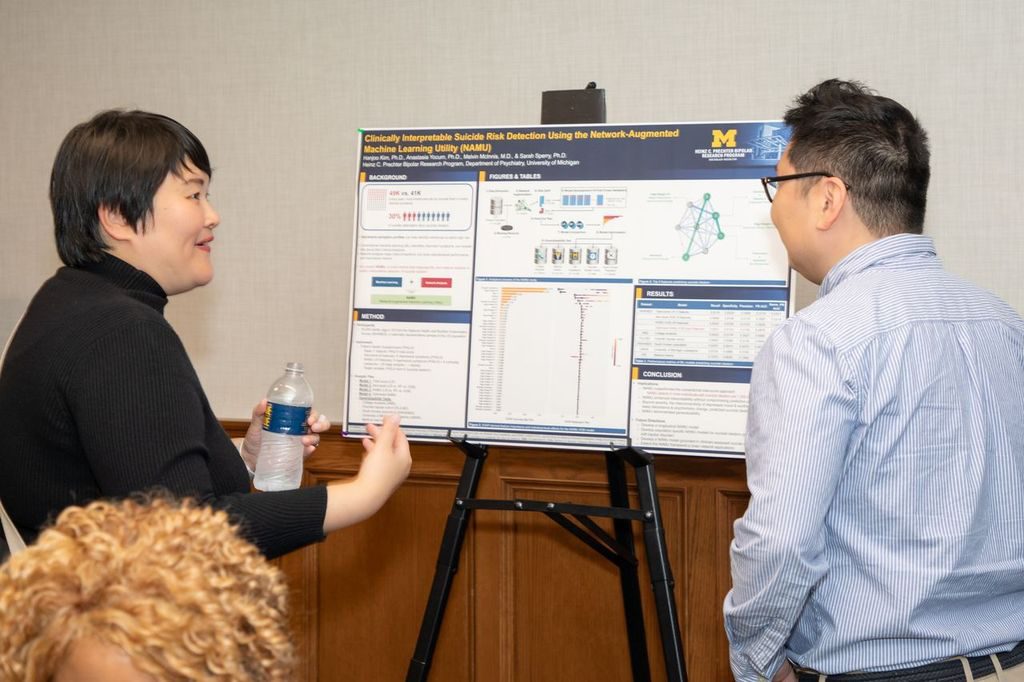
The author during a table discussion. | Rachel Bresnahan
In 2019, I attended the NAMI National Convention in Seattle. A presentation called “Bipolar Disorder: A Lifetime of Passion, an Unpredictable Journey” caught my eye. Walking into the enormous convention hall, the sheer number of people interested in and the number of researchers studying bipolar disorder gave me chills. For so much of my life, living with bipolar had been a solitary journey.
Dr. McInnis took the stage and introduced the groundbreaking, world-renowned work of the Prechter Program at the University of Michigan. Fascinated by the program’s longitudinal study, ongoing since 2006, I was ready to sign up. I wanted to be a part of the solution to provide better treatments for people living with bipolar.
I could not have anticipated then what was to come. Less than nine months later, the Covid pandemic would shut down the world and everything would change. We would lose my father-in-law to cancer. My Michigan-born spouse and I would both become a part of the Great Resignation, leaving careers in Corporate America to move to Ann Arbor for what we hoped was a slower-paced, higher-quality life.
Fast-forward to 2023. At a poetry reading featuring writers affected by bipolar disorder held at the Pittsfield Branch of the AADL, I met the ever-kind and supportive marketing and communications manager of the Prechter Program, Rachel Bresnahan.
It was the beginning of a meaningful partnership. I was featured on a Michigan Medicine Presents podcast about living with bipolar disorder, where I discussed medication, relationships, and caretaking with the famous Dr. Sagar Parikh. Later, along with other volunteers—including Stephanie Prechter, daughter of Wally and Heinz—I spoke to students at U-M Stamps School of Art & Design who used our stories as inspiration to design mental health awareness posters.
Two years ago, at the 17th Annual Prechter Lecture featuring Bonobos apparel company cofounder Andy Dunn as keynote speaker, I served as a study participant panelist. After meeting at the lecture, Dunn offered to endorse my memoir, Phoenix Girl: How a Fat Asian with Bipolar Found Love (Fifth Avenue Press, 2025). And when my book was released, the Prechter Program sponsored a launch program at the Downtown AADL, with Bresnahan as my conversation partner.
This is how I eventually found myself at a welcome dinner at the Gandy Dancer for keynote speaker Ellen Forney, a mentor since my Seattle days. I was seated next to none other than Dr. McInnis himself. “I highly recommend the lobster bisque,” he said, twinkling with excitement. “I’m getting a whole bowl. I’m hungry!” Of course, I had to order a cup to try with my crab cakes too. It was indeed delicious.
I marvel at how I came to live, completely unintentionally but serendipitously, in the same town as the premier bipolar research program in the world. And how is it possible that in less than four years, I would befriend its wonderful staff, director, professors, and even the program founders, who had all felt so larger-than-life to me in the past?
Related: Signs Against Stigma
Back in the Michigan Union ballroom, Forney took the stage to deliver an inspiring talk to more than a hundred people affected by bipolar disorder. My deep sense of gratitude and belonging returned. I was surrounded by people from around the state who gather every year for this series. Forney, a cartoonist, author, and coach who is now studying to become a therapist, shared through compelling illustrations and storytelling the events that led to her bipolar diagnosis as well as her inspiring path to treatment. She talked about creative self-expression as part of her healing process and how she uses comics to help others.
Tabling at the lecture were two separate chapters of NAMI, including NAMI Washtenaw County where I have volunteered. What a full-circle moment, I thought. I am no longer hiding. These are my people, a bigger group than I’ve ever known. How remarkable that we are proud to come together, learn, and advocate for mental health wellness.
I’m reminded of something Wally Prechter once said: “If you truly believe in something, you owe it to yourself to help, to give, and to make a difference. Because ultimately, that is all you leave behind.