
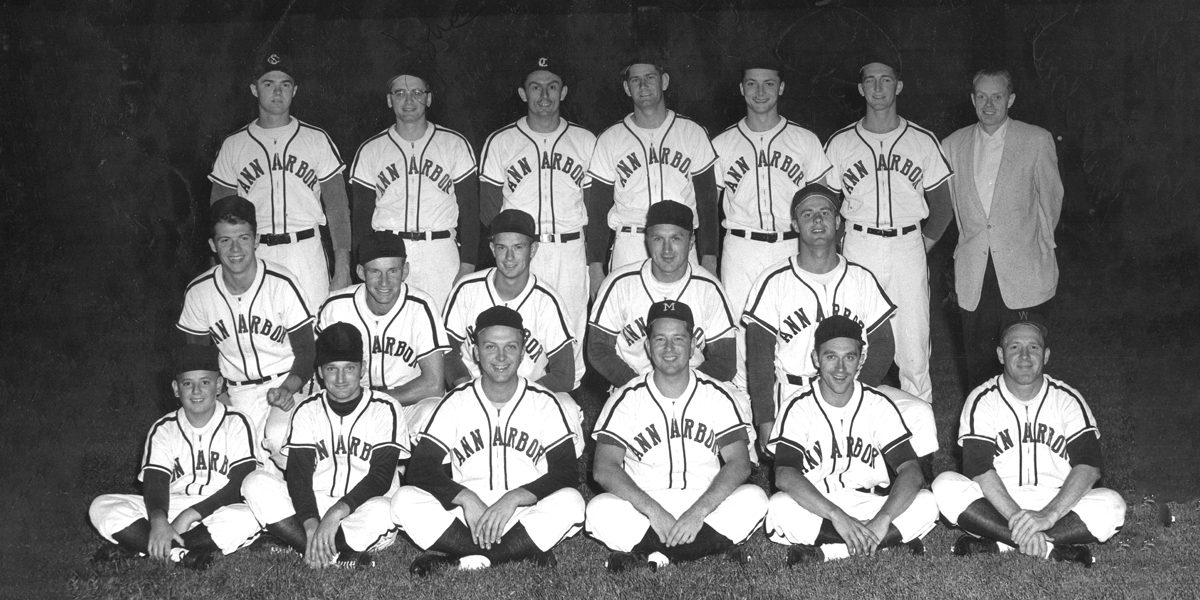
The Travelers were considered a semipro team, but owners Russ McCalla (center row, second from left), Dick Hager, and John Dudley (first and third rows, right) were in it for the love of the game, not money: no admission was charged, and all held day jobs. If they were short a player, the owners or even batboy Mike Sinelli (front row, left) might take the field. | Courtesy of Mike Sinelli
One sunny day in June of 1957, Kenny Scodeller pounded on my front door. When I answered, he commanded, “Get your baseball glove, you’re going to work!”
Ken was a local celebrity on Miner St. and one of the funniest people I ever met. He was a great athlete at St. Thomas, graduating in 1956. Now he was a starter on Western Michigan’s baseball team and had aspirations to play pro ball.
I was in awe. What did this superstar have in mind for his ten-year-old neighbor?
“I am playing center field for the Ann Arbor Travelers, and we need a batboy,” he explained. “We are practicing at West Park in fifteen minutes, and you are going with me to start a new career.”
I grabbed my mitt and we started the three-block trek to the baseball diamond.
The Travelers are a great Ann Arbor story. In the mid-fifties, three Ann Arborites formed a semiprofessional baseball team to compete in the Michigan region of the National Baseball Congress. Russ McCalla was the principal owner and head coach. Dick Hager was part-time second baseman and full-time assistant coach, and John Dudley was the business manager.
Russ and John worked for the post office, and Russ also raised Chester White pigs on his Saline Rd. farm. Dick worked at the King-Seeley factory full-time and scouted for the Washington Senators part-time. All three simply loved baseball. They wanted to field a team of very talented players that could entertain the Ann Arbor fans two or three times a week during the summer at West Park.
And the players were very good. There were young ones like Kenny and Pete Danovich, on their way up in the baseball world and hoping to play college ball or sign a minor-league contract. There were veterans who had played at the Double-A and Triple-A level and just wanted to stay in the game a little longer. It was a great mix: farmers, factory workers, business executives, college kids, even a doctor.
Russ and Dick both stayed in pretty good shape. When we were short of players, Russ could move to the outfield and Dick could play second base. In fact, I even played second base when we only had eight players.
All were equal on the team, and we were only interested in playing and winning baseball games. In the fifties and sixties the Travelers were the best baseball team in town, including the University of Michigan. The fans responded with a loyal group of 100 to 200 people turning out for most of the home games.
Though the Travelers were considered “semipro,” the players weren’t paid. No one sold tickets to our home games. We passed the hat for donations, and the team could earn prize money for finishing high in the state tournament and for doing well if they made it to the national tournament in Wichita, Kansas.
The owners covered all of the equipment expenditures and most of the travel expenses. Financially, it was a losing enterprise. I believe McCalla, the principal owner, provided most of the funding.
Dudley came up with the team name because we had to travel to find opponents. We played Petersen Tire in Mansfield, Ohio and Sullivan’s Furniture in Grand Rapids. We played teams in Battle Creek, Kalamazoo, Vermontville, Ionia and Tecumseh, Ontario.
We played the Jackson Prison team on their field. It was always a home game for them, and they always had a loud, boisterous crowd for support. On a short trip, we played a team in Wyandotte. They had a high school kid in left field named Willie Horton. He hit two 400-foot home runs to beat us.
Coach McCalla explained my duties at the first practice: “You are fully in charge of the bats.” Big responsibility for a ten-year-old.
Before the season started, each player selected a couple of bats that suited their swing. Each game we set up a bat rack in front of the dugout.
We had about twenty-five, mostly Louisville Sluggers, with a few Adirondacks. Both bat makers would model the bats after the ones actually used by major-league players. Nellie Fox’s had a huge handle and a medium barrel. Mickey Mantle’s had a thin handle and huge barrel. Harmon Killebrew’s had a thirty-six-inch bat that felt like it weighed eighty pounds. I carefully set them up so that the players could easily identify them when they were moving to the on-deck circle.
“Two things are very important here,” Russ advised me. “Never set the bats up with the handles crossed, and never start to put the bats back in the bag before the last out of the game. Either of those two situations will guarantee that we lose the contest.
“When someone hits the ball, you need to go up and retrieve the bat without getting involved in the play. You are also in charge of foul balls. This isn’t the majors, and I can’t afford to toss out a new ball every time someone fouls one off.”
Foul-ball responsibility trumped bat-retrieval responsibilities. When one went into the stands or the weeds, I had to bring it back.
In game conditions, the job required my full attention. In fact, on the “danger scale,” I’d put being a batboy right up there with bullfighting and capping oil-well fires.
I stationed myself just outside the on-deck circle and needed to be sure that the on-deck batter didn’t conk me when he was warming up. I had to watch every pitch, because occasionally someone would send a line-drive foul ball straight at me. If it was a pop foul, the catcher or first baseman could run me through the backstop. In addition, I had to pay close attention to the play on the field to make sure that I would not be run over or smacked by a throw to home plate when I was collecting a bat.
We had a lot of colorful players on the team. The most passionate was Denny Fitzgerald, who played third base or catcher. Everything he did was at full throttle.
A former marine, he was a letterman on Michigan’s wrestling team. He was also on the football team, where he was the last to play without a face mask. He chased every foul ball with the same ferocity as his ninety-nine-yard kickoff return in the 1960 Rose Bowl.
George Pratt was an outstanding pitcher for many years. George had an incredible technique for dropping down a bunt and was always the last batter in the lineup. As the pitcher, everyone assumed he would not swing at a few pitches in hopes of getting on base with a walk. For the first pitch, he would stand in the batter’s box holding the bat on his shoulder with one hand. His left hand was down at his side, nowhere near the bat.
The fielders relaxed, knowing that George was going to take the first pitch. The pitcher simply threw a strike down the middle of the plate. With one hand, George would drop the bat and often hit the pitch with a perfect bunt. This took incredible eye-hand coordination, but George could do it. The defense was flat-footed, and if the ball was out of reach for the catcher, he would easily scamper to first base.
Jim Miller was another player with a very unusual talent: he was a truly ambidextrous pitcher. On some occasions he would pitch to the right-handed hitters with his right hand and the left-handed hitters with his left hand. One Saturday, we were short of pitchers, so Jim pitched a doubleheader. The first game he threw with his right hand and won. The second he threw with his left hand and won.
Our nemesis was Sullivan’s Furniture from Grand Rapids. They had talent. A couple of their guys were on the Detroit Tigers taxi squad, who were called up to play a game or two in the majors every year. They were that good.
The NBC State Tournament was a double-elimination event. It seemed like half the time we were playing Sullivan’s for the title.
One year we played the dreaded furniture team with a trip to the national championship in Wichita on the line. Sullivan’s had a four-run lead after eight innings. If they retired us in the top of the ninth, they were the champs.
Unbelievably, before we went to bat, I noticed that they had put their bats back in the bat bag, anticipating that the game was over. Coach McCalla noticed this too and said to me, “We can’t lose. Just watch!”
Exactly as the coach predicted, we rallied for six runs and shut down Sullivan’s in the bottom of the ninth. Never incur the curse of early bat-bagging!
With summer coming to Michigan again, I wish I could resume my batboy duties for the original Travelers one more time.
The revitalized baseball diamond at West Park isn’t much different than the original field. I’m sure that there are a dozen players today as enthusiastic and talented as the group we fielded in the 1950s.
What could be better than spending a spring day with twelve people who simply love to play baseball?
I might be a little slow in running down the foul balls, but I could do everything else without getting hurt.
I spent a great five years with the team. No doubt they taught me a lot about baseball that few ten-year-olds would ever learn. More importantly, they showed me that following your passion is one of the best things you can do in life.
Footnote: From 2008 to 2012 there was another stellar local team called the Ann Arbor Travelers: an elite, amateur, youth baseball team that qualified for the Connie Mack National Championship two years in a row around 2010. One thing that the vintage Travelers and the 21st-century version had in common was needing to travel long distances to play games.
For more of Mike Sinelli’s writings, reminiscence, and ridiculousness, visit sinellimakesyoulaugh.com.
Calls & Letters July 2025: About that 99-yard run
To the Observer:
The [June feature] article about the Ann Arbor Travelers said that Denny Fitzgerald made a 99-yard kickoff return in the 1960 Rose Bowl. Michigan did not play in the 1960 Rose Bowl. In 1959, after hiring coach Bump Elliott for the princely salary of $40,000, Michigan had a record of 4–5. I saw Denny Fitzgerald’s 99-yard run during my first and last visit to Spartan Stadium. Unfortunately, that record-setting run did not lead to a Michigan victory over Michigan State.
I was a wrestling teammate of Denny. I recall coach Cliff Keen saying Denny’s drive made up for his lack of wrestling talent. That drive led to Denny winning the Big Ten championship at 177 pounds. There are some reports that Denny was the last Michigan football player to wear a leather helmet. His football teammate, Ed Hood, disputes the leather helmet claim, but supports the story that Denny was the last Michigan football player who didn’t wear a face mask. He says he saw Denny rip a face mask from his helmet, but it was a hard helmet, not leather.
Sincerely,
Bruce Laidlaw
“Thanks to Mr. Laidlaw for correcting my error,” writer Mike Sinelli emails. “Over time, my memory revised the contest from the Michigan State game to the Rose Bowl. Michigan never played in a Rose Bowl when Denny was on the team. It was a serious mistake on my part not to fact check the game. I am pleased that all of the additional information in the article about Denny appears to be accurate. Thanks again to Mr. Laidlaw for his correction.”
The article said that Denny Fitzgerald made a 99 yard kickoff return in the 1960 Rose Bowl. Michigan did not play in the 1960 Rose Bowl. In 1959, after hiring coach Bump Elliott for the princely salary of $40,000, Michigan had a record of 4-5.
I saw Denny Fitzgerald’s 99 yard run during my first and last visit to Spartan Stadium. Unfortunately, that record setting run did not lead to a Michigan victory over Michigan State.
I was a wrestling teammate of Denny. I recall coach Cliff Keen saying Denny’s drive made up for his lack of wrestling talent. That drive led to Denny winning the Big Ten championship at 177 pounds.
There are some reports that Denny was the last Michigan football player to wear a leather Helmet. His football teammate, Ed Hood, disputes the leather helmet claim, but supports the story that Denny was the last Michigan football player who didn’t wear a face mask. He says he saw Denny rip a face mask from his helmet, but it was a hard helmet, not leather.
Mr. Laidlaw,
Thank you for correcting my error. I try to carefully fact check my articles but I was trapped by my revisionist memory. I had convinced myself that Denny’s spectacular return was in the Rose Bowl. I am pleased that all of the other information about Denny appears to be accurate. Denny was a great personality. He motivated all of us on the baseball team and his example of driving for excellence in all of his pursuits is still an inspiration to me. Thanks to you and Denny, I intend to rachet up my fact checking in future articles.
Mike Sinelli
Hi Mike, My dad is George Pratt who was mentioned in your article, and he was lucky enough to have the story passed on to him! He has wonderful memories of that time! I am thankful you have confirmed many of his stories! He used to tell us he would hitch hike to most of the games! He went on to be a MHSAA hall of fame coach and teacher of the year. Thanks so much for the story!