
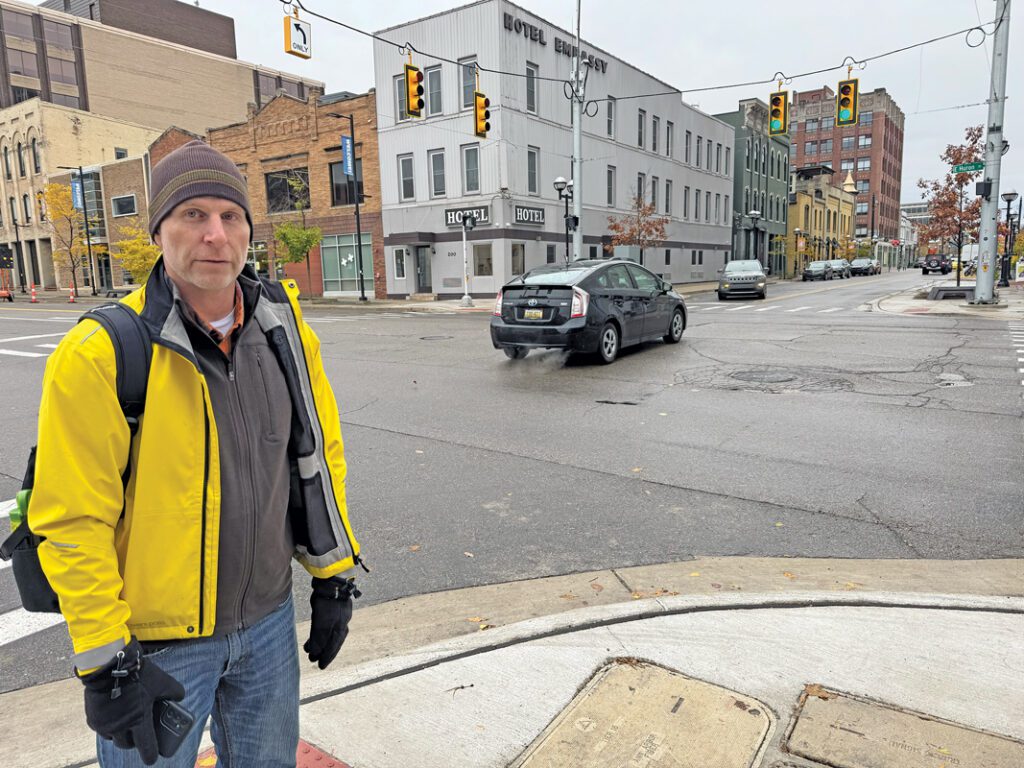
Safety advocate and Transportation Commission member Peter Houk stands at the intersection of E. Huron St. and N. Fourth Ave., where in May, a seventy-nine-year-old in a motorized wheelchair was struck and killed by an intoxicated driver. | Steve Friess
In June 2021, city council adopted its Moving Together Toward Vision Zero comprehensive transportation plan, which called for the elimination of traffic fatalities and serious injuries by the end of 2025.
Three months earlier, city staff announced a slightly less ambitious target: the number of fatalities and serious injuries caused by car crashes would fall below five per year. The two goals share one important commonality: failure.
Ann Arbor didn’t just fail to hit either benchmark; the city has seen an increase in these incidents. In fact, 2025—the year that road utopia was to be upon us—saw the highest number of such accidents since 2014, according to data collected by safety advocate and Transportation Commission member Peter Houk.
“I think we need to be really honest that we made a strong commitment to Vision Zero, but implementation hasn’t really kept pace with the urgency of the problem,” says Dharma Akmon, a first-term councilmember elected in 2022 who also sits on the Transportation Commission.
City spokesperson Robert Kellar echoes this acknowledgement: “We must have an honest, and some may say uncomfortable, conversation about this very complex problem and what is, and isn’t, within the power of the city to control. As the data reflects, we face some significant behavioral issues that can’t be ignored.”
Kellar declined to make city engineers or transportation staff available for interviews, saying they needed to save their ideas and analysis for a mid-November meeting of the Transportation Commission. “Our obligation to discuss this is first and foremost with them,” he emails.
Yet the explanations are the same as they were in 2021—a need to reduce car speeds and improve safety at pedestrian crossings through signal timing changes.
In 2022, Houk launched his blog, Crashes In Ann Arbor, to highlight lessons he gleans from each major accident. “One of the things I didn’t see was a critical look at what was causing the crashes,” says the Ford manufacturing engineer, longtime downtown resident, and cyclist. “That’s not to say that that work wasn’t happening, but it wasn’t being shared publicly.”
Despite setting its Vision Zero goals in 2021, it was only this fall that the city launched its most ambitious initiative, Ann Arbor Roadway Rightsizing. The project will identify ten streets with four lanes or more that can be made safer by narrowing the roadway, adding protected bike lanes, and lowering speeds. The final public input open house before staff presents the list to the Transportation Commission is scheduled for December 10 at the downtown library.
“People drive slower because they have obstacle[s] nearby,” Houk says. “Narrower lanes do that. Having fewer lanes does that. If we can have roads with fewer lanes and narrower lanes but smoother-flowing traffic, then we can move a similar amount of vehicles at an overall lower top speed.”
Nobody who works for the city needs to go far to witness the problems. On a damp and chilly early November afternoon, Houk and I meet to visit three notoriously dangerous intersections along Huron St. within a couple of blocks of City Hall.
First on our tour is E. Huron and N. Division St., where in April a sixty-eight-year-old pedestrian was hit in a crosswalk by a car turning left with a flashing yellow arrow, or FYA. This particularly infuriates Houk because since 2024, he’s been on an otherwise successful campaign to rid the city of FYAs when pedestrians are present, following three other crashes. Drivers, he says, take the FYA as permission to go but don’t see the pedestrian, who has the right-of-way.
As of early November, twenty of the twenty-six such configurations in the city had been reprogrammed, three of which are at Huron St. intersections.
But Huron St. is owned and operated by the Michigan Department of Transportation, and Houk and Akmon say the state hasn’t responded to city requests to fix the problem. The city has been trying to take over control of Huron St. so it can make these changes on its own, but MDOT has been slow to agree to an approach and financial arrangement for such a transfer. “While these two organizations are working through their processes for making changes to the streets, people are getting hurt in preventable crashes,” says Houk.
Next on the tour is E. Huron at N. Main where, in June, a pedestrian sustained a serious injury while crossing Main late at night. She had the walking signal, but the car, which had a green light to turn, didn’t see her. Houk says there’s a relatively simple fix for this, known as a leading pedestrian interval, which gives the walker a head start. It’s already in use at the E. Huron St. intersections with N. Fourth Ave. and Division.
Related: Walk Signs and Candles
From there, we cross back to E. Huron and N. Fourth Ave., where a seventy-nine-year-old in a motorized wheelchair was struck and killed in May. The driver, who admitted to being intoxicated, now faces felony charges. But Houk says there were other contributing factors—it was dark and wet outside, the motorized wheelchair slowed down in the middle of the street due to an apparent malfunction, and the high-visibility pavement markings for the pedestrian crosswalk hadn’t been repainted following recent roadwork.
“Eventually something’s going to go wrong with any solution,” Houk says. “We have a system where when people make mistakes, it can result in a fatality. And that’s what happened here. People made mistakes and someone died.”
If it sounds like Houk is questioning the idea of aiming for zero fatalities and serious injuries, he’s not. “It’s not stupid to want zero. There are ways to achieve it; other cities have achieved it,” he says, pointing to Hoboken, NJ, which hasn’t had a traffic fatality in almost nine years. “Yes, the numbers are going up every year, but this is not just an Ann Arbor problem. But how bad would things be here if Ann Arbor hadn’t made the changes that they have made to bicycle infrastructure and crosswalks?”
Related: Building a Bike-Safe City
Indeed, Akmon also points to various successes, including the narrowing of S. Main St. and a dramatic redesign of Pauline Blvd. between Stadium and Main. Lanes were narrowed, traffic humps installed, and posts added to the centerline. “It reduced speeds greatly and it reduced serious crashes,” she says. “Even if someone crashes, going slower is the difference between a broken arm and a life-altering injury.”
Akmon, too, doesn’t blame the ambition of the goal for the failure to achieve it. “I ran for office on making sure people can get safely around our city no matter how they’re traveling,” she says. “The responsibility is on us. We’re not moving fast enough on our most dangerous corridors. … We can’t wait ten years for a capital improvement project to make these changes. We need to learn to make tactical, quick, cheaper changes that can be effective more quickly.”
I do think that some of the traffic calming changes have instead trained drivers to be much more dangerous — which might explain why traffic-calming changes aren’t having the impact that people had hoped for.
Anyplace where two lanes have been changed to merge down to one, such as westbound Stadium at Seventh, there seem to always be drivers who zoom around other drivers at wildly high speed in order to be the first vehicle to reach the merge, putting everybody’s safety at risk. I think adding these merges has nudged some people to drive in a much more dangerous way. Then those people take their more-dangerous driving everywhere, spreading it throughout the city, normalizing dangerous driving for other drivers too.
Another traffic-calming road change that has made drivers more dangerous is the places where traffic used to have two lanes going toward an intersection and now there is one lane, such as southbound Maple at Miller. People regularly switch into the left-turn lane far before the intersection and drive at full speed for a long distance, past a long line of cars that are stopped, waiting for the light to change. That can’t be safe for anyone! People didn’t drive like that before the roads were reconfigured. I think this, too, trains drivers to use more dangerous habits that spread throughout the city.
Anyway, that is my two cents worth!
I’m no expert but has the city observed the glow of traffic at specific intersections or lanes to see what the norms are BEFORE radically changing the design? Many cars wish to turn right onto Platt when west bound on Ellsworth but now can’t because of barriers forcing them to stay in line. Bicycles ONLY can use that turn lane. There are no bicycles—just lots of cars that could reduce the back up at that light if they could use that land to make their right. If you had a camera observing that intersection, it would become clear that that land should serve cars and not imaginary bicycles. That is true all over A2—a redesign for bicycles where there are none nor likely will there ever be. Incorporating bike lanes is importantly where they make sense. Where they don’t make sense, they impede traffic glow and frustrate drivers.
“But how bad would things be here if Ann Arbor hadn’t made the changes that they have made to bicycle infrastructure and crosswalks?”
We have the answer. Better then it is now. It’s gotten worse with these changes. But of course the Biking and Walking Coalition zealots say it’s because we have not done enough. It will never be enough, until no cars are allowed in the city. That’s the real goal, but only the most obnoxious advocates will come out and say it. And most of them own cars, too.