
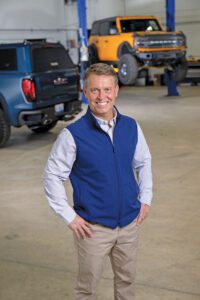
“Most people explore the outdoors on four wheels,” says RealTruck chief growth officer Tony Ambroza. The company’s promotional photos and installation videos are filmed at its on-site content studio. | Mark Bialek
Born as a workhorse for farms and job sites, the pickup truck didn’t stay just a tool for long. Decades of advertising, country music, and pop culture turned it into a symbol of toughness, independence, and blue-collar pride, even as it moved into suburban driveways. According to the Alliance for Automotive Innovation, pickups make up 21 percent of registered vehicles nationwide. That’s fairly consistent with Michigan, where they make 18.6 percent of registered vehicles. But in Washtenaw County, they’re a modest 9.5 percent—and in Ann Arbor, just 5.4 percent.
Today, the pickup (and its cousin the SUV, which makes up 39 percent of registered vehicles nationwide) represents a state of mind as much as a way of life. RealTruck leans into the mainstream aspect of truck ownership, emphasizing utility, adventure, and everyday practicality over cultural identity. They operate on the assumption that drivers care less about the image of owning a truck and more about what the truck lets them do.
Related: We Are What We Drive
“Most people explore the outdoors on four wheels,” says RealTruck’s chief growth officer Tony Ambroza. We spoke at the grand opening of RealTruck’s first retail store, in Rochester Hills, surrounded by the full array of truck and SUV add-ons, including lighting, steps, bed liners, fender flares, racks, floor mats, and RealTruck’s bestseller: truck bed covers.
Founded as Truck Hero in 1998, the company spent most of its early years as a business-to-business supplier selling exclusively to dealerships. Over two decades, it grew by acquiring aftermarket brands like Gator, Belmor, Mountain Top, Husky, and many more, pulling them under one roof. By the time it rebranded as RealTruck in 2022, the company had expanded to more than 5,000 employees spread across seventy-eight facilities on four continents. About 500 of those employees work in Ann Arbor, making the corporate headquarters one of the city’s quieter industrial anchors.
Many of their products are designed in three sizable buildings just off State St. Here, engineers draft new ideas, fabricate prototypes, and run products through tests before they head to manufacturing. Most of the products are made elsewhere in the U.S., but a 130,000-square-foot facility on the campus makes a dozen of RealTruck’s accessories here in Ann Arbor. Engineering sits next to the corporate office, an open space with high ceilings and low cubicle walls that make it seem even larger than it is. Everything from the carpet to the walls to the snack machines is gray and black, accented with pops of RealTruck’s signature color: lemon yellow.
In another building, a content studio shoots installation videos and promotional photos featuring whatever selection of Broncos, Jeeps, and pickups the team has ready. “We have around fifteen vehicles at any one time,” says Tyler Rosenhagen, RealTruck’s PR and social manager. “All of them are ready at a moment’s notice to become the star of an ad or be featured on our website.” A nearby wall holds photo props like kayaks, camping gear, and soccer balls. “We’re not just selling to off-road pickup enthusiasts,” explains Rosenhagen. “We’re selling to families.”
Stephen Palmer, RealTruck’s director of media, says the company’s marketing aims to reflect the diversity of vehicle owners who might like their products. “We have market research that has led into consumer personas,” Palmer explains. “The four main pillars are work, sport, play, and life, and that’s how we focus our marketing. It doesn’t necessarily feed into the long-standing stereotypes about trucks.”
Related: “That’s My FJ!!”
Part of that strategy is physical retail. RealTruck’s flagship Rochester Hills store is located in a shopping corridor bracketed by Walmart, Aldi, and Meijer. Ambroza describes that placement as deliberate. Truck and SUV accessories, he explains, are purchases that spouses decide together, so the company wanted a location where the whole family already shops. The store offers a place to touch, open, try on, and understand products before committing to them.
Back at RealTruck HQ, the company has also built solid relationships with local institutions, including a close collaboration with Washtenaw Community College. RealTruck partners with WCC’s Custom Cars & Concepts class, giving students the opportunity to accessorize vehicles that later appear in the Rochester Hills store or even at the SEMA Show in Las Vegas, the world’s largest automotive aftermarket show. “Students get real-world experience on real-world builds,” Rosenhagen says.
Some of the student-assisted custom trucks eventually become charity vehicles. RealTruck teams up with automotive celebrities like Chip Foose and Richard Rawlings to assemble fully loaded pickups that are auctioned off to benefit the celebrities’ foundations.
RealTruck’s presence in Ann Arbor is felt at U-M’s campus as well.
“We offer internships to students at U-M, as well as MSU and Kettering,” says chief engineering officer Mark Hickey. “About fifty percent of them receive a job offer post-graduation and are still with us today.”