
When Vic Village South opened last year, it was the latest of the half-dozen luxury student high-rises that have sprouted along South University in the last twenty years. With its slightly older sister across South U, Vic Village North, it’s right at the corner of East University—many tenants can look down on the Diag.
With a penthouse lounge, CrossFit gym, and available underground parking, the amenities are pretty great, too. This year, a one-bedroom apartment was listed at $3,099.
Yet as move-in began this August, Vic Village South’s website advertised, “Leasing Now Open for 2025–26!” Social media ads announced, “We have 1, 2, 3, and 4-Bedroom apartments available!”
What happened? For one thing, it’s no longer the newest high-rise in the area. In the last couple of years, city council has effectively expanded the area where they can be built, approving “planned unit developments” in downtown-adjacent neighborhoods. The first to open is on the east side of S. Forest Ave., where a St. Louis developer tore down a 1960s-vintage low-rise apartment building to create Verve. It matches Vic Village South’s amenities and adds a rooftop swimming pool. A studio costs $3,099 a month, and they’re sold out.
Across campus, the Legacy on W. Washington also opened this year. Its most expensive bed also listed for $3,099, but two blocks from campus, that buys a one-bedroom apartment.
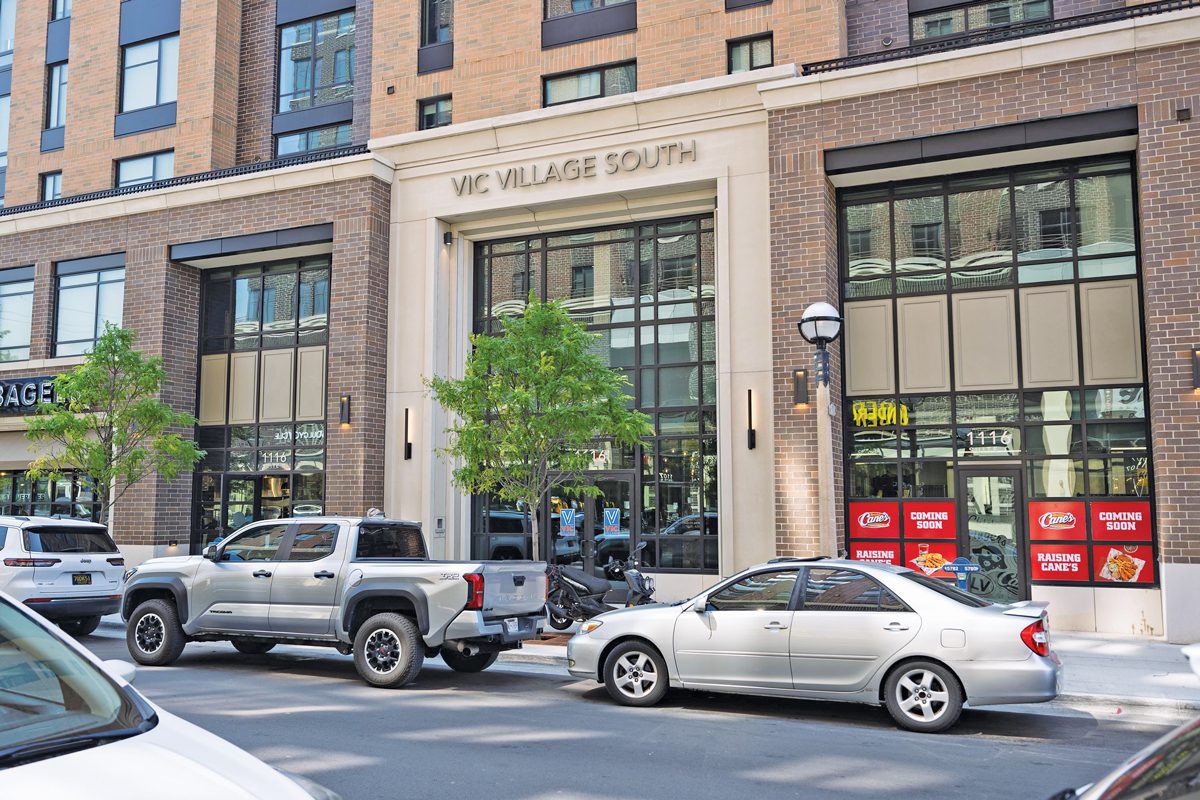
Living alone in the South U area’s newest apartment towers will cost you: a one-bedroom apartment in Vic Village South (above) lists for $3,099. | Mark Bialek
At nineteen stories, the Legacy dwarfs the eight-story Corner House Lofts across State St., but the two share parents: Detroit-area developer Howard Frehsee, and a city increasingly interested in promoting density through taller buildings.
A commercial developer at the time, Frehsee had initially proposed replacing a one-story former fast-food restaurant there with another low building. But the city asked him to think bigger, so he ran some numbers.
In 2022, he told the Observer’s Jan Schlain that when his daughter was a U-M student, he’d been shocked to find her living in a dilapidated old house with a rotted fire escape—he called it “a fire trap, a rat trap.” When he learned how much his ex-wife was paying in rent, he said, “I started to think, ‘Hmm. I can probably build something for less than that that would be really safe.’”
Related: The Last High-Rises?
Going Up
When the Corner House opened in 2004, it was the city’s tallest residential building since Tower Plaza in the 1960s. But as the city continued to encourage more housing in the downtown area, national developers began running Frehsee’s playbook on a much larger scale.
He’d already begun assembling property across State, and was thinking of a bigger building there. It turned into a far longer and more complicated process than he’d imagined—he compared navigating the pandemic to “launching a rocket in the worst weather possible”—and he finally had to partner with one of the biggest national firms, Landmark, to bring it to fruition. But when it opened in August, the 521-bed Legacy was Ann Arbor’s biggest campus complex yet—and a press release announcing its August opening claimed that it was fully leased.
That statement might have come with an asterisk, however: as move-in day approached, social media ads offered deep discounts, as much as $540 per month, plus a $600 gift card for renting one of those costly one-bedrooms.
As the Observer went to press, the deals were still advertised on the Legacy’s website. The steep prices developers are asking, and sometimes getting, have kept them building more. But the newest high-rises opening with vacancies and discounts doesn’t bode well for the half-dozen more currently in the planning process or under construction—especially with a new U-M dorm nearing completion on the former Elbel field, and nearby homes and apartments being demolished to clear the site for a second.
Related: New Dorms at Last
The Last Holdouts

On S. Forest Ave., Verve (right) wants one dollar more—$3,100—for a studio. | Mark Bialek
An Observer survey of recent off-campus construction confirms that living near the campus area puts the heaviest burden on your pocketbook.
Since 2022, developers have completed nine major rental complexes in the Observer’s circulation area (the Ann Arbor zip codes and school district). Verve’s $3,100 studio is the most expensive. Looking at a list of projects that passed through planning review, the least expensive is Avia Lofts, where a one-bedroom rents for $1,600, just over half what Verve is asking. But while it, too, claims to offer luxury, Avia is not remotely in the same league: online photos reveal 1980s-vintage kitchen cabinets, relics of its prior life as a Residence Inn hotel.
For truly new apartments, the best prices we found were at Maple Cove, a cluster of small buildings on Maple Rd. north of Miller Rd. Thanks to less expensive land and “stick-built” construction, a one-bedroom apartment there costs $1,795, according to its website.
Demand seems strong. The developer is proceeding cautiously, one building at a time, but with three up and a fourth underway it now has more than seventy apartments, including roommate-friendly two-bedroom, two-bath units at $2,095. At just over $1,000 per bed, that’s a bargain for new Ann Arbor rentals.
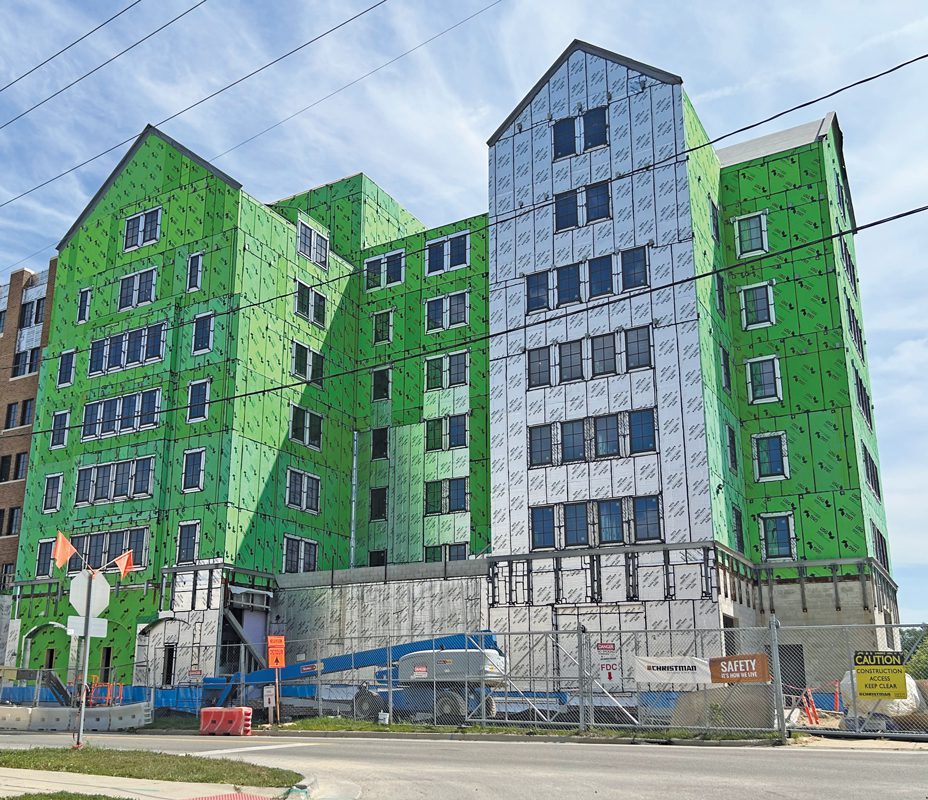
Fortunately for landlords chasing student tenants in August, the U-M’s new dorm is delayed till 2026. | John Hilton
Renters willing to share can trade privacy for savings. At Verve, the cost to lease a bedroom and bathroom in a shared apartment falls as the number of roommates rises—from $2,345 per person in a two-bedroom to $1,799 in a five-bedroom.
Choosing a mid-rise “podium” building farther from campus also costs less. Hoover + Greene, which replaced an entire block of homes and businesses near the stadium, was asking $2,835 for one-bedrooms in mid-August, adjusted for a “two months free” offer. At Beekman on Broadway, which opened its newest building on Maiden Lane last year, you could get a two-bedroom for that, and a one-bedroom for $2,300. And by then, Packard Row, on its namesake street east of Stadium, had marked its available two-bed, two-bath units down from $2,950 to $2,459.
A few distant complexes compensate by running their own shuttle buses. At University Trails, a townhouse and apartment community on Pontiac Trail near Dhu Varren Rd., one-bedrooms start at $2,249—a more than 25 percent discount over a high-rise for students willing to take a bus to campus.
Everywhere, of course, amenities cost more. At Avant on S. Maple, which has a clubhouse, pool, and walking trails, one-bedrooms start at $2,225—20 percent more than at Maple Cove. It’s the same at Woodview Commons, a vast 450-unit apartment and townhome complex south of Dexter at the westernmost end of Ann Arbor’s 48103 zip code.
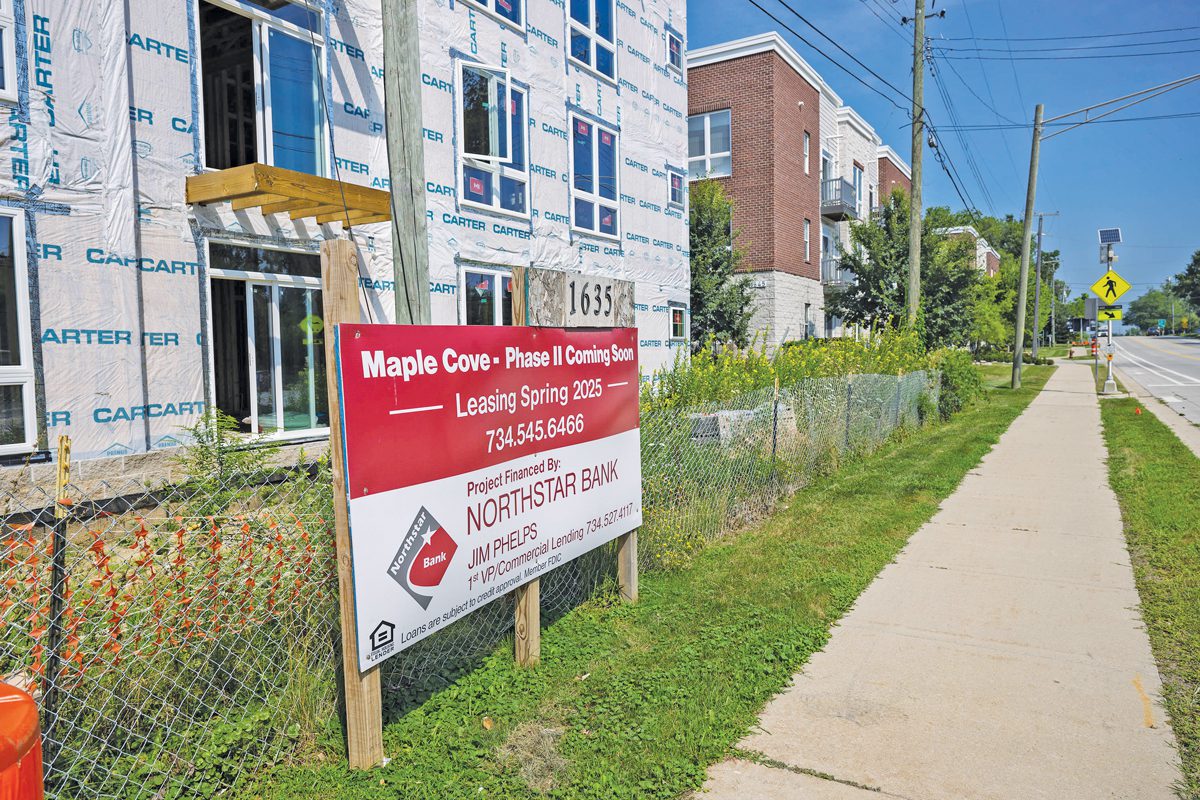
Rents are lower the farther you get from campus: on Maple north of Miller, Maple Cove’s website quotes $1,795 for a new one-bedroom. | Mark Bialek
The August discounts reflect an essential fact about renting to students: everyone needs a place to live before school starts, but very few do after. For landlords, that means that if an apartment doesn’t have a tenant by September, it might remain vacant till the next semester, or even the next school year.
The discounts are intended to give them a short-term edge during that last-minute rush. But when so many landlords are offering them so openly, it suggests that at least on the student side, the number of available beds may finally be catching up with the U-M’s growing enrollment, which is on track pass 53,000 this year. This year’s scramble for students would have been sharper if, as planned, the new dorm had opened this year.
It will open next year, as will still more high-rises. By then the second dorm will be rising as well.
Meanwhile, Ann Arbor is drafting a new comprehensive plan that calls for increased density almost everywhere. Since the city is fully built out, that means replacing single-family homes with small apartments, and small apartments with bigger ones.
If that future comes to pass, Ann Arbor has more apartments in its future—and the day may come when landlords competing for tenants will no longer be news.