
The Ann Arbor Area Community Foundation 2025 Washtenaw County Housing Study revealed what Ann Arbor’s working class has long known: if you make less than $50,000, you can’t afford to live here.
“A person working a lower-wage job and living on one income of no more than $50,000 found himself or herself facing middling options in the rental market, at best, and had no chance at homeownership,” the report reads.
As the Observer went to press, Zillow listed the average rent for one-bedrooms in the city at $1,551, and the average home price, $504,072. As a result, finding affordable housing has become increasingly challenging for that income bracket, especially those who live alone. Priced out of Ann Arbor, workers in service, agriculture, retail, and other low-wage sectors often face a trade-off, such as long commutes, multiple roommates, or dependency on family members, romantic partners, or friends.
Hannah Weber, thirty-eight, is co-owner of Green Things Farm Collective. After years of renting in Ann Arbor Township, she bought a home in Ypsilanti Township in 2023, but “I wouldn’t be able to own a house without family support,” she says.
Liz Joseph, a sales manager with Green Things Farm Collective, makes $25 per hour and lives with her partner in Ann Arbor. Even with her partner covering the lion’s share of their rent, her contribution consumes between 35 and 40 percent of her income. “If I was paying traditional rent in this area, it’d be like 80 percent to 90 percent of my income,” she observes.
“This is an existential question about the soul of our city,” says Phillis Engelbert, owner of Detroit Street Filling Station, the Lunch Room Bakery & Cafe, and North Star Lounge. “What does it say when people who are making a middle-class wage cannot afford to live in town?”
Engelbert bought her home on Ann Arbor’s north side soon after moving to Ann Arbor in 1981, but today “even with a successful business … I most likely would not be able to live in Ann Arbor.”
Many of her employees, including her son, live in Ypsilanti, where the average rent for a one-bedroom apartment is $995, and the average home price is $276,068. But public transportation doesn’t run late enough for evening restaurant shifts and commuting by car is expensive.
“They’re squeezed out,” says Engelbert. “Ann Arbor is no longer for them, and that breaks my heart, because Ann Arbor should be for them. They play music, they make art, they serve food, you know, they do all sorts of things, but they can’t live here.”
Related: Affordable Housing, At Last
When displaced Ann Arborites move to Ypsilanti, “that leaves less and less housing that would be considered affordable for people who are those single earners or people who are truly low-income making that $15 to $20 range,” says Joye Bengston, former program director of Friends In Deed, an Ypsilanti-based nonprofit that provides emergency housing and utility assistance to county residents.
According to the 2015 Washtenaw County Housing Affordability and Equity Analysis, “Ypsilanti cannot remain the de facto affordable housing policy for Ann Arbor and Pittsfield; continuation of this default way of operating will ensure further decline of property values and fiscal stability.” Yet ten years later, the 2025 Housing Study notes that the city of Ypsilanti contains 12.6 percent of the county’s subsidized housing units and 5.4 percent of its population. “For Ypsilanti to become a viable market, and for the county’s poor households to have a chance for upward mobility, development and redevelopment have to be inclusive on a countywide basis,” it reads.
The Ann Arbor Comprehensive Land Use Plan (CLUP) looks to zoning and long-term density as solutions for the housing crunch, such as allowing Accessory Dwelling Units and multifamily housing in neighborhoods once zoned exclusively for single family homes, as well as encouraging mixed-use, transit-oriented development in certain corridors. But there is no guarantee that the type of housing that gets built will be affordable for the people who need it most.
In theory, when many units of market-rate housing are added to a community, those who can afford to will move in, freeing up the cheaper housing for lower-income renters. “If demand stays the same and supply increases, eventually owners at different price points will need to offer discounted rents to be competitive and attract new renters,” says Jennifer Hall, executive director of the Ann Arbor Housing Commission. But this has not happened yet.
“I don’t think the public has embraced the idea that I can’t get my coffee or my dinner because there’s no place for low-income people to live,” Hall observes. “If people understood that, I think they’d be more supportive of affordable housing.”
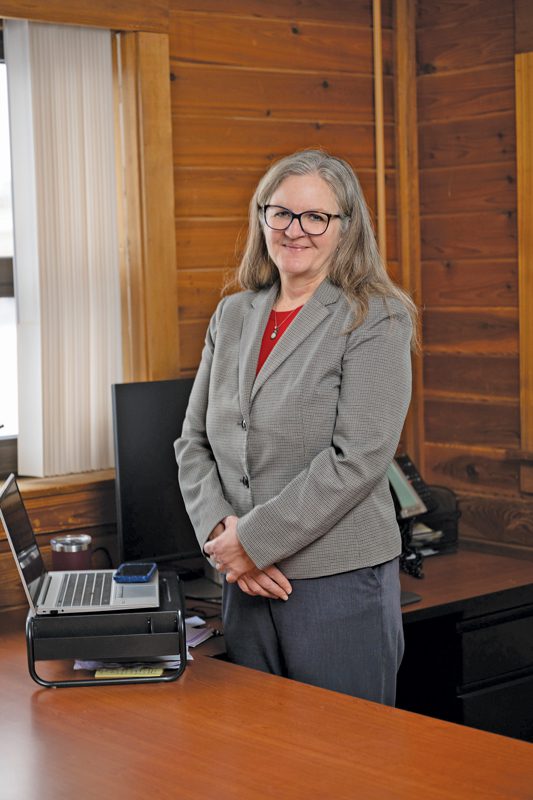
Ann Arbor Housing Commission executive director Jennifer Hall says that despite an increase in building costs, the city is still on track to create 1,500 units of affordable housing. | Mark Bialek
Ann Arbor passed its Affordable Housing Millage in 2020 with the goal of creating about 1,500 units of affordable housing. According to Hall, the housing commission remains on schedule with 136 units built and 1,071 units in the pipeline despite a 40–50 percent rise in building costs. That’s only a start. The Housing Study states that Washtenaw County still needs 11,000 new units for households earning less than $35,000 and 8,700 new units for households earning at least $75,000.
Hall notes that progressive policies and local investment have attracted interest from “a couple dozen” affordable housing developers. But tariffs and soaring construction costs present challenges. “It’s irrelevant what the zoning is and it’s irrelevant what the need is if you can’t get all the funding together to make it financially feasible,” she says.
“I think across the board we need to start looking at housing as a necessity instead of a business,” says Bengston. This would require an unprecedented level of government subsidies—unlikely when the White House has proposed slashing the budget for Housing and Urban Development (HUD) by 44 percent in 2026. “I predict we will have more homelessness in the community because of some of these changes,” says Hall.
Liz Joseph is staying with her job at Green Things Farm, but it isn’t easy. “It takes really creative housing to be a farmer if you don’t have generational wealth.”
Please listen to my interview on the Lucy Ann Lance show regarding affordability and the CLUP:
https://podcasts.apple.com/us/podcast/the-lucy-ann-lance-show/id1747985760?i=1000733159351