
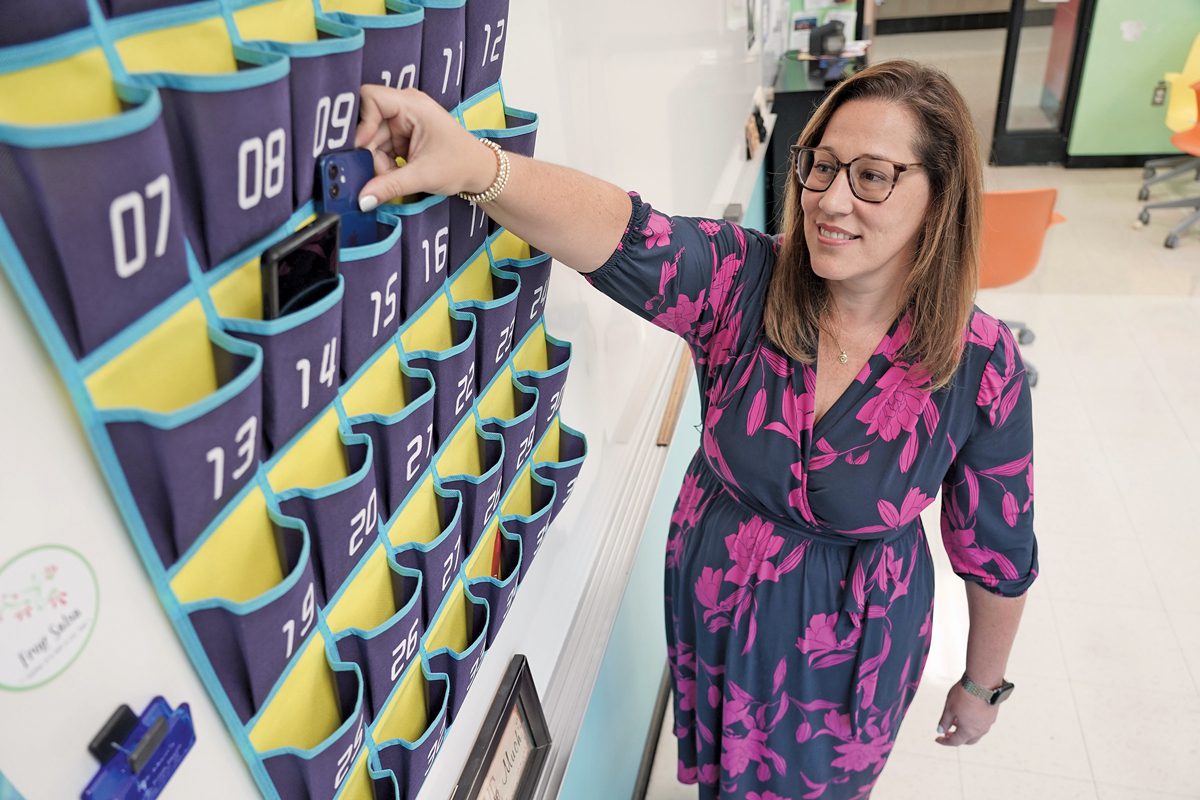
Skyline principal Casey Elmore says teachers are “seeing a much improved classroom environment” since the school started using cell phone caddies. | J. Adrian Wylie
Pioneer High at 3:01 p.m. has the feel of a busy commuter airport. Students pour out of classrooms shouldering backpacks, swinging musical instrument cases, laughing and chatting. Many are holding cell phones.
Those phones are a point of contention at all levels of the education system: from individual classrooms to the school district, and all the way up to the Michigan legislature.
Locally, parents and teachers support limitations on cell phone use in school. In an informal Observer poll on the Ann Arbor Mamas Network Facebook page, 89 percent of the 389 respondents voted in favor of some form of restriction.
Lansing won’t be helping anytime soon. Governor Gretchen Whitmer called on legislators to restrict cell phone use in the classroom in February, and bills were introduced in both the House and the Senate. But the House bill was voted down in July, and with the legislature paralyzed by partisan conflict, a law seems unlikely in this school year.
But also in July, the Chelsea school district announced that it will prohibit cell phones during class time. And last year, both Skyline and Huron high schools piloted similar bans.
Most teachers at Pioneer High also instituted their own restrictions; Sarah Roldán-Dodson is one of them.
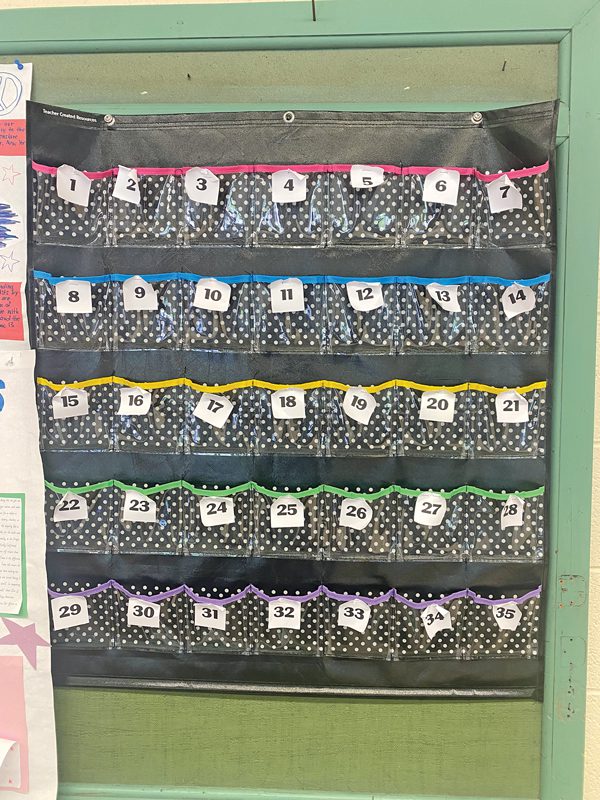
Sarah Roldán-Dodson’s cell phone caddy. | Brooke Black
In May, Roldán-Dodson led me through the chaos of Pioneer at last bell and into the soothing silence of her AP U.S. History classroom. Lively, student-created posters papered the walls, the desks were clustered together in pods of four, and a cell phone caddy hung beside the door.
Roldán-Dodson has been teaching in Ann Arbor for sixteen years, nine at Huron and the last seven at Pioneer; she’ll be teaching at Community starting this fall. The caddy—a hanging closet shoe organizer with polka-dotted plastic pockets labeled numerically and brightened by colorful decorative tape—has been a mainstay in her classroom since at least 2018.
“At a point years ago, many of us recognized that we were spending too much instruction time asking students to put their phones away,” she says.
In those days, she recalls, when a teacher spotted a phone, they’d take it from the student and bring it to the front office, where the parent would have to pick it up. The caddy is easier: students put their phones in their assigned pocket when they enter the room and pick them up on their way out. They have access to their devices if needed, but aren’t tempted to look at them.
And the temptation is powerful. According to a 2024 report from the American Psychological Association, young people’s brains are both hypersensitive to social feedback and less capable of impulse control. In other words, they’re really susceptible to the pull of “scroll hole.”
“It’s such a distraction,” says Skyline principal Casey Elmore. Before last year’s pilot ban, phone use “had been preventing in-class conversations, social dialog and interactions, collaborative work, because they’re so attached to it.”
So during the 2023–24 school year, her administration began researching what was working at other schools and surveying the Skyline community.
A handful of students said they were sick of the distraction, but most opposed a classroom ban. Staff and parents/guardians, on the other hand, were “overwhelmingly” in support of restrictions, Elmore says, though a few expressed concerns about being able to contact their children, and emergency situations. Skyline ended up implementing a schoolwide system of cell phone caddies.
“Teachers reported that it’s made significant differences in what the classroom looks like and feels like, the talk that’s happening, the attention that’s there, the work products that they’re getting,” Elmore says. “They’re seeing a much improved classroom environment with cell phones not being there as much.”
But even schoolwide policies aren’t a silver bullet—just ask Theo Walters (not his real name), a recent U-M School of Ed grad who taught freshman-level world and U.S. history at Pioneer last year. When he tried to enforce phone restrictions in his class, some students pushed back.
“I fight with the students a lot about the phone,” he admits. “I’m still learning how to deal with it properly, and I feel like it’s a larger problem [with] teacher education, where they teach you how to teach stuff, but not how to manage the students.”
“Yeah, ‘How do I take a phone?’” pipes in Roldán-Dodson. “It would be great if ed schools talked about the reality that phones have brought to our lives.”
Walters found it harder than Roldán-Dodson to set limits in his classroom.
“If I try to force the issue, I will be starting a power struggle with students in front of their peers, which is really damaging to our relationship,” he explains. “The issue is also too insignificant to warrant a disciplinary referral to a school administrator. And if I were to contact their parents, parents might not always have the same response.”
Both Elmore and Roldán-Dodson say that parents have been supportive of the cell phone caddies. Do many students resist?
“Of course!” laughs Elmore. “They are not in love with it. However, many of them—not all of them, but many of them—after experiencing class without it, have been appreciative of it.”
And some, like Pioneer junior Elisa Vidal-Parker, see it both ways. Vidal-Parker is bright and articulate, a contributor to the Pioneer Optimist, and was a student of Roldán-Dodson’s last year.
“Her class was set up in a way that it’s mostly interactive—you’re talking to each other, you’re taking notes on her teaching,” she says. “So there wasn’t really a need for phones, and they, in that situation, were a distraction.”
But in other classes, she appreciates phones as a teaching and learning tool: educational games and the language-learning app Duolingo in particular.
“Music helps people work as well. It helps them focus,” she says. “I play solitaire while listening to lectures, and it helps me not, like, go crazy, getting bored out of my mind.”
For some students, phones are an integral part of the learning process. Cynthia Gabriel is a U-M women’s and gender studies lecturer and mother of three; her youngest son is a Community rising sophomore with an individualized education program (IEP). His cell phone, Gabriel says, is “a lifeline for academic and emotional support, and for just understanding the social world.”
His biggest challenge is understanding speech. But with a cell phone, he can snap a picture of whatever’s written on the board, then take the time he needs to absorb what it says. If he can’t ask a teacher for clarification, he can text his mother for help.
Roldán-Dodson allows, grudgingly, that phones may have uses in the classroom—in “very narrow” circumstances: Accessibility for students with special needs. Recording a lecture. The review game Kahoot!, where students use phones to vote on quiz questions. If a student forgets their computer and needs to do something online.
“But beyond that, I don’t see a need for them really at all,” she says, and adds with a laugh, “I’m very anti-phone.”

Social worker Kaleigh Cornelison says phones can be a “lifeline” for teens from marginalized identities—particularly during passing time. | J. Adrian Wylie
Kaleigh Cornelison is not. A trainer, facilitator, and social worker with fifteen years of experience teaching about teen social media use (including five as the assistant director of Michigan Medicine’s Adolescent Health Initiative followed by eight years in private practice), she takes a realistic approach to teens and tech: they’re going to use it, so how can adults help them use it responsibly? That said, she’s in favor of limiting use during class.
“I think we’re gonna be hard-pressed to say that’s always a good thing—or maybe ever a good thing,” she muses. But then one instance occurs to her. “We live in a country where we can’t guarantee safety for young people in schools,” she continues sadly. “We want them to have access to emergency services, family, and friends if the worst thing happens.”
That reality isn’t lost on Vidal-Parker.
“Having your phone with you can help bring a sense of safety, especially in the world we live in right now,” she says. “If, God forbid, something horrible happens … we can contact our parents, we can contact the people we love.”
As for the day-to-day, Vidal-Parker says her phone is useful for directions, letting her parents know when there’s a change of plans, and general communication.
“I spilled something on my shirt, and I was able to text my friend and be like, ‘Hey, do you have an extra shirt that I could borrow?’” she recalls. “And she came to the bathroom, and she gave me the extra shirt.”
Cornelison also sees phones as useful during passing time, particularly for teens with marginalized identities—she lists members of the LGBTQ+ community, those with disabilities, and those who just have a hard time making friends. For them, she says, the phone can be a “lifeline to a parent, a friend who doesn’t go to school with them, something that can self-soothe, something that helps them stay grounded if they’re having a panic attack.”
And for Gabriel, her son’s phone helped avert a dangerous situation when he left school during his free period and got lost.
“He texted a teacher … who figured out where he was, and helped him figure out how to get back,” Gabriel shares, adding with palpable dread, “I think about what would have happened that day if he didn’t have a cell phone …”
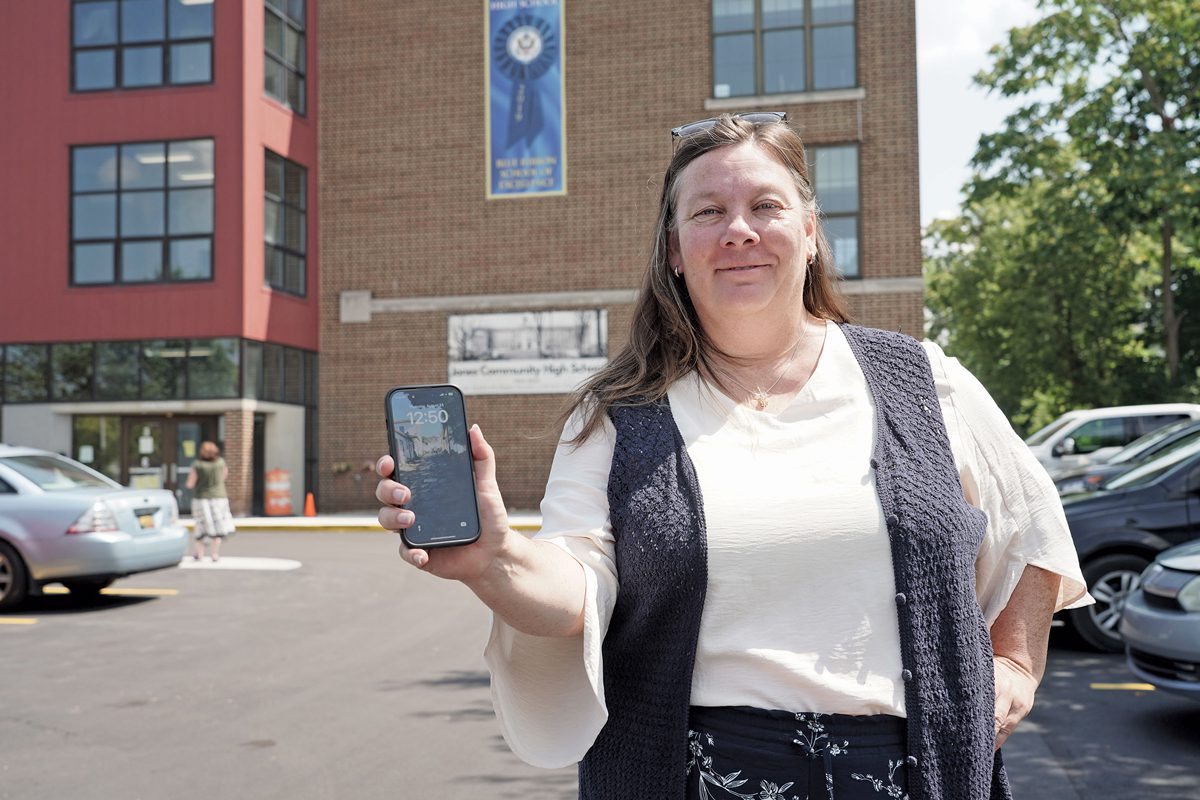
Cynthia Gabriel’s son is a rising sophomore at Community with an individualized education program. He uses his cell phone as a learning aid. | J. Adrian Wylie
The Republican-authored House Bill 4141 lost by three votes, with zero Democratic support. Senate Bill 234, introduced by a Democrat, is still alive, but House speaker Matt Hall, R-Richland Twp., told reporters in August nothing will be passed this year.
That’s fine with Gabriel. A state law is “a one-size-fits-all answer to a problem that even grown-ups are facing,” she says. “None of us are very good at managing time on our phones, but I would give teachers the right to make decisions about their own classrooms.”
Which makes sense, in theory. But in practice, Walters warns, it can create more work for teachers.
“Our district does not have a uniform policy on phone restrictions,’” he writes. “Our superintendents abdicated their responsibility and instead suggested that each school should conduct its own pilots and public engagement with parents. Principals across AAPS devised a patchwork of inconsistent policies. We sometimes receive support to enforce these rules, sometimes not.”
“What’s going to work here in Ann Arbor is not going to work in the same way as in a rural community in northern Michigan,” Cornelison notes. Moreover, a statewide ban “loses an opportunity for the young people to actually be engaged in the process, and I think they’ll be more likely to follow the rule if they’re a part of that conversation too.”
Also absent from the conversation are the tech companies creating the apps that have proven so addictive for young (and grown-up) minds. It’s technologically possible to block notifications and restrict app usage and content; is there a reason why the proposed legislation doesn’t put the responsibility on tech companies?
“The ways we use our technology are constantly changing, so codifying into law specific modes or settings that seem sensible now is not a flexible way to respond to an evolving issue,” emails a staffer for state senator Jeff Irwin, who voted yes on SB 234. “In five years, we could be stuck with a law as outdated as regulating the noise of a dial-up modem.”
Meanwhile, Walters notes, “Our district decided to introduce 1:1 MacBooks for [grade] 9–12 students beginning this year. We are already struggling with phones and kids using GenAI to cheat on their Chromebooks. Now students are given more powerful tools that teachers have less control over. … When we voice our demands against introducing more distractions into the classroom, district executives often respond by criticizing our lessons for not being sufficiently engaging. As if any lesson could compete with video games for the interest of our young students whose impulse control is not yet fully developed.
“The result is that the overwhelming burden to provide consistent, high-quality education lies on the shoulders of individual teachers. The question of phones is emblematic of a host of issues in our district and beyond.”
Those issues aren’t going away, but they’ll no longer be Walters’ problem: he’s leaving the teaching profession—and starting U-M Law this fall.
Related: Chatbots Go to College