
As the increasingly bitter campaign over the future of the downtown library races to a close, both sides are spending the final days before Tuesday’s election making their cases by going door to door, flooding social media, and pushing targeted ads through mail and online platforms.
Voters this week determine the fate of two ballot proposals, one to undo a 2018 city charter amendment requiring a park to be built on the vacant city-owned Library Lot next to the downtown library and another authorizing the city to sell the parcel’s air rights to the Ann Arbor District Library for $1. The AADL, in turn, would build an expansive new downtown branch at the base of a mixed-use high-rise featuring apartments as well as a public plaza.
A lingering wild card: whether Tuesday’s results will count, given a lawsuit filed in July by attorney Noah Hurwitz on behalf of two Ann Arbor taxpayers who argue that the proposals’ ballot language is misleading. The suit notes that Proposal A would allow the city to sell the air rights “for the purpose of building a mixed-use development that includes additional library services, housing, retail and programmable open public space.” There’s no similar restriction in Proposal B, so Hurwitz argues that the library could do whatever it wants with the site.
AADL board president Molly Kleinman, a leading voice for the Supporters of the Downtown Library ballot committee, says the library district won’t stray from its public promises. “The library is absolutely bound by the stated purpose of the ballot question,” she says. “We want to be there. We’re a library. What we want to do is operate a library.”
Despite filing an emergency motion, Hurwitz says the earliest a judge was willing to hear the complaint is August 25, three weeks after the election. Nonetheless, he says he’ll continue to fight to invalidate the outcome should the proposals pass “because the language is unlawful.”
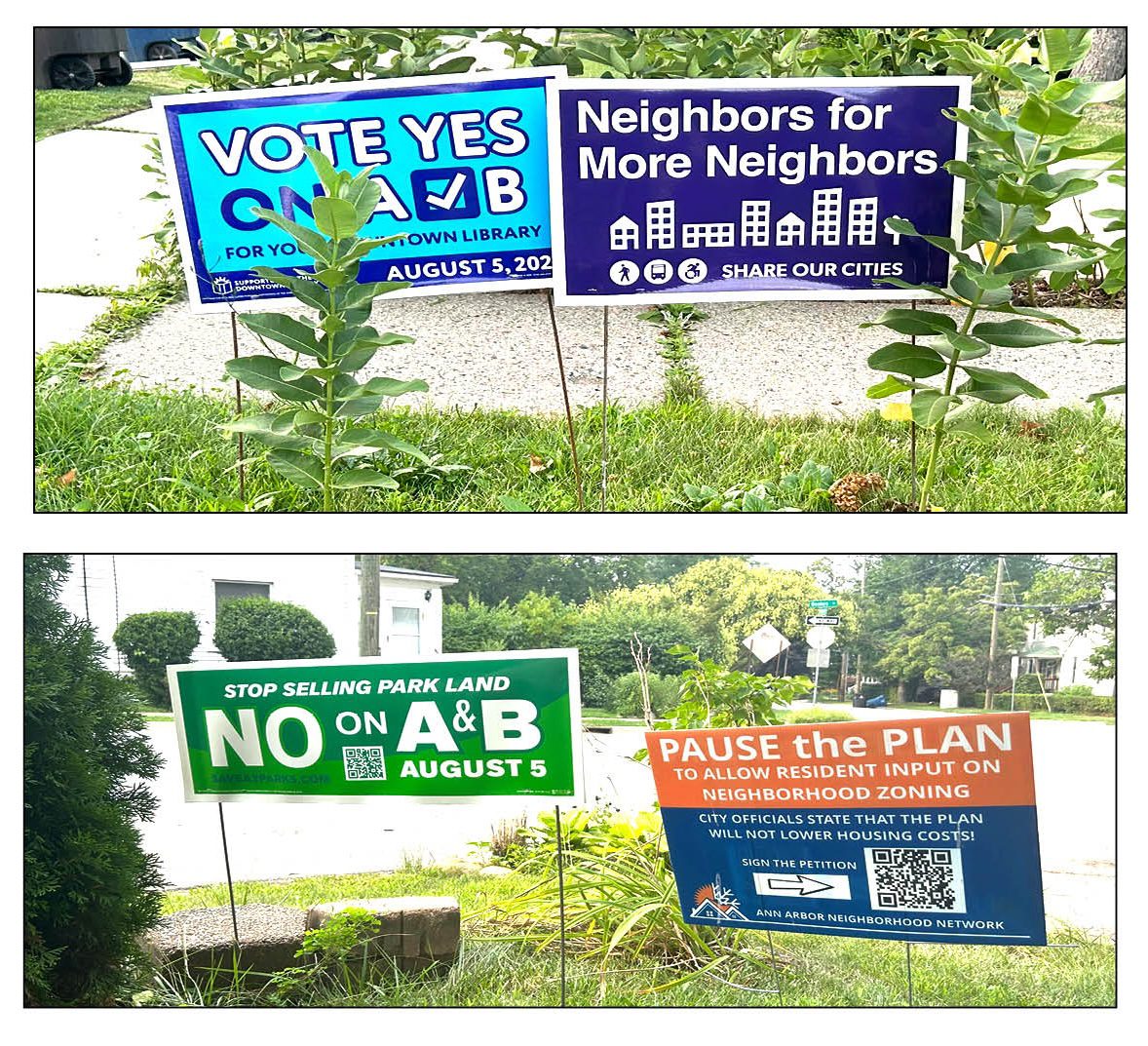
On Tuesday, August 5, voters will decide the fate of the “Library Lot”—and the shape of a future downtown library.
The Library Green Conservancy, which supported the proposed park, has legal headaches, too. After attorney Tom Wieder posted on Nextdoor that the nonprofit had spent $59,000 on the election, U-M researcher Andrew Robbins filed a complaint to the state asserting the LGC had violated a campaign finance law. The LGC is a nonprofit and not a registered ballot committee, Robbins says, so they can’t spend more than $500 on campaign advocacy.
Wieder emails that LGC “doesn’t need to file any financial disclosure” to provide information. “It can discuss issues raised in the campaign, factual history, and even discuss pros and cons of certain outcomes. The sole prohibition is that it may not issue ‘communications containing express words of advocacy of election or defeat …’ The LGC has been very careful to avoid violating that prohibition in its ads and mailed materials.”
Wieder argues that it’s the Friends of the Ann Arbor District Library that may have to disclose its funding, pointing to a report that shows the nonprofit contributed $23,000 to the Supporters of the Downtown Library. That “is most definitely an advocacy organization, so contributions to it would be considered advocacy by the FAADL in excess of the campaign finance threshold. This would require the filing of a registration certificate and a report disclosing contributions and expenditures. As of last Friday, it has not done so.”
The legal tit-for-tat isn’t the only way the amped-up intensity of the ballot campaigns has gripped the city. On social media, the debate has occasionally turned nasty, as when city councilmember Jen Eyer complained last month on Facebook that “between the anti-library campaign and the Pause the Plan movement (which share many of the same organizers), it is the summer of disinformation in Ann Arbor.” Pause the Plan is the slogan promulgated by opponents of a proposed comprehensive land-use plan that would encourage denser development.
In response, Judy Stone posted that she’s not “anti-library” but rather “against that particular vision and plan. That’s all.” Eyer engaged Stone by asking her to explain her opposition, but others piled on, with one user likening Stone to “a Trump supporter or genocide denier.”
LGC president Rita Mitchell, who helped push through the 2018 ballot measure, says AADL can get its new library without the city giving up the park it voted for.
Mitchell told the Observer last month her group is concerned that the charter amendments lack “detail sufficient for voters to make informed decisions with respect to design, lack information on the private housing component, lack definition of the public space to be offered, and lack justification for giving away public land for $1 that was previously offered for sale for $10 million.”
Kleinman points to AADL director Eli Neiburger’s online post attempting to debunk some claims. Among them are that an image circulated of the proposed building by opponents “does not represent AADL’s vision, disregards engineering realities, and does not adhere to building codes for residential space.”
Kleinman says that should both proposals pass, AADL will issue a request for proposals to partner with developers for the mixed-use library facility. If the proposals fail, the library will reassess. Kleinman also says that AADL does not currently have any developers lined up.
Right now, the campaign takes priority.
“We’re leaving everything on the field, we’re running through the tape, squeezing out the very bottom of the tube,” she says. “I’ve been fighting really hard for this campaign. It’s something I believe a lot in. The bottom line for us is ‘bigger site, better library,’ so we’re out here fighting until the last day.”
Early voting has ended, but city residents can still register to vote at the City Clerk’s office in City Hall on Monday or Tuesday. Polls are open on Tuesday from 7 a.m. to 8 p.m. If you don’t know if you’re registered or where to vote, check the Michigan Voter Information Center.