
Last January, the Ann Arbor Educators Association (AAEA) union and the school district signed a letter of understanding that teacher pay should align with comparable districts. But that didn’t happen. The contract expired December 31, and a new round of negotiations begins January 26.
“We want to be able to provide competitive wages that help retain and attract high-quality educators in the Ann Arbor Public Schools, while at the same time continuing the process of ensuring long-term financial health,” reads a December 18 message from AAPS superintendent Jazz Parks.
Ann Arbor Public Schools (AAPS) is still contending with the effects of the $25 million budget shortfall revealed in April 2024 (Over the Cliff, May 2024). The district had an FY2025 ending fund balance of 7.17 percent of expenditures—up from 2.2 percent the year before. (The fund balance is a “rainy day” reserve to help cover normal budget fluctuations; it’s also used as a measure of financial health for a school district.) As a result of this improvement, the Michigan Department of Treasury released AAPS from its Early Warning Potential Fiscal Distress watchlist, though it will continue to keep an eye on the district’s finances.
Related: What’s Next for AAPS? (Aug. 2024)
“I think those are all good steps to try to show the community that we’re being fiscally responsible,” says school board president Torchio Feaster. “But honestly, we have further to go. I don’t think you come back from a $25 million shortfall, and that slate gets wiped clean within a year or two.”
Budgeting for the 2025–26 school year got off to a rocky start. The Michigan state education budget was delayed by four months, meaning school districts had to plan their budgets without knowing how much money they’d receive.
The June version of the AAPS budget projected $315 million in revenue and $314 million in expenditures, bringing the fund balance to 5.88 percent. But the amended budget, presented at a December 17 board meeting, showed $308 million in revenue and $311 million in expenditures, which brought the fund balance to 5.72 percent. “This amendment aligns with fund balance projections shared publicly when the district adopted its budget in June 2025,” Parks wrote in her message.
The decrease in revenue was due in part to a $7.8 million miscalculation of Act 18 special education funds from the Washtenaw Intermediate School District (WISD). Since Act 18 money is a reimbursement, it reflects money the district didn’t spend—in part because of a reduction in AAPS’s special education staff.
“Our reduction in staff across the board, it obviously had an impact,” explains Feaster. “On the other hand, other districts have increased their special education funding, which means they get a larger piece of that pie from the WISD.”
But AAEA president Fred Klein sees it differently: “They overestimated what the reimbursement would be, which to me, seems like not really great bookkeeping.”
Coming back from a budget crisis doesn’t happen overnight—particularly since AAPS hasn’t had a chief financial officer since late 2023. But Klein says the issue of teacher compensation goes back much further than 2024.
“The biggest raise I’ve had, and I’m a thirty-six year veteran here in Ann Arbor, was [a] 2.5 percent raise in 2006, so twenty years ago.” He pauses to let it sink in. “It’s just unsustainable.”
Between 2010 and 2014, he adds, teachers absorbed more than 5 percent in permanent salary reductions; freezes were imposed in 2018–19 and again in 2019–20. In this latest round of negotiations, the district asked for concessions in exchange for what he describes as “small, insignificant raises.”
Teachers’ salaries are arranged in a grid of what are known as “steps” and “lanes.” Every year a teacher stays in the district, they move up a step; earning an advanced degree, moves them up a lane. Moving up a step or a lane comes with a bump in pay. This isn’t the same as a raise, since these steps are predetermined and therefore are included in budgeting.
In theory, anyway. Since 2008, steps have only been honored in full five times. (Recent legislative changes have made it mandatory for districts to honor pay schedules.)
Sarah, who teaches lower elementary and asked that we not use her last name, says she and a group of other teachers had completed a master’s degree program, but the district didn’t automatically adjust their lane. “We had been getting paid wrong for five years,” she says. “[The district] moved us when we figured it out and called them on it, but didn’t back pay us for any of that, even though we had that certification the whole time.”
The AAEA is also pushing for the state maximum 80–20 cost share for health insurance; currently, Klein says, it’s closer to 60–40. He adds that health insurance rates rose 25 percent in 2024 and 18 percent in 2025.
“This insurance increase, it’s two and a half years worth of utility payments for my family,” says Allison, a high school teacher who also asked that her last name be omitted. “When you do the math, it’s three daycare payments. … It’s three mortgage [payments].”
In a group interview with eight AAPS teachers (some of whom asked to be referred to by their first name) revealed that many must supplement their wages with a range of side hustles including Uber Eats, test proctoring, substitute teaching, tutoring, coaching, babysitting, dogsitting, administrative work, after-school and summer camps, library programming, dance and swim lessons, secret shopping, online surveys, carpentry jobs, and teaching summer school and online classes. One teacher even participated in medical experiments at U-M.
Related: “Moonlighting,” Jeff Kass’s Teacher/Pizza Guy
“The emotional labor that takes place when you’re just constantly thinking of that next hustle, and constantly thinking about ways you can build something up to make more money, or constantly looking for other jobs, is significant,” says Luke, who teaches lower elementary.
“Or ways to cut costs,” adds Sarah Winter, an eighteen-year veteran of the district who teaches art. “I used to live in Ann Arbor, but now I live in Detroit, because I can’t afford to live in Ann Arbor anymore.” In fact, all but two of the eight teachers interviewed live outside Ann Arbor (though many of them do so by choice).
“We’re at the mercy of the state in terms of our fund balance and our per-pupil funding,” says Feaster. “I would love to pay the teachers everything that they want and desire, but we have to work with the realistic numbers that we have.”
The belated state education budget included a 4.6 percent increase in base per-pupil funding. But Feaster points out Ann Arbor’s per-pupil foundation allowance—which makes up 58 percent of general fund revenue—hasn’t changed much historically. He’s not wrong: the current amount is $11,051, and in 2006, it was $9,619. Adjusting for inflation, the current amount would have to be $15,719 to equal what it was twenty years ago.
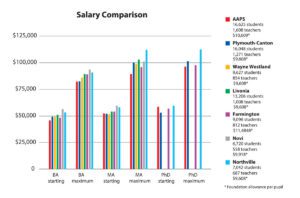
Analysis of 2025 data reveals that Michigan schools with comparable per-pupil funding, number of students, and ratios of teachers to students are able to pay their teachers more than in Ann Arbor.
Meanwhile, enrollment continues to fall—it’s now at 16,625 students. But Feaster notes that enrollment is a statewide issue. Although Ann Arbor lost 1,132 students between 2019 and 2024, the twelfth most of any school in Michigan, that marks only a 6.3 percent drop in student population, putting it at 191 out of the 480 districts with decreased enrollment.
Per-pupil funding and enrollment notwithstanding, there are comparable school districts doing more with less. Analysis of 2025 data (the most recent publicly available) for the Plymouth-Canton, Wayne-Westland, Novi, Northville, Farmington, and Livonia school districts reveals that AAPS has the second-highest foundation allowance, but the lowest starting salary for a teacher with a BA, as well as the lowest longevity pay for teachers of all education levels.
Plymouth-Canton had 16,048 students, roughly the same as AAPS, and a foundation allowance of $1,001 less. Yet the starting salary for a teacher with a BA was $3,370 higher.
The AAPS has attributed the 2024 budget crisis to an increase in staff—paying more teachers while getting money for fewer students. According to 2025 Munetrix data, AAPS had an average of 10.3 teachers per pupil. But Novi had 9.8 teachers per pupil, a $9,918 foundation allowance, and its starting salary for a BA holder alone is more than $10,000 per year higher. Northville had the same number of teachers per pupil as Ann Arbor, a foundation allowance of $1,001 less, and a starting salary for a teacher with a BA that was $7,600 more than AAPS.
“We’ve lost a lot more employees in my school in the last couple years than we’ve had prior, just because people are looking elsewhere,” says Nathan Smead, who teaches at A2STEAM middle school. “It’s just not a sustainable environment right now.”
Klein acknowledges that the changes teachers want to see won’t happen in one contract, but adds that progress must be made.
“We love the students that we work with, and we’ve evidenced that through years of agreeing to some concessionary contracts at some points because we didn’t want to sink the district,” says Klein. “They need to start prioritizing teacher raises before they spend the other money that they get as their revenue.”
Teachers deserve what they are owed !
All contracts , steps and lane increases need to be be honored
This is remarkable in Ann Arbor where taxpayers support the public schools so strongly that they voted to fund a more than 1 billion dollar bond issue to support the school buildings and equipment. The community wants the best possible education for their children. That outcome begins with well paid highly dedicated teachers who don’t need second jobs to cover insurance, housing, food and other essentials of life. The teachers who have not left for other districts are highly dedicated but won’t be able to give their best without adequate compensation to allow them to perform at their best. The district should look at the overall operations budget to insure that buildings and other operations are utilized optimally to maximize funding for the core education process.
I’m still mad that we have elected administrators making over six figures that allowed a 25 million dollar shortfall. Which has drastically cut services in special education councilors, specialists, and therapists. And the general consensus now in Ann Arbor is clueless because we have a large aging population with no children who talk of getting rid of income taxes of all things. Talk about going from the greatest generation to the greediest. I really fear for our children’s future.