
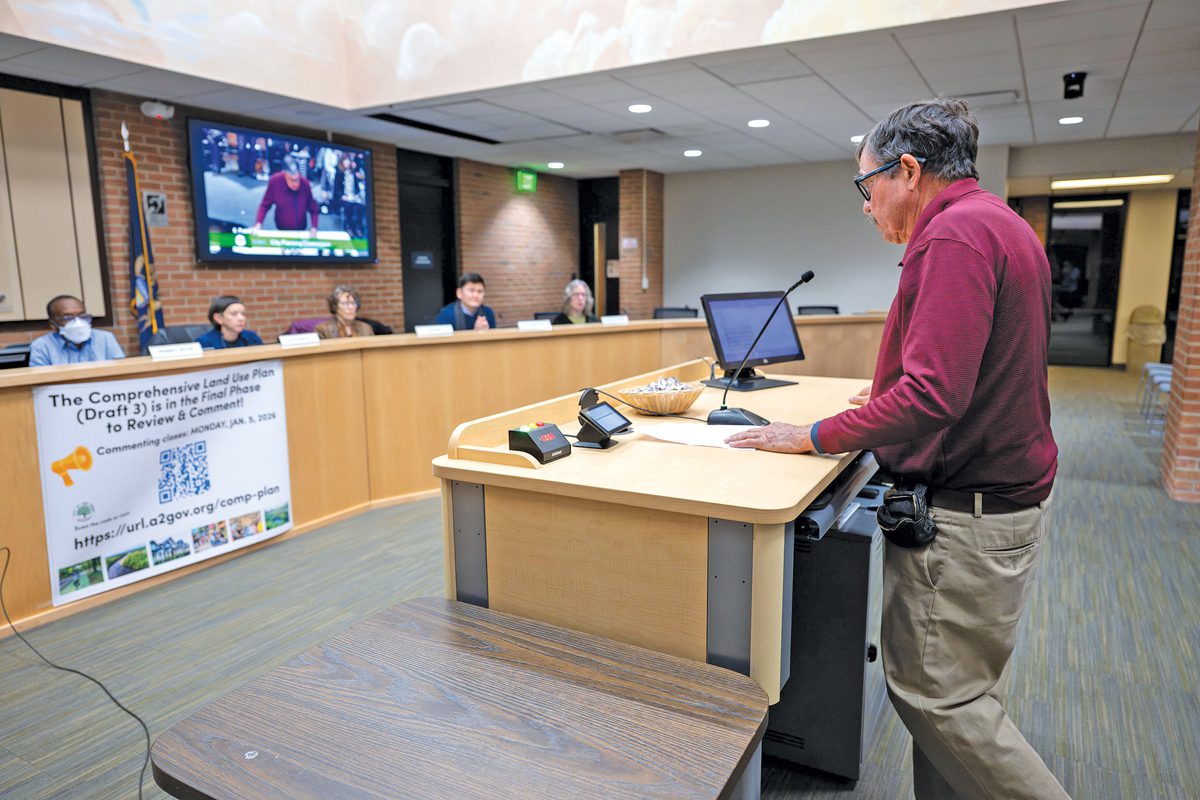
Jeff Crockett, a resident of the Old Fourth Ward, spoke against his neighborhood’s Transition designation at a November 18 planning committee meeting. Historic districts, he said, “provide density at a human scale.” | Mark Bialek
It’s been in the works for more than two years, and controversial since the first draft was released last spring. The plan called for four-unit buildings anywhere, and planning commissioners had just voted to allow them to be up to forty-eight feet tall.
In the uproar that followed, city council asked planners to pull back. They did, a little: the next draft trimmed the number of units allowed in “Residential” districts to three, and the height to “approximately 3 stories.” That’s unchanged in the third draft, which continues to call for more high-rises in expanded “Hub” districts downtown and on the periphery, and low- to high-rises in “Transition” zones around downtown and along transit corridors.
“There are some residents who think that this is a very progressive way forward, that we are allowing more options and flexibility for people,” principal planner Michelle Bennett says. “And then there are people who are established in those neighborhoods that have a lot of concerns about what a greater density in their neighborhood might look like.”
Ann Arbor currently houses roughly 123,000 residents and has around 80,000 commuters traveling to the city daily. A major goal of the CLUP is to create housing so some of those commuters can live closer to work.
“From the planner’s perspective, we question that maybe growth has been stifled because we haven’t allowed more options for more people to move here, and that it’s become a very exclusive community overall,” says Bennett.
The hope is that adding housing near transit will allow residents to get around more easily, expanding housing options while keeping environmental impact low. “Growth is inevitable if you live somewhere that’s desirable and you have a massive economic engine like the University of Michigan on your doorstep,” Bennett says. “It’s our job to plan responsibly, and that’s the purpose of this plan.”
The Ann Arbor Neighborhood Network, which formed to fight the changes, continues its calls to “Pause The Plan.” Another vocal contingent, Neighbors for More Neighbors, has emerged in support of the CLUP. People on both sides of the issue were quick to chime in at a November 18 planning commission meeting.
Former city councilmember Kathy Griswold emphasized the importance of walkable neighborhoods and pedestrian safety. Observer contributor Ken Garber said the CLUP “falls way short” of its sustainability goals. Former city councilmember and planning commission chair Kirk Westphal raised concerns about the zoning for recreational facilities and open space that doesn’t fall under the city parks designation, such as the Racquet Club of Ann Arbor and Ann Arbor Golf & Outing.
There was also robust discussion of the CLUP’s relationship to the city’s historic districts. Old Fourth Ward resident Jeff Crockett spoke against the Transition designation for his neighborhood.
“Historic neighborhoods provide economic diversity at the neighborhood level,” he said. “Historic districts are more densely populated than other single-family neighborhoods, and have a greater variety of housing types, including rentals. They were designed from the beginning for mixed uses. They provide density at a human scale.”
Susan Kaufman echoed Crockett’s concerns, noting that Historic District Commission guidelines are “incompatible with the greater massing and height permitted in Transition and Hub land use categories underlying all or part of residential historic districts.”
Alex Lowe, wearing a Neighbors for More Neighbors t-shirt, said, “I find the selling points of historic districts that other commenters have given to be very fascinating, because the very benefits that they’re offering and claiming to be unique to historic districts are, in fact, what the comprehensive plan aims to make legal throughout the city—rather than just in small, exclusive areas that predate our exclusionary and racist zoning laws.”
In an October council meeting, mayor Christopher Taylor pointed out that “Historic District rules will remain the same.” And planning manager Brett Lenart noted that the Historic District Commission, not city council, controls its boundaries. But outside the historic districts, Bennett acknowledges that some residents are “concerned that we’re changing the character of their neighborhood.”
In fact, in draft 3, references to “preserving neighborhood character” were removed on the grounds that the phrase is coded language that, according to a city memo, was historically used for discriminatory and exclusionary purposes. Bennett acknowledges that that legacy may still carry over those consequences, even though it’s no longer the intention.
But it’s the planners’ vision of increased housing density that’s stirring up the most tension: the plan envisions more high-rises downtown and in fringe shopping districts, mid-rises along streets like Liberty, Packard, and Washtenaw, and three-story apartment buildings popping up in neighborhoods that are now entirely single-family homes. Supporters call this “gentle density,” but many neighbors remain unconvinced.
The city is accepting comments online at engage.a2gov.org through January 5, 2026. The planning commission will meet on December 16 to review comments before public hearings and city council’s adoption vote in early 2026.