
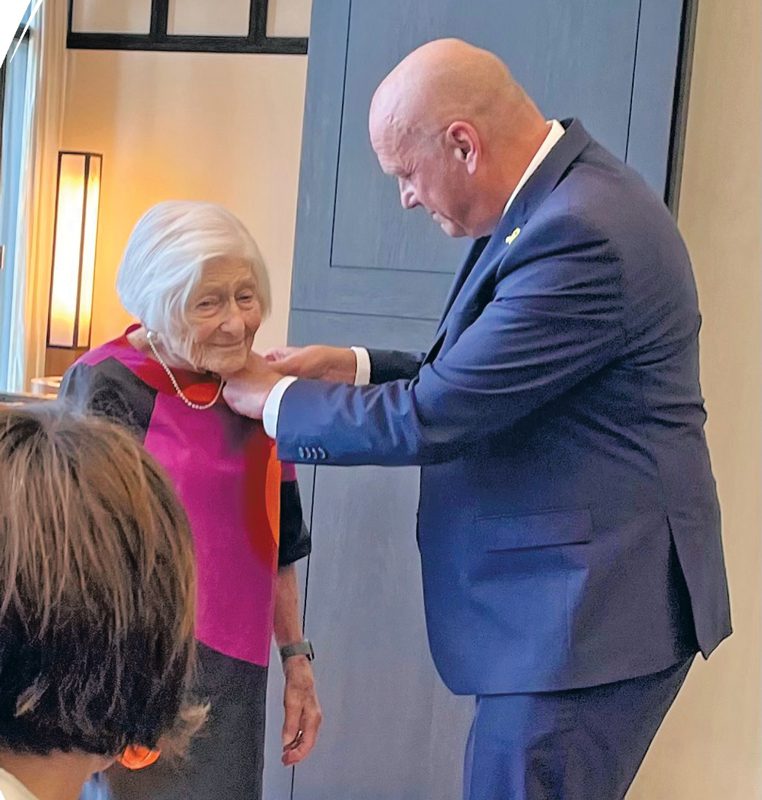
In January 1945, Irene Hasenberg and her family were suffering a “very black” time in Germany’s Bergen-Belsen concentration camp. Last summer, Germany’s ambassador to the U.S. awarded her its highest civilian medal. | Courtesy of Irene Butter
Born in Berlin, Germany, in 1930, the retired U-M professor remembers a wonderful childhood—until 1937, when the Nazis confiscated her father’s bank and gave it to “non-Jews.” Ever resourceful, her father managed to find a job with American Express and moved the family to Amsterdam. “But we had not moved far enough,” Butter says. The Nazis invaded the Netherlands in 1940 and instituted the same anti-Semitic policies the Hasenbergs had fled three years earlier.
In 1942, her grandparents, who had remained in Germany, disappeared into Theresienstadt ghetto and were never heard from again. Frantically, John Hasenberg contacted sympathetic friends, trying to get visas for his family to leave the Netherlands. Ecuadorian immigration papers arrived at the family’s Amsterdam home in 1943.
By then, Irene, her parents, and brother Werner had been sent to Westerbork transit camp. But miraculously, the postal system actually forwarded the paperwork to them. “The Germans knew we had no ties to Ecuador, but they needed people to exchange for German citizens in Allied hands.”
The Hasenbergs struggled against time, hunger, overwork, and Nazi cruelties while continuing to hope they would be released in a trade deal. Thanks to a sympathetic guard who knew her father, they were able to stay in the transit camp longer than most, but were eventually sent to the dreaded Bergen-Belsen concentration camp. There she was briefly reunited with her friend Anne Frank.
“January 1945 was very black for us,” Butter recalls. “Mother was in bed, father was very weak after a brutal beating, and Werner had a serious foot infection.” That’s when Irene’s best friend in the camp, Hanneli Goslar, told her that she had seen Anne Frank there. “We met at the barbed wire fence and learned that she and her sister were very sick and they needed clothes.” The two girls managed to find some clothing to toss over the fence to Anne—“but a woman swooped in and stole them.”
They promised to return the following night, but the next day, the Hasenbergs were informed that, thanks to their Ecuadorian papers, they would leave immediately for Switzerland—if they passed physical tests. Her father could barely walk and her mother and brother could only move with assistance, but “either by accident or a humanitarian impulse—I’ll never know”—one of the most brutal Nazi guards “mistook” fourteen-year-old Irene for her invalid mother and allowed the family to board the train.
John Hasenberg died of his injuries two days later, and his body was left at the nearest train station. But Werner, Irene, and their mother crossed into Switzerland and freedom.
“However, the Swiss managed to do what the Nazis couldn’t: they separated my family,” Butter says. She was sent to a refugee camp in North Africa while her mother and brother were hospitalized in Switzerland.
Related: Family Secrets
Ann Arborite Evelyn Neuhaus
When the war ended, a family member in the United States offered to sponsor Irene. She arrived in Baltimore on Christmas Day 1945. Her mother and brother joined her six months later.
She earned a scholarship to Queens College, became the second woman to earn a PhD from Duke’s department of economics, and married psychology grad student Charles Butter. They came to Ann Arbor to teach at the U-M, and raised two children here.
Like other survivors, Butter had been advised to put the past behind her and never to speak about the experience. But when their daughter Pamela was in high school, she wrote a paper about the Holocaust and asked her mother to serve as her “visual aide.”
“I was surprised at how well that went,” Butter says. From that day onward, she began speaking publicly about her experiences—though never in German. If she heard someone speaking her native tongue, she would turn her back on them, because it “reminded me too much of the Nazi guards who screamed at us.”
Then a German school invited Butter to visit, and the teacher asked if she would speak in German. Butter told her she didn’t think she could. “Just a few German words?” the teacher urged. Butter agreed to try—and when she finished, realized she had spoken German the entire time. “I realized I had broken a barrier. I concluded my resentment.”

The Officers’ Cross of the Order of Merit of the Federal Republic of Germany is the country’s highest civilian award. | Courtesy of Irene Butter
Last June, Andreas Michaelis, Germany’s ambassador to the U.S., presented Butter with Germany’s highest civilian award, the Officers’ Cross of the Order of Merit of the Federal Republic of Germany. It reminds her of the Iron Cross her father won for bravery while fighting in the German army during WWI. “I was very honored to be the second one in our family honored by the German nation,” she says. “It was an act of reconciliation.”
In March, the Netherlands’ Council of State will honor her with the Anne Frank Award for Human Dignity and Tolerance during a ceremony in Washington, D.C. After the war, Butter learned that Frank had died just a day or two after she saw her.
“Anne didn’t live to tell the rest of her story, so I have believed I must do it for her,” Butter says.