
The federal government’s demands for cash payments from universities have made headlines around the country. In August, when the Justice Department fined UCLA $1.2 billion for allegedly tolerating antisemitism, California governor Gavin Newsom called it “extortion.”
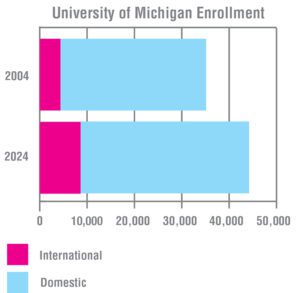
Less noticed is another way the federal government is causing schools financial pain: creating hurdles, both bureaucratic and psychological, for their international students.
The U-M is particularly vulnerable, because last year, 8,635 international students came here to study. That’s twice as many as twenty years ago, and 16 percent of the student body.
Related: International Students
“Throughout this period, U-M has worked closely with students and campus partners to provide guidance, resources, and reassurance,” emails Kay Jarvis, U-M Director of Public Affairs. “We are excited to welcome international students back to Ann Arbor and look forward to the unique perspectives and contributions they bring to our academic and cultural life.”
But a preliminary analysis by NAFSA: Association of International Educators predicts a possible 30 to 40 percent decline in new international student enrollment this fall at U.S. institutions, translating into an estimated 15 percent drop in total enrollment this year. If the prediction holds true, the U-M may enroll 1,300 fewer international students this year than last. Each year going forward, total enrollment would continue to decline as successive first-year classes are depleted.
The U-M had yet to release 2025 enrollment figures as the Observer went to press. However, a professor at the Ross School of Business confirms a rumor that the school didn’t meet enrollment targets for its MBA programs this spring. Ross was able to catch up over the summer, this person says, but schools are chasing candidates: “Harvard steals from us, and we steal from [less prestigious programs].”
Related: Research at Risk
The obstacles take varied forms, from red tape to detentions. In May, the State Department suspended new student visa appointments at its embassies. Appointments resumed the following month, but with enhanced scrutiny of applicants’ social media. Also in May, Secretary of State Marco Rubio announced that the administration would aggressively move to revoke the visas of Chinese students with ties to the Communist Party or who are studying in “critical fields.” (Just under half of U-M international students last year were from China.) In mid-August, Fox News reported that the State Department had so far revoked over 6,000 student visas, two-thirds of them for alleged legal violations.
Back in April, the government revoked the visas of twenty-two U-M-affiliated individuals, twelve students and ten recent graduates, for no apparent reason. These were part of a wave of seemingly random visa cancellations around the country. Legal challenges, including an ACLU lawsuit, eventually restored their visas, says Russell Abrutyn, a Southfield immigration attorney who helped on some of the cases. “It wasn’t easy,” he says. “There were dozens or hundreds of court challenges around the country before these were resolved.”
The cumulative effect has been to create a climate of fear for prospective students. The high-profile detentions or arrests of students like Rümeysa Ӧztürk (Tufts University), Yunseo Chung (Columbia), and Alireza Doroudi (University of Alabama) fed that fear, and many new college students are now avoiding the U.S. altogether.
“The aim of this administration is to sow chaos and fear by attacking some people to terrorize us all,” writes Loren Khogali, executive director of the ACLU of Michigan, in a statement. “Now, they are coming for international students who provide critical perspectives and contributions to our academic communities and, through their spending, make a major contribution to our economy.”
Even those who aren’t intimidated might rule out studying in the U.S. because they may not be able to complete their educations here. The Department of Homeland Security, at the end of August, proposed a new rule that would limit student stays to either their program end date or four years—whichever comes earlier. Currently students are admitted for “duration of status,” with no firm end date. Many PhD and professional programs take more than four years.
The rule, if adopted, “would make it much more difficult for students to stay longer than four years, even if they need more time, and to finish their degree; or if they need to change schools, or move on to another degree program, once they graduate,” says Abrutyn. “I think that’s going to have a significant impact, not right away, but maybe as early as 2026.”