
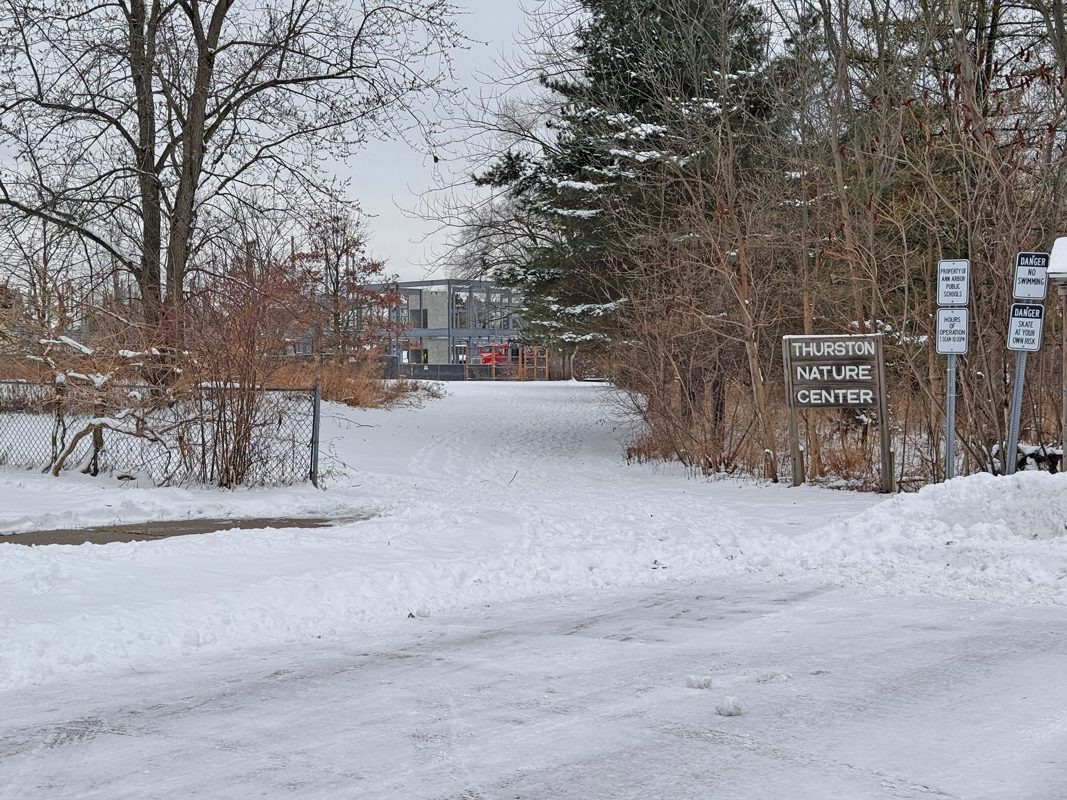
The new Thurston Elementary came at the expense of key ecological features of Thurston Nature Center—and opponents say the neighborhood wasn’t given adequate notice. | Steve Friess
A dispirited Praveena Ramaswami sits behind her steering wheel offering, yet again, her arguments against the placement of the new Thurston Elementary School. It required the destruction of key ecological features of the beloved Thurston Nature Center (TNC); it’s being built on soft peat; it all happened without adequate notice to, input from, or consideration of the neighborhood.
Today is too windy and chilly, so we’ve scotched our plan to talk as we walk around the pond. Instead, we’re parked, watching the few birds that didn’t migrate for winter bounce from spot to spot and listening to the rumble of construction vehicles nearby.
“Sixty years of us neighbors literally making those rain gardens and digging them and watering them every day and caring for this land didn’t matter,” says Ramaswami, a former president of the TNC and currently a plaintiff in a lawsuit against AAPS over Thurston. “That broke a lot of people’s hearts. Of course, we need a new school. But did it have to be here?”
Related: Tending the Thurston Nature Center
Hours later, I’m in the office of exuberant Mitchell Elementary principal Samantha Cucu. The new Mitchell, which broke ground first among the four schools now under construction, was topped off in December with a beam signed by the school’s students, and she is moving into the mode of a new homeowner picking out amenities. (Disclosure: my children attend Mitchell.)
“Oh, I just got this the other day,” she says, shuffling through mounds of paperwork on her desk until she digs out an inch-thick catalog for Burke playground equipment. “I’ll probably give input, but I imagine we will meet with kids to get their feedback. That’s what I would like to do. That’s what I always do. It’s so, so awesome. I’m so excited. Everybody is.”
Thurston and Mitchell represent extremes of AAPS’s $1.44 billion school construction and renovations program—one community angered and saddened by the district, the other delighted and grateful for what’s coming. The money comes from two sources: a ten-year 2.5-mill property tax for a sinking fund and a $1 billion bond issue. They were approved by voters in 2017 and 2019, respectively.
Related: Schools Millage
With such a vast and complex program under way that includes four new schools under construction and several middle schools undergoing renovations, AAPS leaders say little fires are bound to pop up everywhere.
The discontent varies from project to project, detail to detail. The episodes include:
- Residents near Lawton Elementary expressing anger that the new Lawton will take over 7.5 acres of an adjacent public park.
- Concern that the new Logan Elementary, rising beside Clague Middle School across Nixon Rd. from the old one, will create danger for future students having to traverse the busy thoroughfare.
- Anger over tree removals at several sites.
- Tests of radon levels caused by construction activity requiring remediation at Thurston over the most recent winter break.
- Dozens of music teachers protesting to the board last year when it was revealed that the new elementary schools won’t have permanent performance stages.
- Minimal information so far on when or how the three major high schools—Huron, Pioneer, and Skyline—will get their renovations.
“I am aware of some people being unhappy about different aspects of all of our projects and issues arising,” school board president Torchio Feaster says. “It’s to be expected, I guess.”
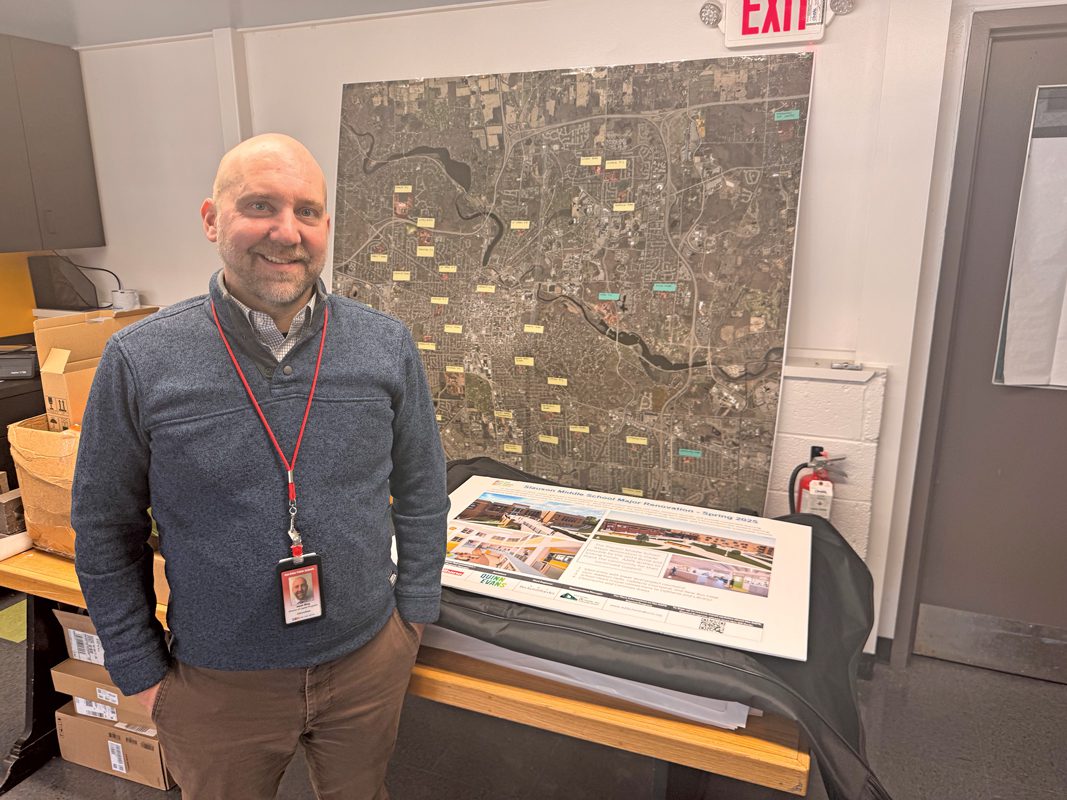
AAPS capital projects director Jason Bing. | Steve Friess
For the most part, the projects continue to move forward with little delay or change—with one big exception.
In early January, AAPS capital projects director Jason Bing disclosed they would not install a geothermal power system at Slauson Middle School because of confirmation through groundwater tests that school sits atop the ever-growing subterranean Gelman Plume of the carcinogen 1,4 dioxane.
Related: Ground Zero
Gelman Plume a Superfund Site?
“When we first started the Slauson conversation in 2020 or 2021, we were out of the prohibition zone,” says Bing, who oversees all construction and renovation projects related to the bond and sinking fund. That zone refers to Washtenaw County Health Department’s restrictions on use of groundwater in ways that involve human contact or consumption in regions of the plume, which was caused by dumping of industrial chemicals in the 1960s and earlier. “Since that time, the prohibition zone has migrated a little further, onto the Slauson site.”
While operating geothermal wells do not pump water out of the ground, there is concern about the water that would surface during their construction, says Chris Svoboda, a geologist monitoring the plume for the Michigan Department of Environment, Great Lakes, and Energy.
WCHD officials told Bing they’d need to “double case” the bores used to dig to prevent groundwater escape. “We could likely do it where we would meet all of our regulatory requirements safely, but it was going to cost more—hundreds of thousands of dollars more—and add a significant chunk of time,” Bing says.
Feaster, who learned of the Gelman issue during our interview, called the situation “unfortunate.”
“We want to be as energy conscious as possible, and we want to do what we can to protect the environment, but if we can’t do it as a result of the conditions, then I suppose we’ll find other ways.”
Likewise, Slauson Parent Teacher Student Organization president Joe Valerio says he’s “a little bummed” about it but excited for the coming renovations of all classrooms, among other aspects. The long-defunct pool was demolished last year and a new gymnasium is taking shape in its place. Among details of the plans, “They’re gonna have options for the lunch room to actually go outside and sit, things like that,” Valerio says. “It’s just really gonna make it great.”
It is telling, though, that Bing gave an additional reason beyond cost and time for not pursuing geothermal: It could be a public relations headache.
“The risk was the perception of what happens when that mud and clay and sand mixture come back up from that bore to the surface layer,” Bing says. “We were told that in sunlight, the chemicals evaporate out of the water, so there is not a real risk. But the perception could be there that it’s dangerous.”
After more than a year of intense controversy around the new Thurston location, the district would rather not get into a public fight over this.
The new Thurston is taking shape exactly where AAPS officials said it would in September 2024 at the first community-wide public meeting about it. All the Sturm und Drang that followed—the petitions, the angry testimony at public meetings, the lawsuits, the letters from elected officials—did result in some significant changes to the placement of a bus loop and the saving of part of an oak savanna, among others.
The building itself, however, still rises at the edge of a beloved wooded and pond area, necessitating the relocation of some oaks and other native plants.
At issue was the new school’s impact on Thurston Nature Center, more than twenty acres of pond, wetlands, woodlands, and open fields that for generations, as its website says, has been “providing an invaluable space for education, recreation, and environmental stewardship” as “a living laboratory for students, a sanctuary for local wildlife, and a gathering place for nature lovers of all ages.” Most of the property is owned by AAPS, and the Thurston Nature Center Committee (TNCC) is technically a subcommittee of the Thurston PTO.
As Ramaswami notes, it is also an historic landmark of sorts, one of the nation’s first nature areas attached to a public school and used regularly to enhance the students’ educational experiences. The surrounding neighborhoods are populated by longtime volunteers and donors who have planted trees, removed invasive plants, built rain gardens, and erected explanatory signage.
The environmental damage was troubling enough, but TNC supporters were equally galled by the failure of the district to inform the general public of the plans sooner. “When this announcement was made, not only was this community not informed but agencies like the city and county and Huron River Watershed Council were not engaged in a decision made to build this on top of this land,” Ramaswami says. “They saw a green piece of land next to a building and didn’t understand or know that this was something for sixty years, that this community was part of.”
For his part, Bing expresses remorse for how it all went down. The district felt obligated to “have a planning process that would be internal-stakeholder-driven, and then come to the board and community with updates on where that process was, and then make revisions and continue the process. … We did that, but we’re doing so much work in a big district, and what we recognize is that we need to engage with the community from the beginning in a more intentional process.”
Opponents of the school’s placement wanted AAPS to build the new Thurston on the existing building’s site by relocating the student population to nearby Logan Elementary after the new Logan is completed. Such “staging” efforts are planned elsewhere; the populations of Angell, Burns Park, and Pittsfield elementaries are expected to move into the existing Mitchell when their schools are being renovated or rebuilt.
Doing so for Thurston, Bing says, would have been expensive and stall the new Thurston’s construction by several years, and the entire Thurston population wouldn’t fit at Logan so some would have to go elsewhere.
In February 2025, the school board voted 4–3 to move forward with the new Thurston in its planned location. Feaster, who voted with the majority, nonetheless advocated for a new process going forward to earn buy-in from the general community for future new schools.
“The program could have kicked off better than it did,” he says. “The superintendent is doing a good job of changing the process to make sure that the community feels as if they have as much input and buy-in as possible as early as possible so that we can try to build what’s in everyone’s best interest.”
Bing says that, since the vote, he has worked closely with the TNCC to mitigate their concerns. Jim Vallem of the TNCC agrees, pointing to the Bing’s staff moving a “shed, signs, a trellis, and several oak trees, a few shrubs, and other plants.” After the new Thurston is completed, Bing says it will rebuild some rain gardens and green space.
“I want to continue the good relationship we’ve had with the facilities folks,” Vallem says. “We didn’t get everything we wanted, but we got some things. They were trying to work with us, and we were trying to work with them. I don’t think there’s going to be any real hard feelings other than with the school board.”
Ramaswami remains a plaintiff in a lawsuit against the district, although she declined to comment on the purpose of continuing litigation given that the school is half-built and various natural features have already been destroyed, moved, or removed.
Says Vallem: “I think the facilities people, for the most part, are really kind of sad about how things came out. Jason Bing is a nature supporter. We’re just moving forward now.”
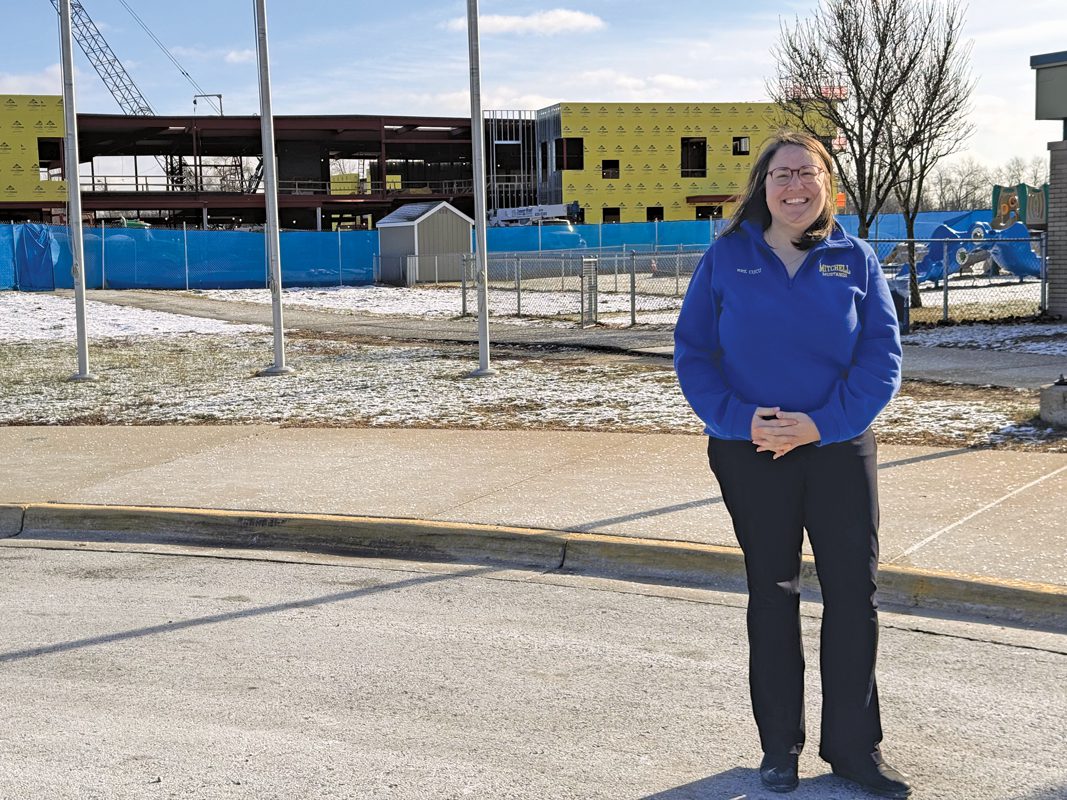
Mitchell principal Samantha Cucu praises the engagement capital projects director Jason Bing and his staff have had with the community. | Steve Friess
Mitchell ended up first in line through a combination of opportunity and necessity. A 2018 needs assessment of all AAPS schools found the sprawling 1952 structure most in need of costly repairs better solved with replacement. There also were indications that the area’s school population could increase in coming years, Bing says. And the bond emphasized that it would prioritize Title I schools; Mitchell is one of the most low-income school populations in Ann Arbor.
Mitchell also had one more thing: land. The district needed a place with enough property to build the new school and keep the old one operating to host the populations of Angell in 2027, Burns Park in 2029, and Pittsfield in 2031, according to the latest plans. “Mitchell checked all the boxes for being able to get going right away,” Bing says.
Even with these quotidian reasons, the Mitchell community is feeling excited and fortunate. For a population unaccustomed to getting nice things from the public trough, Mitchell PTO president Jessamy Green-Husted says, “Part of it is, it’s about time, Mitchell gets shortchanged on so much that getting this prioritized for us is great.”
Principal Cucu talks effusively about the levels of engagement Bing and his staff have had with the community from the start of the process. She even flew to Salt Lake City along with top administrators from other schools being replaced to see a school built there by the same architect. “We got to see how this will work,” she says, pointing to innovative designs that include classes of the same grade level in neighboring rooms separated by removable glass walls.
It also allayed her concerns about the lack of a proper auditorium stage. She saw a big, broad staircase leading to a large main-floor open space that “could provide a stage” while kids sit on the stairs.
Other things that could be points of concern or contention—like the idea of the area being crammed with two populations of students in coming years—are shrugged off, too. The traffic plan, Cucu says, “makes sense to me” and Green-Husted says she’s heard from locals who are actually happy the old school gets this extended life before demolition.
“The construction folks have been actively coming to PTO meetings and giving long presentations about all the stuff, about what the things will look like, down to the very construction materials and types of boards that will be used,” Green-Husted says. “I haven’t seen anything other than excitement.”
The next stage of the program is still being developed, Bing says. The plans for the high schools haven’t been mapped out in part because he has to evaluate how much money is left after the elementary and middle school renovations and rebuilds. Finances have shifted—a rapid rise in construction costs since 2019 when the bond passed have reduced how much $1 billion can buy, but rising property values have increased what AAPS gets from the sinking fund millage from taxes.
There also are concerns about dropping enrollment. When then-superintendent Jeanice Swift pitched the bond to the public ahead of the 2019 election in an eight-minute video, one graphic noted the necessity because the projected student population by 2023 was over 19,000. Then enrollment fell sharply following the Covid pandemic—enrollment was just shy of 17,000 in 2023 and has dipped lower since—and that has it reassessing how much additional capacity is needed.
Feaster, ever the optimist, believes the new buildings could help bring students back to AAPS.
“If I had young children and I had the option to go to a beautiful brand new public school in my neighborhood, that would be a factor I would consider when I’m deciding what school district or private school or charter school to put my kids in,” he says. “If these buildings can help, then that’ll be amazing for this community.”
Still, Bing says enrollment drops are “definitely on the radar for the district. We’re going to revisit our capital plan over and over and over again.”
How about geothermal at Pattengill School?