
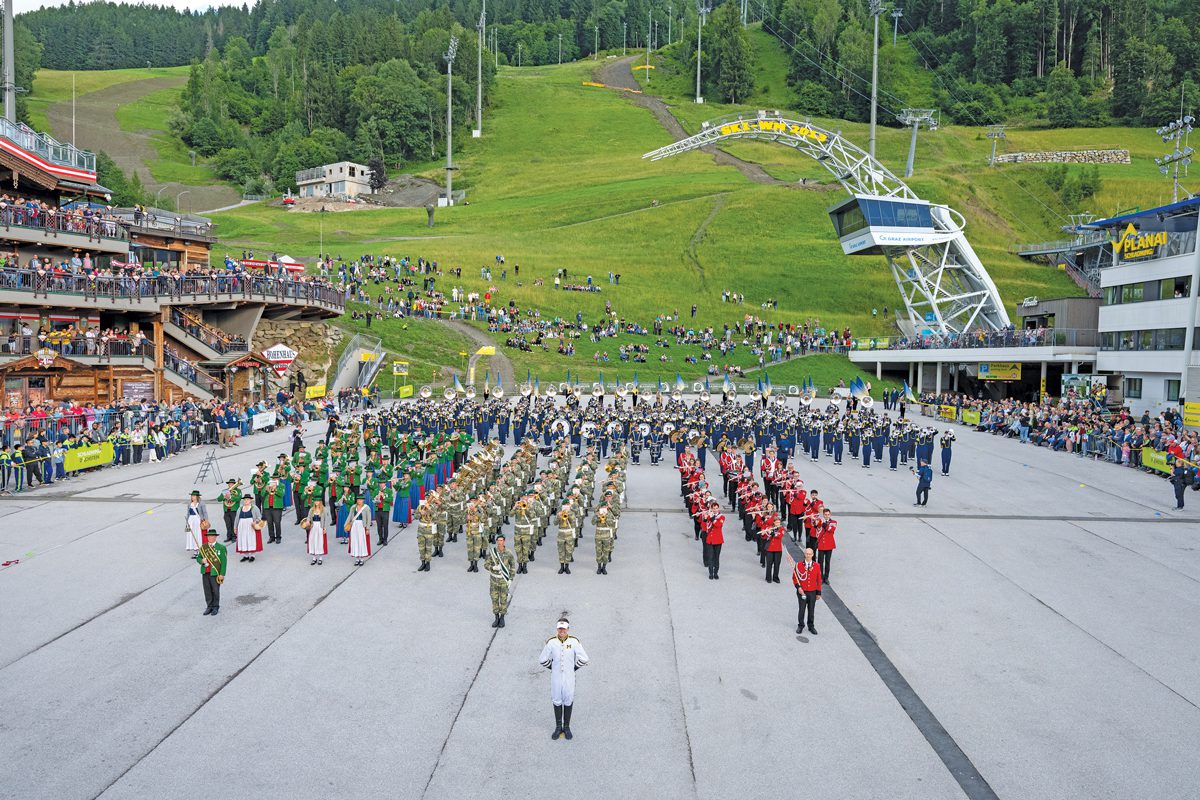
At the Schladming Tattoo, the marching band performed alongside the Austrian Armed Forces band, the regional band from Stein an der Enns, and the marching band of Vielharmonie Kirchlintein. | Mark Haddlesey
It took three airlines to ferry the 300 members of the Michigan Marching Band, their instruments, and staff members over to Europe, says band director John Pasquale. Then it took six buses and a semitruck to transport them once they arrived.
Over eighteen days, the band performed in Austria, France, and Germany, filling town squares and concert halls in seven cities. “We were a spectacle everywhere we went,” Pasquale says.
As it turns out, the band might be going back to Germany—if Michigan Football gets its wish. In July, the program announced that it wants to open its 2026 season against Western Michigan at Deutsche Bank Park in Frankfurt.
This would be the Wolverines’ first game outside North America, but Big Ten rivals, including Michigan State, Wisconsin, and Penn State, have all competed offshore. The National Football League has been playing outside the U.S. since 1987, including two games at Deutsche Bank Park. The proposed game, which would replace the Western match currently scheduled for Sept. 5, 2026 at the Big House, comes as NCAA teams are embarking on a new era of paying athletes for name, image, and likeness (NIL). Michigan has pledged to provide for scholarships and direct payments, as well as linking with the Champions Circle to help athletes market their own NIL.
Related: Warde Manuel in the NIL Era
“We are always looking for unique opportunities to expose our student-athletes to other cultures. In the last 10 years, our program has been to Italy, France, and South Africa, and this game would provide another chance to grow our international fanbase,” Sherrone Moore, U-M’s football coach, said in a news release.
Michigan teams have gone abroad before, but only in the offseason. Funded by donors, those tourist visits cost as much as $1.5 million.
By contrast, the marching band’s European tour was paid for by the members themselves, says Pasquale. That worked out to roughly $5,500 per band member, supplemented by donors who paid for some meals and excursions. “That support was extremely, extremely appreciated,” he says.
The band began planning the European tour in 2018, aiming for 2020 or 2021, but it was put on hold due to pandemic restrictions. Along with their personal fundraising efforts, members were allowed to pay in monthly installments of $250 over the past two years. “We did everything we could to keep costs down,” the director says.
This summer, the band performed two styles of concerts. One was a “military tattoo,” with the band marching and playing in an open space. Without the markers on a football field to guide them, the band had to orient themselves to the more open surroundings of a soccer surface and a paved town square.
The other type was a “stand still” concert, like Band-O-Rama at Hill Auditorium—though the band marched through the streets of Ettenheim, Germany, on its way to a concert there. Commemorative merchandise was for sale (and is still available on the band’s website).
Related: The Band Takes the Field
Each performance had three elements: excerpts from popular halftime shows (think “Caravan” by Duke Ellington and “Conga” by Gloria Estefan; campus music, such as “The Victors” and “Temptation”; and local melodies, like the German folk song “Böhmischer Traum” (“Bohemian Dream”).
Marching band members were divided between flights on American, Lufthansa, and Delta, since the airlines couldn’t handle more than about 100 passengers each during peak summer travel season.
Large instruments, like tubas and drums, were flown direct to Munich. “We couldn’t risk having them lost on connecting flights,” Pasquale said.
About twenty band members who speak German helped staff and fellow students navigate language barriers. Now that he’s shepherded 300 students to Europe, “I can relax a bit,” Pasquale says, laughing.
If he were to repeat the experience, he would try to schedule a trip immediately after the school year ends and cut back on the amount of new music the band learned for the trip. He’d also try to enjoy himself more.
Closer to home, the marching band will perform at a Detroit Lions game in October. And Pasquale has his fingers crossed that the band can return to Germany with the Wolverines.
Meanwhile, the band has been learning the music of another European act—ABBA—for its first 2025 home game on Aug. 30 against New Mexico.