
Roberto Isla Caballero, sixty-four, spends his days selling Groundcover News at the intersection of Main and Washington. He hasn’t had a permanent home since he separated from his wife in Phoenix ten years ago. At one point he had a subsidized apartment in Spokane but lost it for letting friends from the street shower and watch TV there.
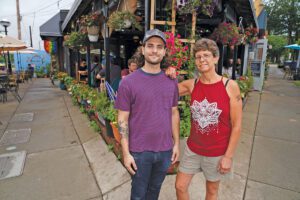
Restaurant owner Phillis Engelbert and her son and staffer Ryan Shea backed the planned building at Catherine and Fourth. | Photo: J. Adrian Wylie
He likes selling the paper and appreciates Ann Arbor’s robust bus system, and he’s on the waitlist for the Delonis Center shelter and a Section 8 apartment. For now, though, his nights are spent on the streets, finding a place where he can use a bathroom in the middle of the night. He has ongoing health problems and longs for a place to call his own.
Restaurant manager and bluegrass musician Ryan Shea has worked at his mother Phillis Engelbert’s businesses since he was a teenager. He now earns $55,000 a year at her North Star Lounge and Detroit Street Filling Station, but he works with many people who are just now starting out and earn far less.
And even he is priced out of the Ann Arbor housing market. After living in a student co-op and “in a few rickety houses” in the Kerrytown area, Shea says, he moved to Ypsilanti three years ago.
—
Caballero is one of the unhoused people whom Ann Arbor voters set out to help when they passed an affordable housing millage in 2020. Since then, the end of a federal Covid eviction moratorium in October 2021, along with spikes in rents and building costs, has made an already desperate situation even worse, says Jennifer Hall, executive director of the Ann Arbor Housing Commission.
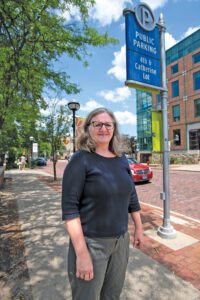
“The demand is scary,” says the housing commission’s Jennifer Hall. | Photo: J. Adrian Wylie
“The demand is scary,” Hall says. She points to data from the Washtenaw County Office of Community and Economic Development which indicated that, as of April 2023, 567 residents were experiencing homelessness. Since June 2022, the overall homeless population in Washtenaw County has doubled, while the number of families with minor children experiencing homelessness has tripled.
Shea’s restaurant coworkers represent a second cohort the millage aims to help: people who work here but can’t afford to live here. They’re a substantial segment of the tens of thousands of people who commute to work in Ann Arbor from other places.
“If we don’t take aggressive and meaningful action over the next ten to fifteen years, that will be permanent,” says Ann Arbor mayor Christopher Taylor. “The expansion of affordable housing in the city of Ann Arbor is an absolute necessity.”
—
The twenty-year millage will acquire, build, and renovate affordable housing as well as provide support services to residents. It has already helped finance the purchase of an existing apartment complex, Siller Terrace on W. Liberty. But the millage’s biggest impact will likely be the construction of new apartment buildings on city-owned parking lots and service yards.
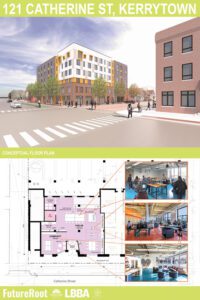
The planned building at Catherine and Fourth.
The city lots are vital, because it’s impossible to compete with the private sector when it comes to acquiring property, says Hall. The city hopes to create 500 to 1,500 affordable residential spaces there. Some sites will be comprised entirely of affordable housing, while others will be mixed income.
The millage funds are specifically for households earning 60 percent or less of the area median income (AMI). In Washtenaw County, that currently works out to a maximum of about $52,000 for a one-person household or almost $60,000 for two. And Hall hopes to see at least one-third of the apartments dedicated to those who earn 30 percent AMI or less, have special needs or, like Caballero, are facing housing insecurity.
There are nine city-owned lots, all but two of which are downtown: 353 S. Main, 121 Catherine, 404 S. Ashley, 721 N. Main, 309 S. Ashley, 350 S. Fifth Ave., 415 W. Washington, 1510 E. Stadium, and 2000 South Industrial.
For the 2022 through 2024 fiscal years, the total amount spent of the millage money is just under $20 million: $19 million spent or committed for capital costs, and $1 million to support residents.
In addition, the Ann Arbor Downtown Development Authority is providing significant financial support for developing the city-owned lots. The DDA paid $1 million for utility work for the planned six-story building on Catherine and committed an additional $350,000 for streetscape work there. It will also perform utility and streetscape work to support the twin high-rises planned for the former YMCA lot across from the downtown library.
The housing commission “understood the assignment [of the millage], and they are responding with urgency and moving all these things forward,” says DDA board member Jessica Letaw.
—
The project that’s furthest along is Catherine St., where council has already approved a site plan. Avalon Housing is the developer, and the housing commission will be the owner and property manager.
All sixty-three units will be affordable housing. Hall says half will be reserved as permanent supportive housing for people with incomes below 30 percent of AMI and the other half for workers earning less than 60 percent of AMI.
It could also be home to people like Shea’s coworkers. “We absolutely hope that we end up with downtown workers, including restaurant workers, living at Catherine,” Hall emails.
Avalon hired Yodit Mesfin Johnson to lead a community engagement process. Before the city’s open housing ordinances in the 1960s, most Black Ann Arborites lived nearby, so she convened a twelve-member, all-Black, intergenerational Community Leadership Council (CLC) to help guide its development. The goal is to “support BIPOC [Black, Indigenous, People of Color] entrepreneurship, support the arts, and honor and celebrate the history of this location’s African-American culture and neighborhood,” says city councilmember Lisa Disch. While the city can’t discriminate in favor of Black residents, they should be well-represented: According to Hall, 60 percent of the people on the housing commission’s waiting list are Black.
Hall points out that two other city-owned lots, 404 N. Ashley and 721 N. Main, are also located in the historic Black neighborhood, “So we want to continue having these types of conversations with the community on what types of housing they’d like to see.”
A controversial issue that arose with the Catherine lot was focused on parking—the current lot there has forty-nine spaces, four reserved for electric vehicles and forty-five available to other customers at nearby businesses and the farmers market. The site plan includes eighteen public parking spaces, still with four reserved for electric vehicles, leaving just fourteen for residents and customers at area businesses. The housing commission will purchase two EVs for resident use. “Less parking equals more affordable housing units,” Disch says.
Ji Hye Kim, owner of Miss Kim in Kerrytown, supports that choice. “It doesn’t sit with me well that we as Ann Arborites are comfortable having our workers come here to work and serve us, but cannot afford to live here,” she says. Phillis Engelbert, whose businesses are within a block of the site, agrees.
Andrew O’Neal, whose family owns Kerrytown Market and Shops, say merchants were divided on the issue; those with businesses that get more traffic in the evening, when more parking is available, supported reduced parking, while those that had more customers during busier daytime hours opposed it. He fears that with fewer places to park, fewer customers will come to Kerrytown, threatening the existence of its locally owned businesses.
City councilmember Jen Eyer disagrees. “There are hundreds of spaces available in downtown Ann Arbor,” she says. “People come before cars.” Maura Thompson, the DDA’s interim executive director, acknowledges that the Catherine lot is typically full during market days but says the parking structure two blocks away at Ashley and Ann always has availability.
Still, vendor Karlene Goetz is worried. “It’s difficult to attract new customers if they have to struggle and waste a lot of time to find a place to park,” she says.
Market manager Stefanie Stauffer says that there already aren’t enough spots for vendors to park on busy Saturdays. Since their trucks can’t fit in parking structures, they end up taking surface spots that otherwise would be available for customers. But she points out that the Community High School and county parking lots will still be available on weekends, and says “the trade-off is definitely worth it.” Fewer customers can park, but “we’ll be gaining all the people” who can now afford to live there.
Engelbert isn’t worried. “People love the Kerrytown area,” she says. “They will not stop coming because some parking spots are lost.”
Hall said that she’s been surprised that the parking issue has been “the most polarizing and important issue in the community in discussing these sites, more so than affordable housing.” She expects the debate to continue in other city-owned lots, particularly the “Kline’s lot” at 309 S. Ashley, which provides parking that’s critical for businesses on Main and Liberty.
—
At two other sites, the city plans to partner with private developers. Federal and state affordable housing funds aren’t available for 415 W. Washington, the former city maintenance garage across from the Ann Arbor YMCA, because it’s located in the Allen Creek floodplain. That won’t be an issue for a private company, which could also use brownfield tax credits to clean up contamination on the site.
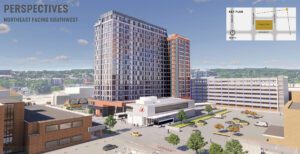
The city is hoping to partner with a private developer for 350 S. Fifth Ave., across from the downtown library (at left in this rendering). The PUD zoning would permit two high-rise towers, and the current concept envisions buildings of seventeen and eighteen stories with roughly 400 units, about 140 of them affordable to households earning up to 60 percent the county’s median income. | Photo: Smithgroup Architects
SmithGroup architects’ conceptual drawing for the site shows 125 to 150 housing units in a building up to seventy feet tall. Mark Wishka, whose home on Third St. backs up to the proposed site, says that will dwarf his and neighboring homes in the Old West Side Historic District. “I am actually disgusted by the size and scale of that structure,” he says. But Derek Delacourt, the city’s community services administrator, points out that it is similar in height to the YMCA and nearby downtown apartments and condos.
In a March letter to city council, U-M professor emerita Rita Loch-Caruso urged members not to allow housing on the site. Loch-Caruso, who helped draft the Allen Creek Watershed Plan, pointed to high probability for serious future flooding due to climate change. In a memo, Jerry Hancock, the city’s stormwater and floodplain programs coordinator, wrote that any increase in density on the site would be “inconsistent with the established floodplain mitigation policies of the City.”
Delacourt notes that Hancock’s memo was provided to council, and Disch clarifies that the planned unit development will take place in the flood fringe, where buildings are permitted, not the floodway, where they’re not. In April, council voted unanimously to approve the PUD.
But at most 15 percent of the units will be affordable, and possibly none: The developer will have the option to make a contribution to the city’s affordable housing fund. Disch says that in this instance, it may make more sense to take the money and leverage it through the housing fund on another site.
The city also is hoping to partner with a private developer for 350 S. Fifth Ave., across from the downtown library. Council has already approved a PUD zoning that would permit two high-rise towers there. The current concept envisions buildings of seventeen and eighteen stories with roughly 400 units, about 140 of them affordable to households earning up to 60 percent AMI.
Taylor says that going forward, the biggest challenge is the huge escalation in building costs—Hall calls it “a nightmare.” Still, she conservatively estimates that at least 200 affordable units will be built in the millage’s first ten years.
—
Roberto Caballero hopes there’s room there for him. Asked whether he would like to again have a place of his own, Caballero breaks out into a big smile and says, “I think so.”
Ryan Shea believes the workforce housing will be extremely beneficial to the many downtown workers who have just started out and make far less than he earns. It could allow them the chance to live in Ann Arbor, near where they work.
“To have a livable place you’re proud to live in, where you could walk down to the river and walk to work—that would make a lot of things easier.”
Calls & letters, September 2023
EV chargers and PlugShare
To the Observer:
The August issue has an error.
In the article about affordable housing it talks about the “four” EV parking spaces under the solar panels at the 4th & Catherine lot. There are only three chargers, with just those three spots reserved for EV parking. (And for June and half of July one of those three chargers was dead, but luckily that got fixed.)
You can check the PlugShare app to find pretty up-to-date, crowd-sourced, info on chargers of all types anywhere in the country. I consider it an EV owner’s travel bible, even if the travel is just around town.
Sincerely,
Craig Harvey
I live in rural northern California, and was referred to your paper by an ex-Ann Arbor resident. I was amazed as to how similar the housing problems are in Ann Arbor with the problems in our small communities. People being unable to afford to live where they work; hundred of homeless people on the street — although some do have have mental health and/or drug issues, many are just plain unable to afford a place to live. Towns wrestling with the problems of providing housing versus providing parking. Things are grim everywhere.